· adobe, history, type-1
How Adobe turned fonts into software
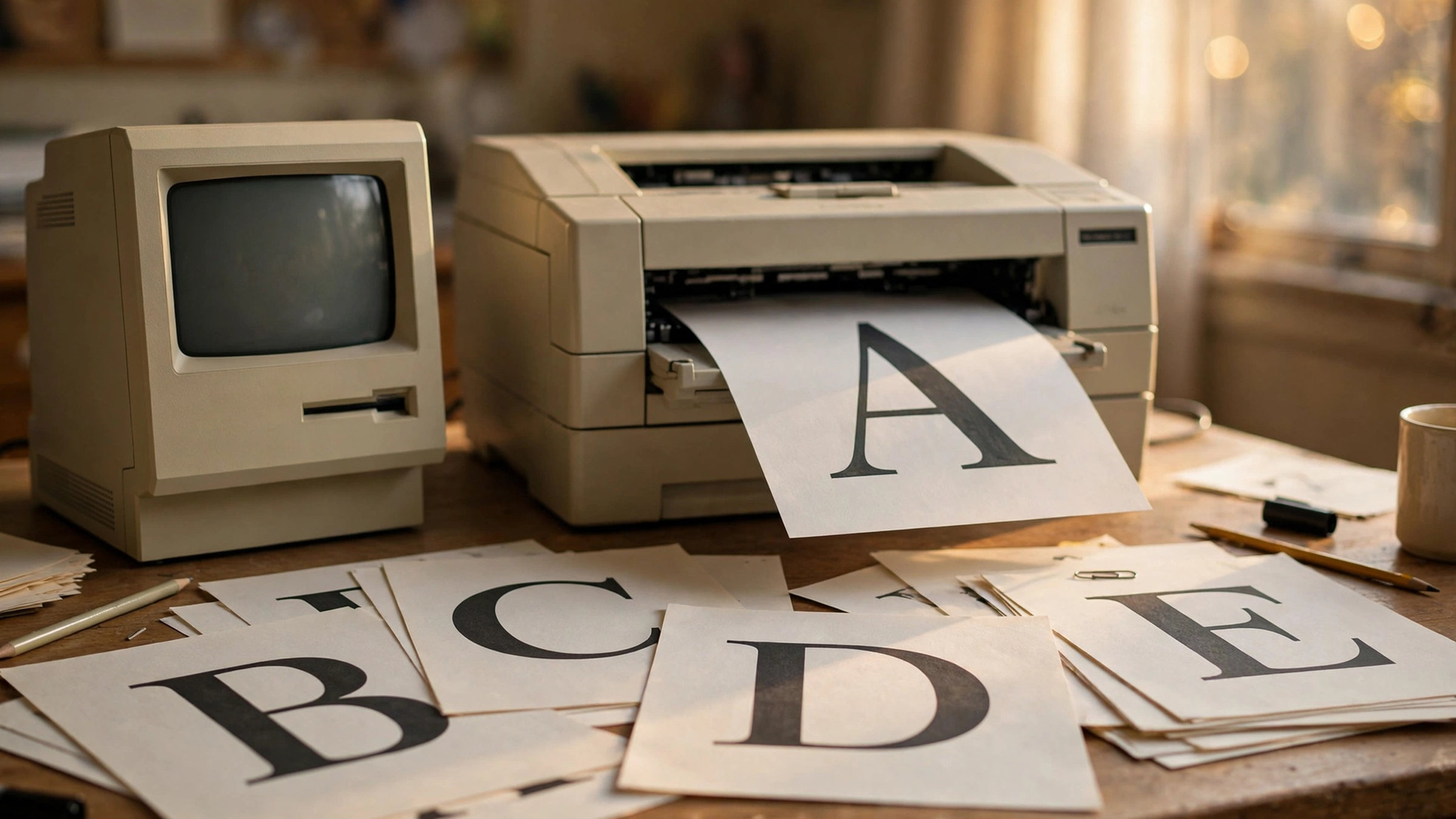
Adobe turned type into software. Its PostScript language, released in 1984, put licensed fonts inside printers, and its encrypted Type 1 format made Adobe the toll collector for type. Apple and Microsoft broke that toll with TrueType. Adobe then became a foundry, then a landlord renting fonts by subscription, and finally gave a family away.
How did Adobe turn fonts into a toll booth?
Adobe was founded in December 1982 by John Warnock and Charles Geschke, two Xerox PARC researchers, and PostScript followed in 1984: a language that describes a page once and renders it identically on any device. The payload was fonts. A page language is only as good as the type it can set, and in 1984 Linotype agreed to license Helvetica and Times Roman to Adobe and to build PostScript into its Linotronic 300 imagesetter. A document proofed on a desktop printer could now go straight to a Linotype machine for final output.
The Apple LaserWriter, announced in January 1985 and shipped in March at $6,995, carried 13 Type 1 fonts in ROM: the Times, Helvetica, Courier, and Symbol families. A Plus model in 1986 brought the total to 35. The fonts lived inside the printer while the screen showed bitmap stand-ins, and Adobe sold more faces as the Adobe Type Library. Type had become a manufactured product with a price list.
fonts become software
$6,995, 13 fonts inside
ATM and Adobe Originals too
the black book
one font, many weights
Adobe joins Microsoft
fonts by subscription
Adobe goes open source
sync limits removed
Acrobat still reads it
Four decades of Adobe fonts, from PostScript to the end of Type 1 authoring.
What made Type 1 worth licensing was hinting, the instructions that keep letterforms legible at low resolution. Adobe kept its hinting scheme secret and locked the outlines and hints behind the format’s eexec encryption. Type 3, the documented alternative, was public and unencrypted, and it had no standardized hinting, which meant cruder type. Anyone who wanted to make Type 1 fonts licensed the technology from Adobe, at prices contemporaries considered high. The five files of a Type 1 font are taken apart in our post on archaic font formats.
In 1989 Adobe extended the toll to the screen with Adobe Type Manager, announced that year; a Windows version followed in 1990. ATM rasterized Type 1 outlines on the computer itself, so fonts displayed smoothly at any size and printed to printers without PostScript. It redefined what-you-see-is-what-you-get, and it let Adobe sell its library directly to users, no printer required.
What happened when Apple and Microsoft refused to pay?
Apple had been building a rival outline format since late 1987, led by engineer Sampo Kaasila, and announced it in May 1989. That September, at the Seybold Desktop Publishing Conference, Apple and Microsoft announced a cross-license: Apple licensed the format, TrueType, to Microsoft, and Microsoft licensed Apple a PostScript-compatible printer technology in exchange. Microsoft’s own history of TrueType gives the motive without varnish: it was a means of avoiding per-font royalty payments to the owners of other font technologies. The specification was public, and any vendor could build TrueType fonts without paying anyone.
Warnock called the announcement “snake oil” at the same conference, and Apple sold all of its Adobe shares within days. The threat was structural: if both operating system makers bundled a free outline format with every computer, Adobe’s per-font royalties and its licensing toll shrank together.
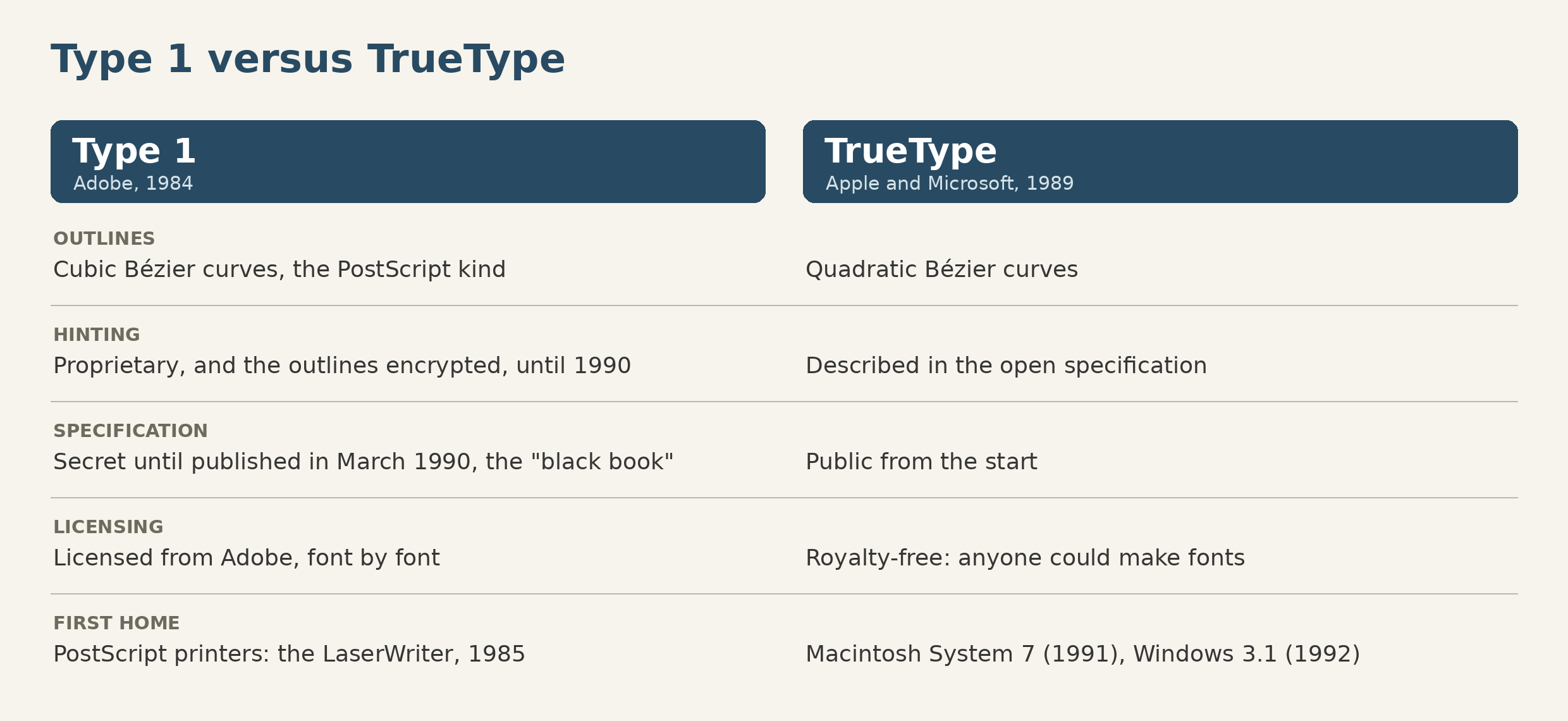
The two formats that fought the font war, side by side.
Adobe answered in two moves. At Seybold itself it promised to publish the Type 1 specification, and in March 1990 the spec appeared as a book, Adobe Type 1 Font Format, nicknamed the black book: hinting, the charstring format, and the encryption algorithms, all disclosed. Fontographer could now create Type 1 fonts, and anyone could produce them without an Adobe license. The second move was ATM, which kept Adobe’s library worth buying on screens the operating systems controlled. TrueType shipped with System 7 in May 1991 and with Windows 3.1 in April 1992. The toll booth was still standing, but driving around it was free.
How did the font war end?
It ended in a merger. OpenType began at Microsoft as TrueType Open in 1994; Adobe joined in 1996, contributing Type 1’s outline technology, stored in the new format as CFF, and the two companies announced OpenType that year. One file format now held either TrueType or PostScript-style outlines, with Unicode encoding and OpenType Layout features on top. Adobe completed the conversion of its entire library to OpenType by the end of 2002.
By then Adobe was also a type foundry. The Adobe Originals program began in 1989 under Sumner Stone, the company’s first director of typography. Its first releases that year were Robert Slimbach’s Utopia and Adobe Garamond and Carol Twombly’s Trajan, an all-capitals face drawn from the inscription on Trajan’s Column in Rome, later the default voice of movie posters. Slimbach’s Minion followed in 1990. In 1992 Twombly and Slimbach released Myriad, a humanist sans designed to be neutral (its working nickname was “Generica”), which Apple adopted as its corporate typeface from 2002 to 2017.
The foundry’s boldest experiment was Multiple Master, introduced in 1992. A Multiple Master font carried two or more master designs of every glyph, and software interpolated between them along axes of weight, width, and optical size, generating any in-between style. Minion MM and Myriad MM, both released in 1992, were the flagships. It failed on workflow rather than mathematics: most applications supported it poorly, and every variation a user tried became a separate font file with a name like MinioMM_578 BD 465 CN 11 OP. The interpolation idea returned a quarter century later, standardized, as the variable fonts now everywhere.
Why did Adobe give fonts away?
On August 2, 2012, Adobe released Source Sans Pro, designed by Paul D. Hunt under Slimbach’s guidance, under the SIL Open Font License. It was Adobe’s first open-source typeface, built as a user-interface font for the company’s open-source projects and drawn so that I, l, and 1 cannot be confused, with roots in Morris Fuller Benton’s gothics. The company that had once encrypted its outlines to keep them from being read was now publishing a flagship text face for anyone to use.
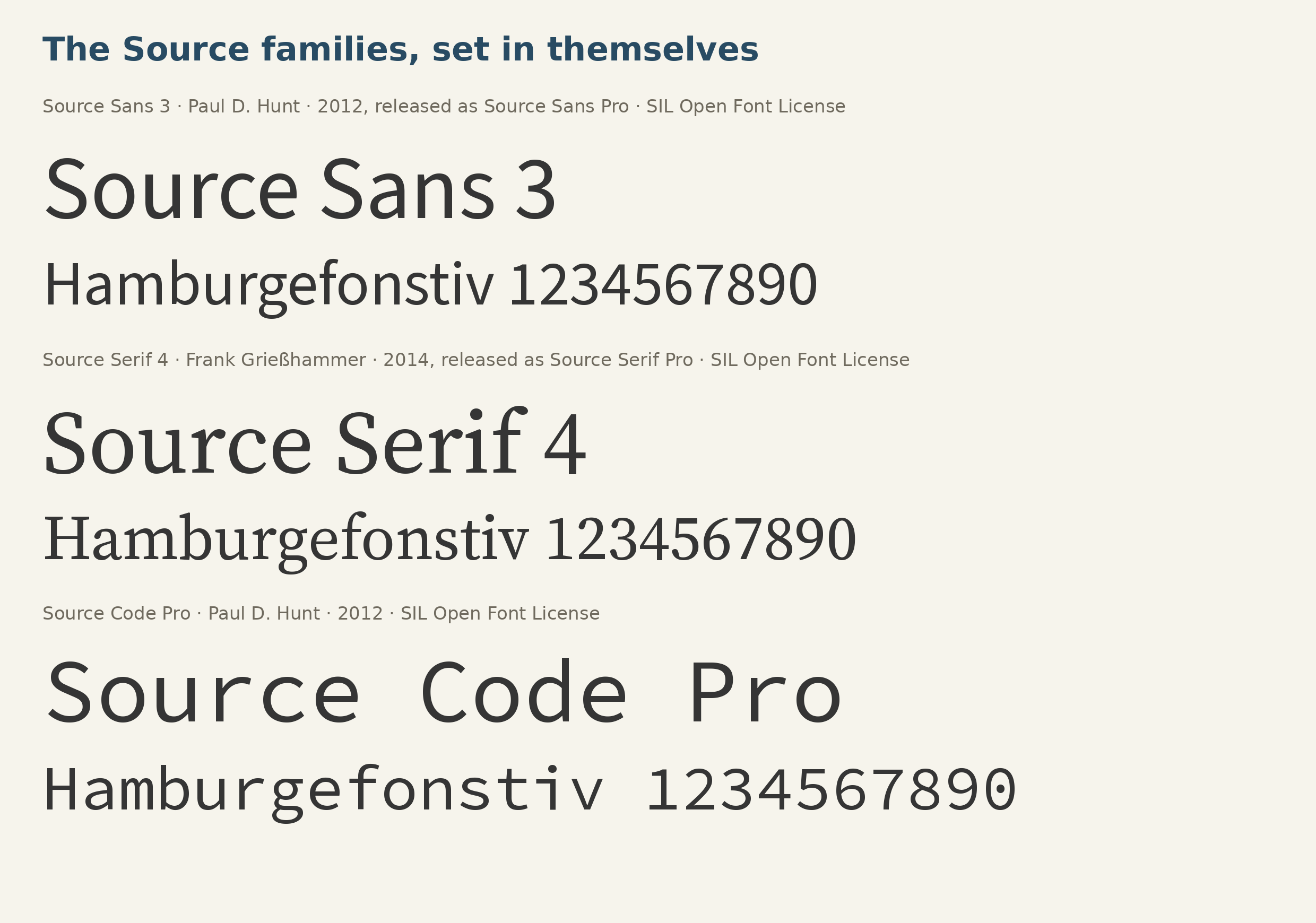
The Source families, rendered from Adobe’s open-source font files.
The family grew quickly. Source Code Pro, Hunt’s monospaced companion, followed in September 2012. Source Serif Pro, designed by Frank Grießhammer, arrived in May 2014; it was also the 100th typeface released by the Originals program. That same year Adobe and Google released Source Han Sans, directed by Ryoko Nishizuka, covering Simplified and Traditional Chinese, Japanese, and Korean in seven weights, at 65,535 glyphs per font, the CID-keyed maximum. Google ships the same fonts as Noto Sans CJK.
When did fonts stop being things you buy?
Typekit launched on November 9, 2009, built by Small Batch, Inc., and sold web fonts by subscription: a site paid for the library and embedded fonts with a line of JavaScript. Adobe acquired Typekit in October 2011. On October 15, 2018, the service became Adobe Fonts, folded into every Creative Cloud plan. The rebrand removed the limits the service had kept: all sync limits went away, web-only fonts ended, and pageview and domain caps were removed, across a library of about 14,000 fonts. The Typekit Marketplace, where fonts were bought outright, outlived the rebrand and was retired in November 2019; fonts bought there remain licensed to their buyers.
The owned library had peaked as a box. Font Folio 11.1, released in December 2011, put the whole Adobe Type Library, 2,433 OpenType fonts, into a single product at a single price. Adobe ended Font Folio sales on June 1, 2022, and the library it contained now lives inside the subscription, which passed 30,000 fonts by November 2024. The box gets its own telling in Font Folio: the whole Adobe Type Library in a box, where the final edition’s complete font list is transcribed alongside it. What activation looks like in daily work is covered in our guide to adding fonts to Photoshop.
 Adobe FontsAdobe's font library: the Typekit service under its current name, included with Creative Cloud plans.Visit site
When did Type 1 end?
Adobe announced the end in January 2021: support for authoring with Type 1 fonts would end in its products after January 2023. Photoshop went first, dropping Type 1 in version 23.0 in October 2021, a cutoff Adobe had signaled since 2019. From January 2023, Type 1 fonts no longer appear in the font menus of current Photoshop, Illustrator, and InDesign releases, and documents that use them report missing fonts. The format Adobe had guarded with encryption ended as a maintenance burden.
The guarded file left one legal legacy. When Southern Software extracted Adobe’s Type 1 outlines, scaled them, and sold the results, the lawsuit that followed established that a font file is protected software even where its letterforms are not; the case and its consequences are laid out in our account of font copyright law. And Type 1 is not quite gone. Acrobat still displays and works with Type 1 fonts, as the ISO PDF specification requires, and Type 1 data embedded in PDF and EPS files still renders wherever those files are placed. Why documents outlive the format is the subject of our companion post on fonts in PDF.