· adobe, font-folio, reference
Font Folio: the whole Adobe Type Library in a box
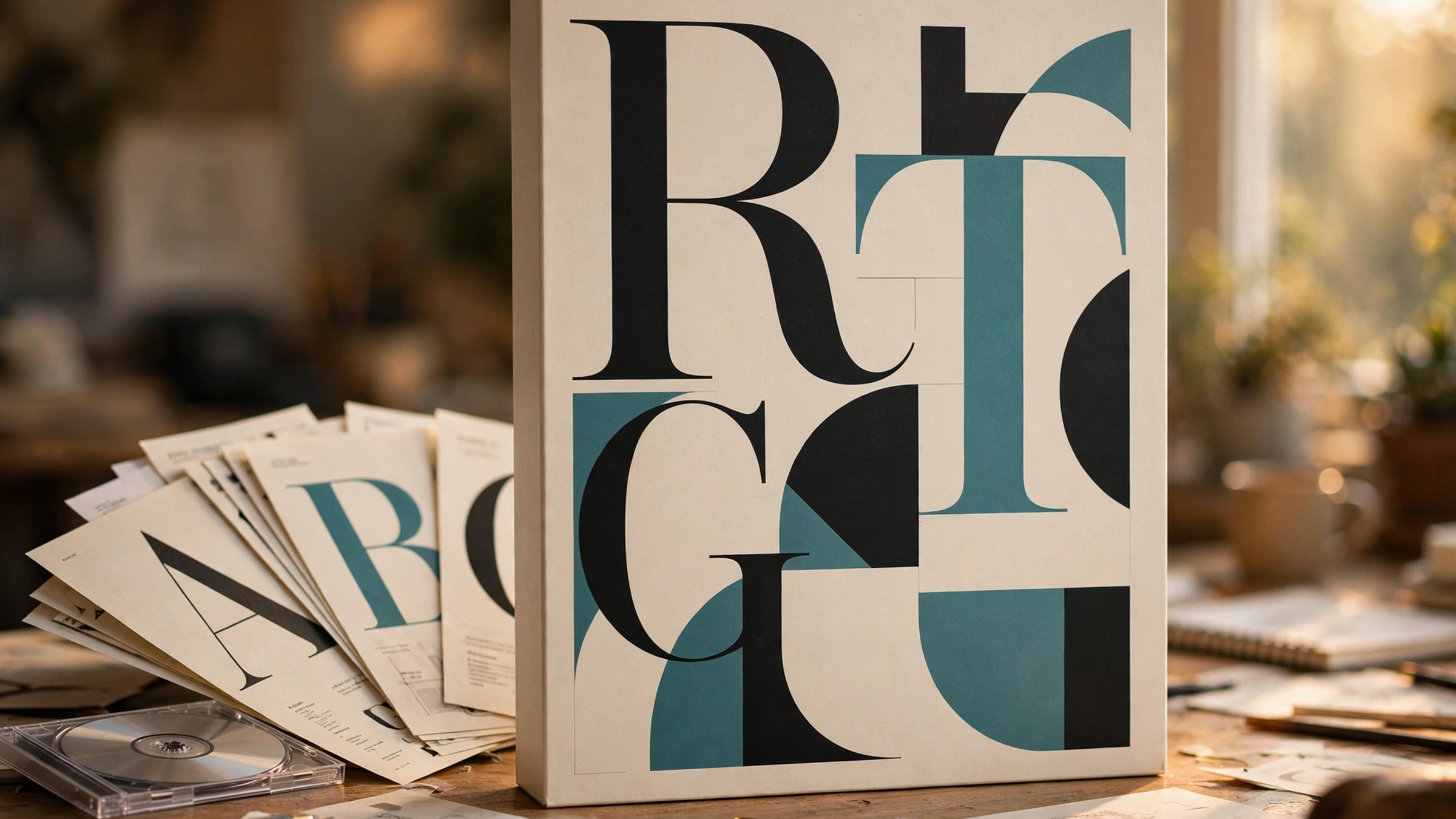
Font Folio was the Adobe Type Library sold whole: a single boxed product at a single price, with a perpetual license to every font Adobe sold. Its final edition, Font Folio 11.1, gathered the library into 2,433 OpenType fonts at Adobe’s count, from Trajan and Minion to the licensed catalogs of ITC, Linotype and Monotype. It was the professional end of the shelf our font CDs guide surveys, the boxed library against which the era’s cheap retail bundles measured themselves.
What was Font Folio?
For most of its life, the Adobe Type Library was a price list. Designers and print shops licensed the faces they needed one family at a time, and the library grew from the original PostScript fonts into the industry’s reference catalog. Font Folio was the other way to buy it: the entire library, bundled as a single product with a single license, aimed at studios, publishers and service bureaus that set type all day and wanted the question of which fonts they owned settled once and for all.
The line ran through a series of editions and closed with Font Folio 11.1, released on December 21, 2011. Adobe’s datasheet for it promised “more than 2,400 typefaces from the Adobe Type Library,” all in OpenType format, and the company’s own count for the edition was 2,433 fonts. A smaller sibling, Font Folio Education Essentials, cut the same idea down to 500 fonts for schools. No later edition followed 11.1; it stayed the current Font Folio for the product’s remaining decade, which makes it the natural edition to document. Adobe published a complete font list for it, and we have transcribed that list in full on the companion page, Font Folio 11.1: the complete font list.
What was inside the box?
Counted from Adobe’s own published list, the 2,433 advertised fonts resolve into 553 families. The list itself enumerates 2,429 entries; the four-font gap sits between Adobe’s headline count and its own document, and the transcription on the companion page follows the document. The core is the Adobe Originals program, the faces designed in-house or commissioned by Adobe’s type team: Minion Pro alone runs to 64 styles, and Arno Pro, Chaparral Pro, Cronos Pro, Adobe Jenson Pro and Warnock Pro each fill 32 slots with optical sizes and weights. Trajan Pro 3, Carol Twombly’s inscriptional capitals rebuilt for the edition, was one of the families flagged as new in 11.1.
Around that core sits the licensed trade. Sixty-five families carry the ITC name, from ITC Avant Garde Gothic to ITC Veljovic, Jovica Veljovic’s calligraphic serif. Linotype’s catalog accounts for 86 families under the LT mark, including Helvetica, Frutiger, Univers and Palatino, and Monotype’s accounts for 31 under MT, among them Times New Roman and the Gill Floriated Caps. The datasheet also credits smaller firms such as LetterPerfect and MVB Fonts, and individual designers including Veljovic and Michael Harvey. The single largest family in the box is Kepler Std, Robert Slimbach’s old-style serif, at 168 styles: four optical sizes across weights, widths and italics, a matrix no other family in the library matches.
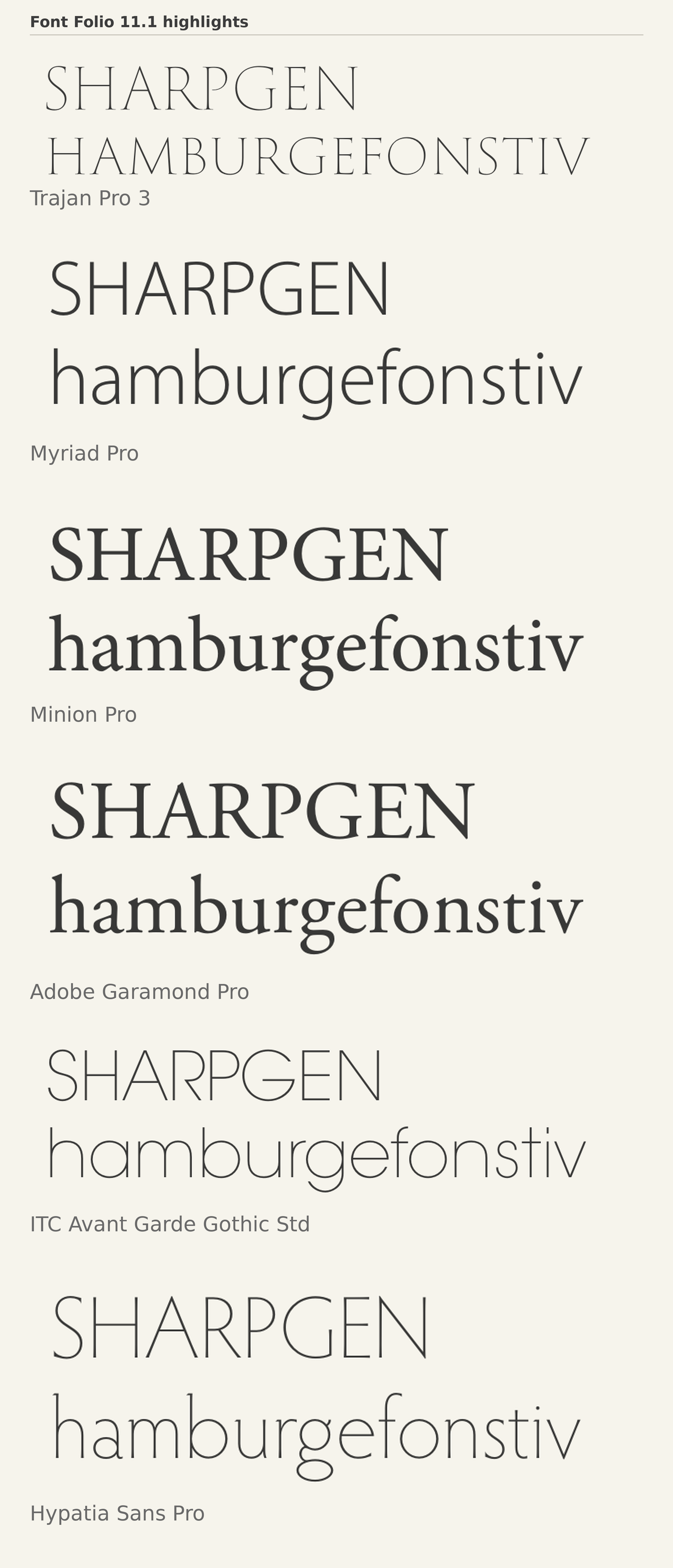
Six of the library’s signatures, as Adobe printed them in its own list: Trajan Pro 3, Myriad Pro, Minion Pro, Adobe Garamond Pro, ITC Avant Garde Gothic and Hypatia Sans Pro.
The margins of the list hold the library’s curiosities, the pi and ornament fonts that a working typeshop once needed on tap. ITC Zapf Dingbats is here, as are Adobe Wood Type Ornaments and MVB Greymantle Ornaments. The Linotype Game Pi families package chess, dice and card suits as fonts, the European Pi sets cover the symbols of pre-digital technical drawing, and Border Pi Std 1515-9 is nothing but rules and corners. None of these would justify a license on its own; in a library sold whole, they simply came along.
The tail of the list is the part buyers in 1995 could not have imagined. After the Latin catalog, Adobe’s list closes with the company’s world-script families: Adobe Arabic, Adobe Hebrew, Adobe Devanagari and Adobe Thai, Myriad in its Arabic and Hebrew forms, and licensed Japanese and Korean libraries, the Heisei, Kozuka and Ryo families from Japan and the HY and SM families from Korea. Eighty of the fonts in 11.1 were new to the edition, most of them in those script families and in fresh Originals such as Hypatia Sans Pro and Adobe Text Pro.
What did you actually own?
A Font Folio license was perpetual and covered desktop use: install the fonts, set print work with them, and keep using them for as long as the files ran. It was a publishing license, not a web one; the fonts were not licensed for web use, and embedding them in a website was outside the deal. Within those terms, though, the fonts were yours in a way no subscription font is. There was no server to check in with, no plan to keep paying, and nothing to switch off.
That is the exact opposite of the model that replaced it. Adobe Fonts, the service traced in how Adobe turned fonts into software, rents a much larger library, over 20,000 fonts by 2022, as part of a Creative Cloud subscription. The selection is bigger and the marginal cost of one more font is zero, but the license lives and dies with the subscription. Font Folio was the old bargain at its largest: a single box at a single price, and the transaction ended there.
How did it end?
Quietly, and on Adobe’s schedule rather than the market’s. Adobe discontinued Font Folio sales on June 1, 2022, eleven years after the last edition. Nothing dramatic happened to the fonts themselves: copies already bought continued to work, exactly as the perpetual license promised. What ended was the future tense. There would be no updates and no corrected or expanded reissues, and Adobe’s support for the product ran out on December 31, 2022.
The box’s contents did not disappear. The Originals and most of the licensed families live on inside Adobe Fonts, where they are rented rather than sold, and the library Font Folio froze in 2011 is now the fixed point that shows what the Adobe Type Library looked like at its boxed peak. The complete contents, all 553 families with every font file named, are on the companion page: Font Folio 11.1: the complete font list.