· reference
Font copyright law: the file is protected
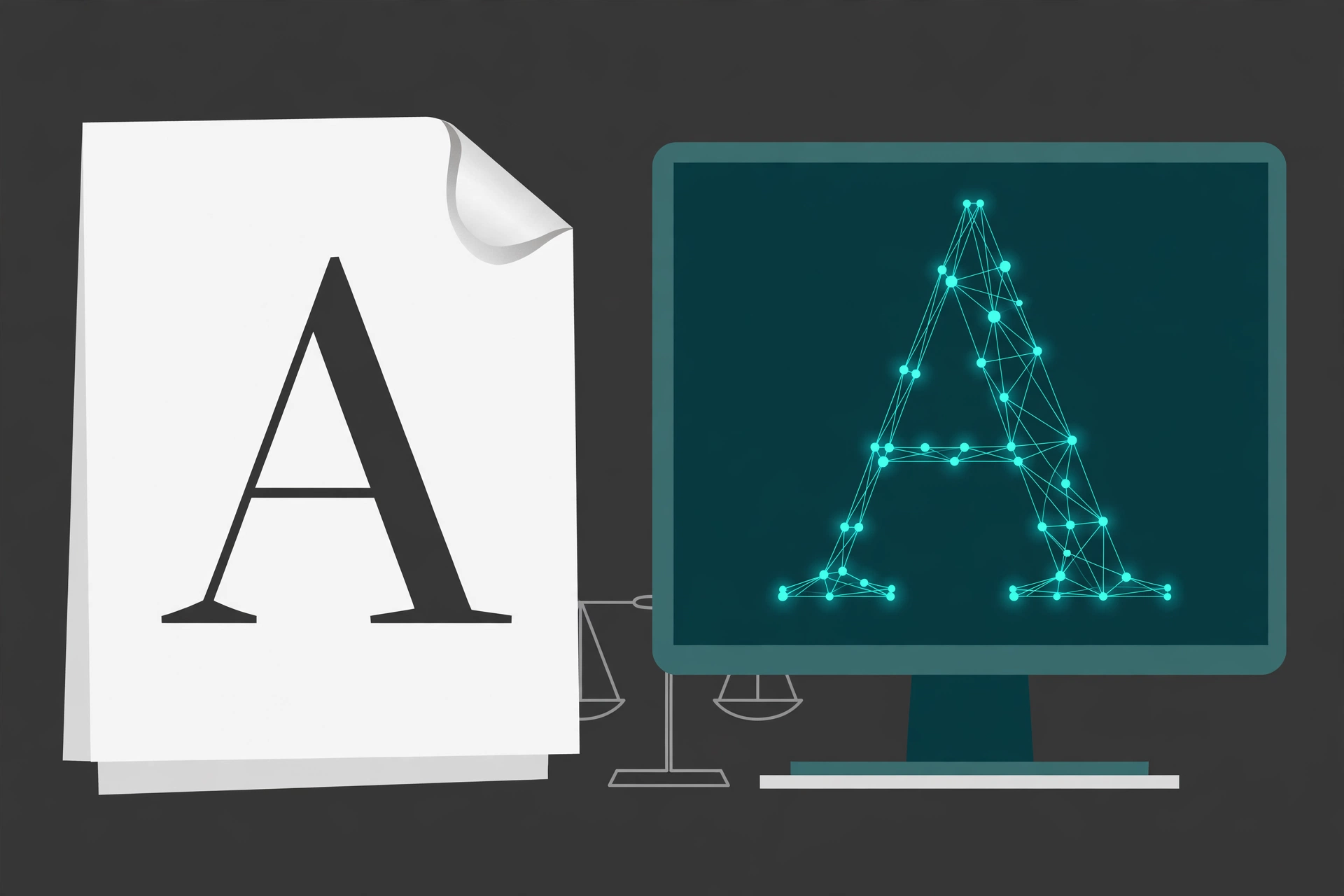
American copyright law cuts every font into two separate things, and protects only one of them. The design, the actual shapes of the letters, is not copyrightable. Anyone in the United States may print a page in a commercial typeface, scan the printout, digitize the letter shapes into a brand new font file, and sell the result. The font file, on the other hand, is protected as a computer program. Copy the file, or lift the data out of it, and you have infringed. Almost everything strange about the font business, the clone libraries, the lawsuits, the pirated downloads, follows from that one split.
The design: Congress said no, on purpose
This was a decision, not an oversight. When Congress wrote the Copyright Act of 1976, it considered protecting typeface designs and deliberately deferred the idea. The House report defined a typeface as a set of letters and symbols related by repeating design elements, and said plainly that such a design is not a copyrightable pictorial, graphic, or sculptural work. The Copyright Office wrote the position into its regulations, where it still sits at 37 CFR 202.1(e): “typeface as typeface” is not registrable.
The one early court test went the same way. In Eltra Corp. v. Ringer (4th Cir. 1978), Eltra sued when the Copyright Office refused to register the design of a typeface it had commissioned, a commission attributed to Hermann Zapf, though the opinion itself does not name the designer. The Fourth Circuit upheld the refusal. A decade later, in its 1988 policy decision on digitized typefaces, the Copyright Office extended the logic to computers: data that merely depicts a typeface, the bitmap fonts of the era, was not registrable either.
The reasoning is functional. Letters are tools for writing, and locking up their shapes would let one owner tax every printed page that resembles them. Copyright protects expression, and the law treats an alphabet as closer to a tool than to a picture.
The file: a program that happens to draw letters
Four years after the 1988 decision, the Copyright Office changed course on the part that mattered. Its 1992 policy decision (57 Fed. Reg. 6201) held that creating a scalable font involves original computer instructions, not mere depiction. A modern font file is built from outline points chosen by a person, spacing and kerning data, and in formats like TrueType, actual executable hinting instructions. That package is a computer program, and programs are copyrightable. What is protected is the data: the specific points, tables, and code. The shapes the program draws when it runs remain unprotected.
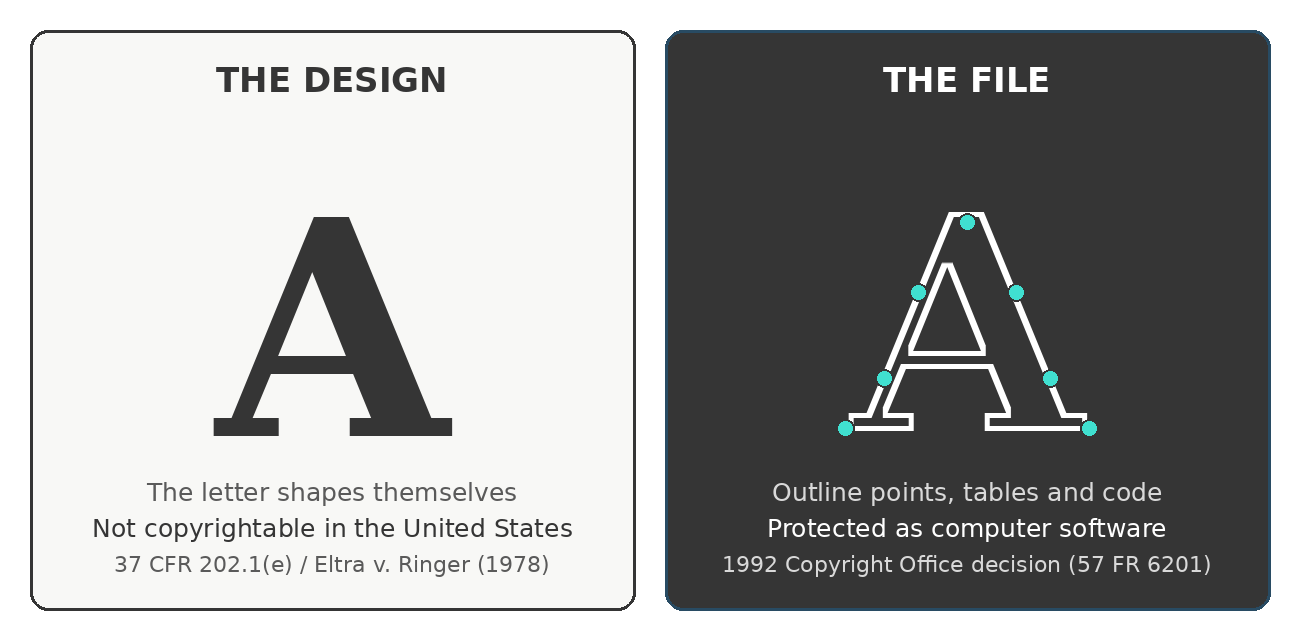
So the same A exists twice in the law. As a shape, it belongs to anyone. As a set of coordinates and instructions in someone’s file, it belongs to that file’s maker.
The case that cashed the check: Adobe v. Southern Software
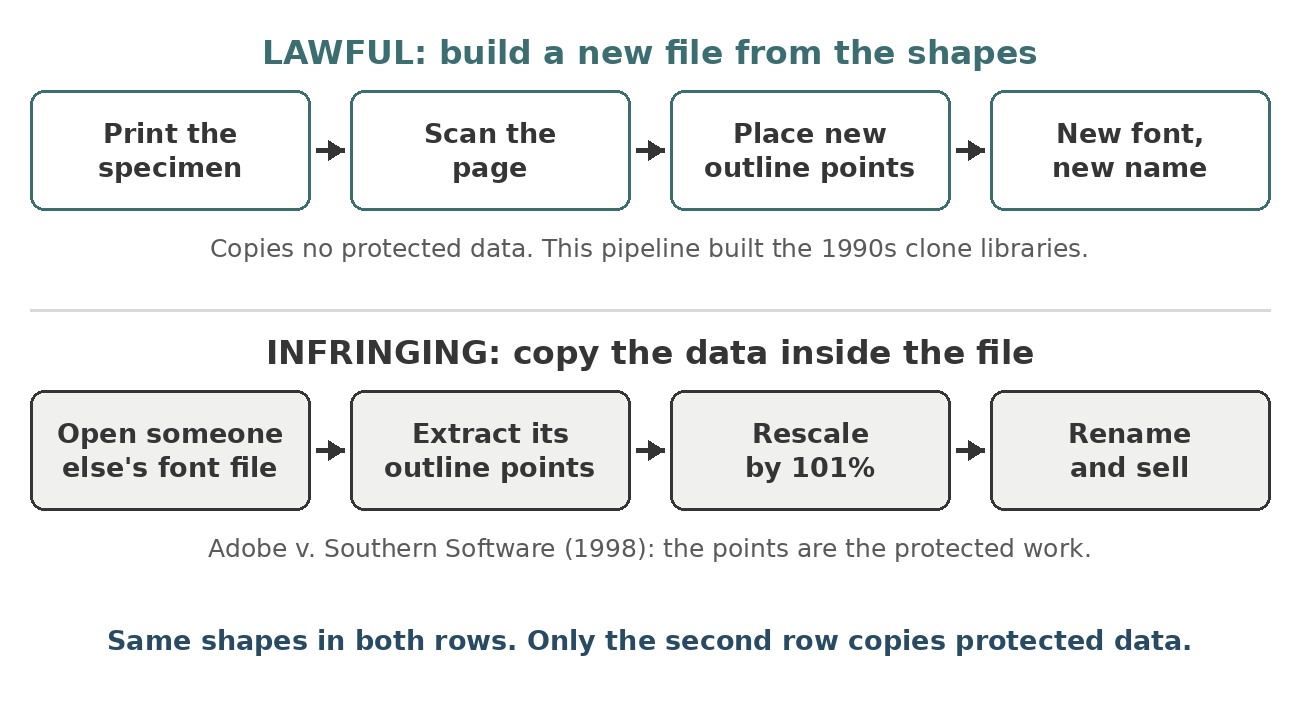
The 1992 decision was a theory until a federal court applied it. Paul King of Southern Software had extracted the outline points from more than 1,100 Adobe font files, stretched them by one percent, and sold the results under new names. On February 2, 1998, Judge Whyte of the Northern District of California granted Adobe summary judgment: the selection and placement of outline points is original authorship, two designers digitizing the same letter by hand would choose different points, and copying those points, however slightly rescaled, copies the protected work. The Learning Company, which had licensed King’s fonts, settled for $2 million and withdrew its font CDs. In 1999 King consented to judgment and a permanent injunction, in Emigre’s parallel case as well as Adobe’s.
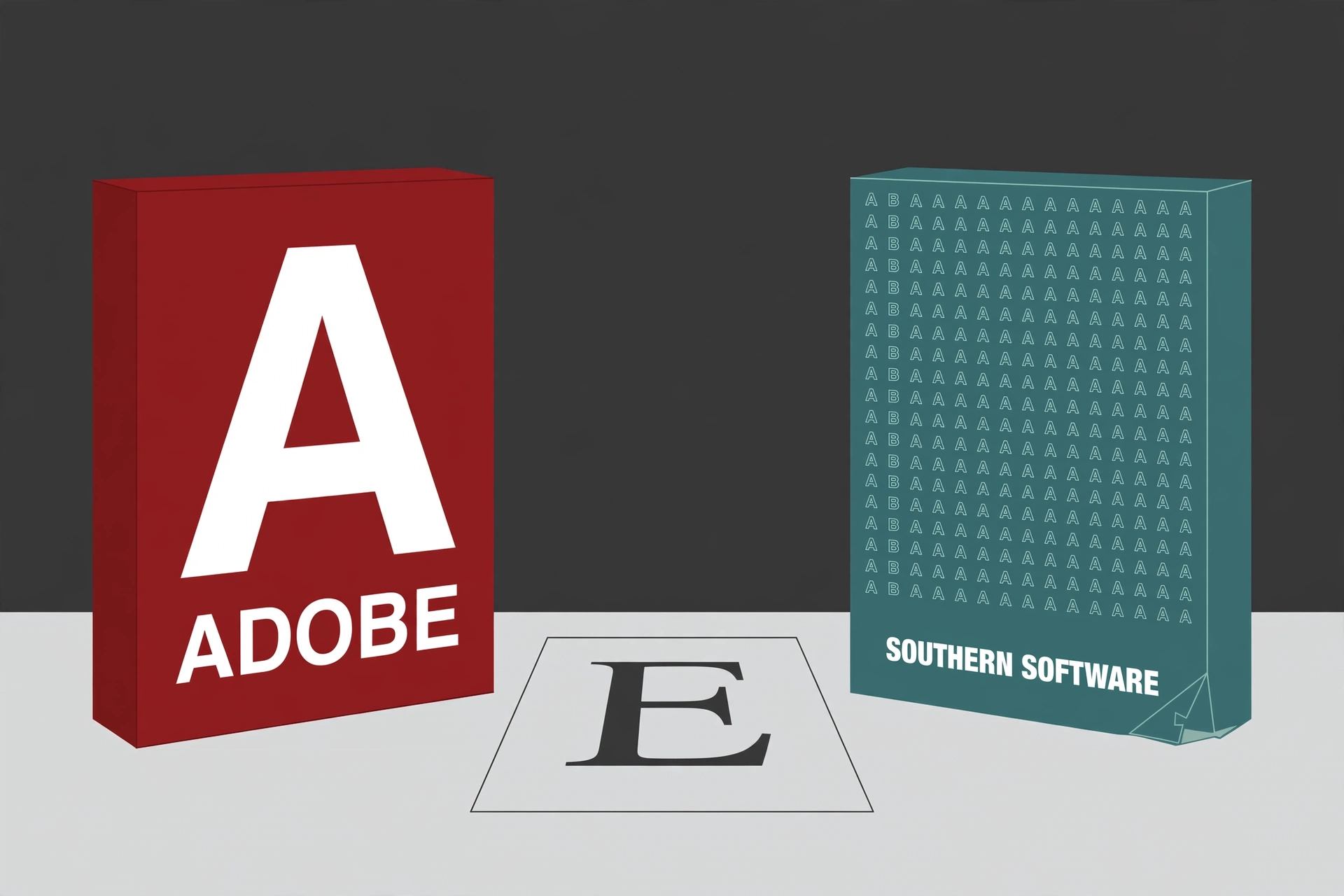
Note what the case was never about. King was not punished for making fonts that looked like Adobe’s. He was punished for taking Adobe’s data. Had he printed Adobe’s specimen books and digitized the shapes fresh, the same court would have had nothing to give Adobe under copyright. Whatever protection letter shapes get comes from design patents, a narrow and short-lived instrument covered in our trademarks and design patents post.
The clone pipeline the law built
That distinction was an industry. The lawful workflow ran: buy or borrow the printed specimen, scan it, place new outline points over the scan, name the result something else. No protected data changes hands, so no infringement occurs, whatever one thinks of the ethics. Weatherly Systems ran this pipeline at wholesale scale in the 1990s, selling re-digitized libraries to software publishers by the thousand, and its own catalog cheerfully named the famous designs each face followed. Our census of the ClickArt Fonts 2 disc found the same pattern stacked three deep: 845 font families on one retail CD, nearly all re-digitizations by Bay Animation and MicroLogic, sold under fresh names with strict no-redistribution stamps on the files.
One boundary does survive the trip through the scanner: the name. Trademark law is separate from copyright, and a clone may not be sold under the original’s registered name. That is why clone libraries are full of near-miss names, close enough to identify the model, different enough to stay legal. It is also why naming a new typeface is a legal exercise as much as a creative one, and why we built the Font Name Checker to screen a candidate name against the existing catalog before anyone falls in love with it.
Why designers distrust free font sites
Now put yourself in a working type designer’s chair and open a free font site. A listing grid there mixes three things that look exactly alike: fonts the designer genuinely gave away, lawful clones of commercial faces re-digitized from print, and pirated files, straight copies of retail fonts, sometimes with the names filed off. The second category is legal but feels like theft; it took the design, which is the part the designer actually made, and the law offered nothing. The third category is outright infringement, and download sites have historically been slow to police it. Unable to tell the three apart at a glance, and having watched their own retail faces come back as “free” downloads for thirty years, many professionals treat the whole category as knockoffs and pirates. The distrust is not really about the law. It is about a grid where the lawful and the stolen wear the same thumbnail.
design registration refused
a mere depiction, not registrable
Adobe wins on the points
The DMCA: the machinery that polices the file
Everything above describes what the law protects. The Digital Millennium Copyright Act of 1998 is how the protected thing, the file, actually gets policed online, and it explains the behavior of every site in the grid above. The DMCA is a copyright statute only. It says nothing about typeface designs, which need no policing because they are not protected, and nothing about names, which belong to trademark law; takedown systems built on it expressly refuse trademark complaints.
Its centerpiece is a trade, in section 512. A website that stores files at its users’ direction is shielded from money damages for those users’ infringements, if it runs the machinery honestly. It must register a designated agent with the Copyright Office (a $6 filing, renewed every three years) and post the agent’s contact information on the site. When a proper notice arrives identifying a file, it must remove the file expeditiously, without deciding who is right. It tells the uploader, who may counter-notice; the file then goes back up in ten to fourteen business days unless the sender files suit, which almost nobody does. The host must also run a real repeat-infringer policy, terminating accounts that keep uploading other people’s work, and it forfeits the shield for any specific file it actually knows is pirated and leaves sitting. What the law never asks is the thing site owners most fear being asked: section 512(m) says the host has no duty to monitor uploads or go hunting for infringement on its own.
So the liability for a site like FontSpace, where designers and ordinary users upload fonts, is mostly procedural. The uploaders carry the direct liability; they are the ones who copied the file, and uploading terms put the warranty of rights on them. The host’s exposure turns on its own conduct: a current agent registration, fast removals, a working repeat-infringer policy, and no known-pirated files left up after it has genuinely seen them. One boundary deserves emphasis, because it is the one that decides hard cases. The harbor covers storage at a user’s direction. What the operator itself chooses, uploads, or promotes is judged as the operator’s own act, outside the harbor’s shelter.
Two smaller tools complete the kit. Section 512(h) lets a copyright owner obtain a subpoena from a court clerk, no judge involved, ordering a host to identify an anonymous uploader; it is the likely mechanism behind the string of otherwise cryptic miscellaneous cases in Emigre’s enforcement campaign, filed years before anyone explained them. And section 1202, which forbids stripping copyright management information, is the digital descendant of the clone era’s handiwork: a font’s embedded name and copyright strings are exactly the kind of information it covers, so the modern rename-and-strip job that Southern Software did with FontMonger is now its own violation, separate from the copying.
The doctrine, tested: two letters that actually arrived
Two cases on this site show the machinery from the receiving end. In the Metallica case, the letter was trademark only, because the lettering’s shapes are free: it policed a category label, not any file. In the Dr. Seuss case, two DMCA notices policed the files themselves, because the fonts were charged with reproducing copyrighted artwork. Read together, they mark the boundary this page describes: names and files are enforceable, shapes are not.
Other countries answered differently
The United States is the outlier. The United Kingdom protects typeface designs as artistic works under the Copyright, Designs and Patents Act 1988, while carefully exempting ordinary printing: using a typeface to print is never infringement (section 54), and manufacturing new type-producing articles becomes free 25 years after the first ones are marketed (section 55). Germany’s Schriftzeichengesetz of 1981 protected a new design for ten years, renewable once for fifteen more, a 25-year ceiling, until its protection-granting provisions were repealed on June 1, 2004; registrations made before the repeal carried over under section 61 of the Design Act, and new typefaces since then have gone through German or EU registered design law. That statute was written for the Vienna Agreement of 1973, a treaty drafted to protect typefaces internationally. Germany and France were the only states ever to ratify it, two of the five ratifications it needed, so it never entered into force and its international deposit register never opened. The United Kingdom signed but never ratified it; its typeface rules are its own. Typeface protection remains a patchwork: designs protected in London and Munich, unprotected in New York.
What this means when you download a font
Three practical rules follow. First, using a font, printing and publishing with it, is governed by its license, not by design copyright; our licensing guide covers what licenses allow. Second, the bright legal line is the file: giving someone the file, posting it, or embedding it beyond your license is where infringement lives. Third, redrawing a typeface from printed specimens is lawful in the United States, which is why revivals and workalike faces are a permanent, legal feature of the font world, and why a font’s license and a font’s look are two different questions. Keep them separate and most font law gets much less confusing.
This article is general information about how these laws work, not legal advice about any specific case.