· reference
Southern Software: the company that copied Adobe
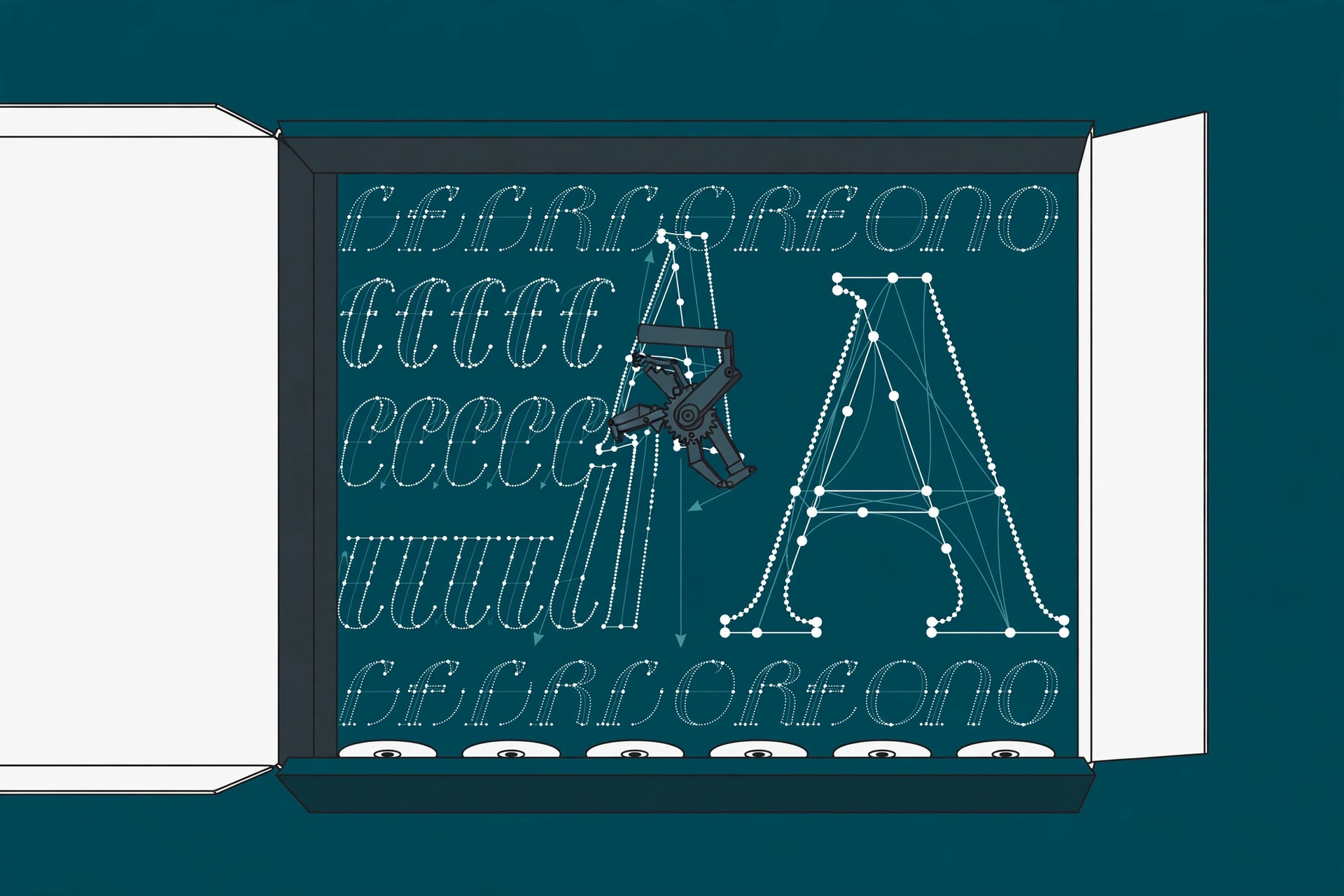
Weatherly Systems, the subject of our previous post, rebuilt other people’s typefaces from scratch and sold the results wholesale. Southern Software Inc. did something simpler and much riskier. It took Adobe’s actual font files, pulled the outline data out of them, stretched that data slightly, gave the fonts new names, and sold them by the thousand on cheap CDs. The difference sounds technical. In court it was the whole case. That case, Adobe v. Southern Software, is the central precedent in our explainer on font copyright law, because it settled that a font file is protected software even though letter shapes themselves are not.
One man in Port Charlotte
Southern Software Inc., usually shortened to SSI, was based in Port Charlotte, Florida, and by every account of the litigation it was a company of one: Paul Eric King, its sole officer, director and employee. Luc Devroye’s SSI dossier describes the business plainly: not a foundry that drew type, but an operation that reworked other companies’ fonts, Adobe’s and Monotype’s among them, and packaged the results in bulk.
The products were the font CDs of the era, sold on volume. Key Fonts Pro 1555 came first, then Key Fonts Pro 2002 and Key Fonts Pro 3003, each number advertising roughly how many fonts the disc held. A later CD, Just My Type, carried 3,360 fonts and sold for $29.95, according to Devroye. At those prices, nobody was paying for drawing. They were paying for a library, and the library had to come from somewhere.
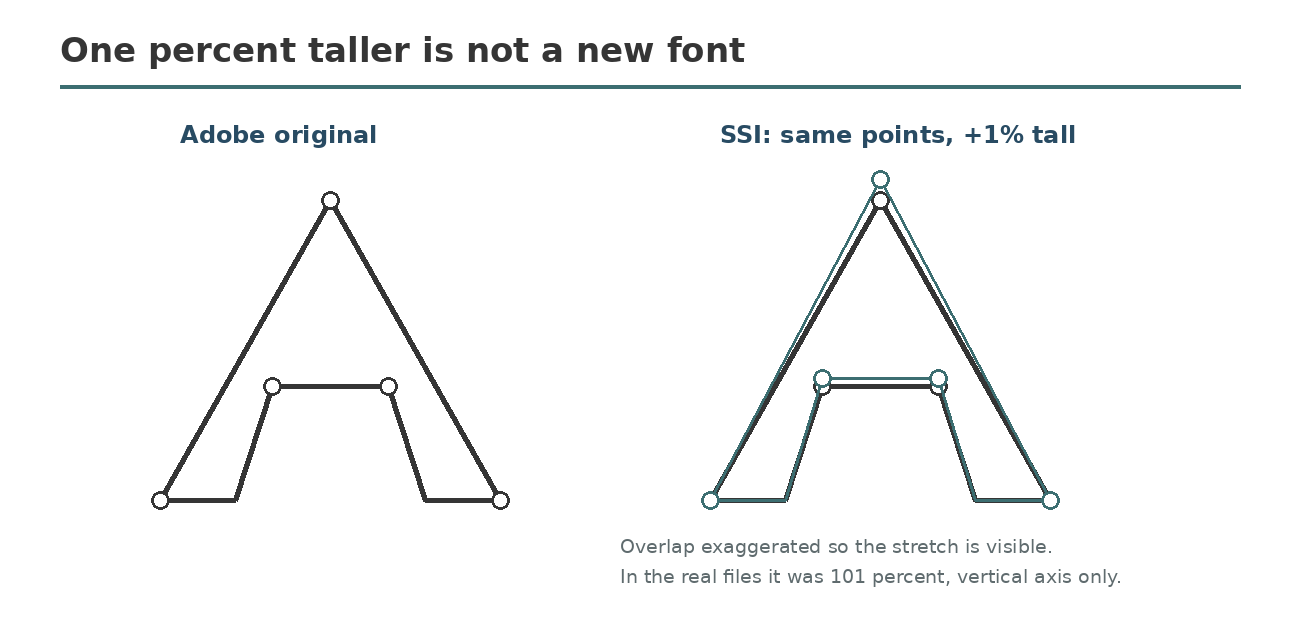
It came from Adobe’s files, by a method that left evidence inside every font. King loaded Adobe font software into two commercial font editors, FontMonger and Fontographer. Those tools could open a font and expose the outline points, the control points that define each letter’s curves, for editing and resaving. King extracted Adobe’s points, scaled the vertical coordinates to 101 percent so every letter stood one percent taller, and saved the results under new names. Adobe’s Utopia, for example, came out the other side as “Veracity.” Adobe also alleged that the tools had been modified to strip its copyright notices. Repeating the process across the Adobe library produced the Key Fonts Pro catalog, and Adobe eventually accused King of infringing more than 1,100 of its fonts.
The customer was Broderbund’s owner
SSI did not only sell its own discs. It licensed the Key Fonts Pro programs to The Learning Company, the former SoftKey, which distributed the fonts under further new names. That license is why the story touches the rest of this site’s CD history: The Learning Company was the company that bought Broderbund in 1998, and Key Fonts Pro was the product line behind the SoftKey font CDs cataloged in our font CDs hub. The same stretched Adobe outlines, wearing three companies’ names in turn.
Adobe sued SSI and The Learning Company in October 1995, and added King personally as a defendant in January 1997. The Learning Company settled: Devroye’s ruling page records $2 million, plus withdrawal of the font CDs, the 1555 and 3003 series and two others. King fought on.
The point about points
King’s defense was the strongest argument available, and it was nearly right. American law does not copyright typeface designs: the shapes of letters, as shapes, are unprotected, a rule stated in the regulations at 37 CFR 202.1(e) and in the Eltra v. Ringer line of cases. If the design is free for anyone to redraw, King argued, then the points that describe the design must be free too, because the points are just the design written as numbers.
Judge Ronald M. Whyte, of the Northern District of California, disagreed, and the reasoning is the part of the case that still governs fonts. An Adobe font editor, the court found, does not trace a letter mechanically. Choosing where the control points go, how many a curve needs and where its handles sit, involves creative judgment: two editors starting from the same letter can produce output that looks identical while sharing few points. That selection and placement is original authorship, and the font file that embodies it is a computer program protected by copyright. King had not redrawn Adobe’s letters. He had copied Adobe’s point selections wholesale, and stretching them by one percent was a mechanical change that cured nothing. Even loading the files into the editors counted against him, as infringing intermediate copying into RAM. The full ruling is Adobe Systems, Inc. v. Southern Software, Inc., No. C 95-20710, and Jonathan Mezrich’s contemporary analysis works through it in detail.
On February 2, 1998, the court granted Adobe summary judgment on copyright. It did not grant summary judgment on Adobe’s design patent claims, where it found genuine factual disputes, a distinction worth keeping: the victory was about the file, not the letterforms. The ruling was controversial then and is still argued about. Critics, Richard Kinch among them, held that the court had protected coordinate data rather than a program, and that the RAM copying holding swept too broadly. But no later case has displaced it, and it remains the case lawyers cite when they explain that a font file is software.
The Learning Company settles for $2 million and withdraws the discs.
Adobe buys FontMonger's distributor and discontinues the tool.
The end of SSI
What remained was cleanup. In 1999, King and SSI consented to judgments and permanent injunctions in both the Adobe case and a parallel Emigre case, covering more than 1,100 Adobe programs and 35 Emigre programs, and barring them from making or distributing font software that copies or extracts Adobe’s or Emigre’s points. Adobe also bought Ares Software Corporation, the distributor of FontMonger, and discontinued the tool King had used to do the extracting. SSI ceased operations.
The contrast with the wholesaler in our previous post is the lesson the two companies teach together. Weatherly’s model, re-digitizing published designs under new names, sat on the lawful side of the American line, however sharply the original foundries disliked it, and WSI was never sued out of existence. King’s model crossed the line at the exact place the court drew it: he took the file, not the design. One percent taller, a new name, and a $29.95 price tag changed none of that, and the discs that carried his work were withdrawn by the company that had licensed them. The shapes of letters are free. The points somebody chose to draw them with are not.