· reference
Weatherly Systems: the font wholesaler
If you installed consumer software in the 1990s, you almost certainly installed Weatherly Systems fonts. You would not have known it. Weatherly Systems, Inc., usually shortened to WSI, was a font wholesaler in Huntsville, Alabama, run by Mike Charness. Its name appeared on almost nothing a customer could buy. It survives where wholesalers’ names always survive: inside the goods, in the copyright and trademark fields of thousands of font files that other companies sold as their own.
A wholesaler, not a foundry
WSI’s business model is stated plainly on its own archived company page, preserved in Luc Devroye’s WSI dossier: the company did not sell directly to end users, but provided fonts to software publishers who sold them under their own labels. The list of licensees it claimed runs to dozens of names, among them SoftKey, Canon, Fuji, Epson, Serif, Borland, Novell, Maxis, Cosmi, Expert Software, IMSI, Parsons Technology, Media Graphics, GraphicCorp and The Learning Company. The library was large, thousands of fonts by Devroye’s account, priced at rock bottom and supplied in every format the era used.
That one fact explains the strangest thing about WSI fonts in the wild: the same font turns up wearing many different uniforms. Inside surviving files, the version field names whichever publisher shipped that copy. Media Graphics International’s Publisher’s Paradise, October 1994. SoftKey’s Handwriting KeyFonts, 1995. The IMSI MasterFonts Collection, 1996. PrintMaster, 1998. The trademark field, by contrast, keeps pointing back to Huntsville: digital font data provided under commercial license by W.S.I., followed by an Alabama phone number. The publishers were the retail channel. WSI was the supply chain. The method behind that supply chain, re-digitizing printed specimens with fresh outline points, is the lawful workflow our guide to font copyright law sets against Southern Software’s point copying.
later pressed onto ClickArt Fonts 2
Other people’s type, renamed
The best single document of the library is WSI’s own. In 1997 the company published Font Tasting, a set of descriptions by Robert Long written for the OEM trade, walking buyers through the collection face by face. The text survives on Devroye’s site, and it is remarkably candid: entry after entry introduces a WSI font by naming the well-known commercial design it follows, then explains how the WSI version differs. A sample of the pattern:
| WSI name | The design Long’s catalog names as its model |
|---|---|
| Aladdin | Legende |
| Anastasia | ITC Anna |
| Avian | Avant Garde |
| Balogna | Balloon (Max Kaufmann, 1939) |
| Basset | Baskerville |
| Boston | Bodoni |
| Bulletin | Futura Flyer |
| Businko | ITC Busorama |
| Carlisle | Carrick-Groovy, by David Rakowski |
| Palisade | Palatino |
This was not hidden. It was the sales pitch. American law has never copyrighted typeface designs themselves, only the font files that draw them, so a library rebuilt from printed specimens and sold under fresh names occupied ground the industry largely tolerated, however much the original foundries disliked it. Long’s catalog also calls a minority of faces, such as Quantas and Phinster, WSI originals, and the library carried working tools alongside the display faces: barcode fonts, a MICR font for printing checks, foreign-language fonts and dingbats. But the center of the catalog was the great type library of the twentieth century, re-digitized, renamed and priced for bundling.
Other people’s handwriting
The handwriting side of the business went one step further. Long’s descriptions introduce WSI’s Handwriting Collection as fonts made from the handwriting of real people, with the fonts named for their writers’ first names. The files still circulate under names like AmandasHand, AshtonsHand, TanyasHand and JuliesHand, carrying the IMSI and SoftKey version stamps described above. Somebody’s hand, turned into a product line.
How the hands were gathered is the part of the record that raises eyebrows. Devroye reports that the collection apparently began as a service: customers paid to have their own handwriting made into a personal font, and the fonts created that way were then sold as a collection, including on a ClickArt Handwritten Fonts CD, for which Michael Yanega compiled a list of the names and their equivalences. The contracts those customers signed have not surfaced, so what they agreed to is unknown. What is documented is the outcome: a library of named strangers’ handwriting, licensed to publishers as casually as the barcode fonts, decades before personal handwriting fonts became a normal consumer service.
The slice on the ClickArt disc
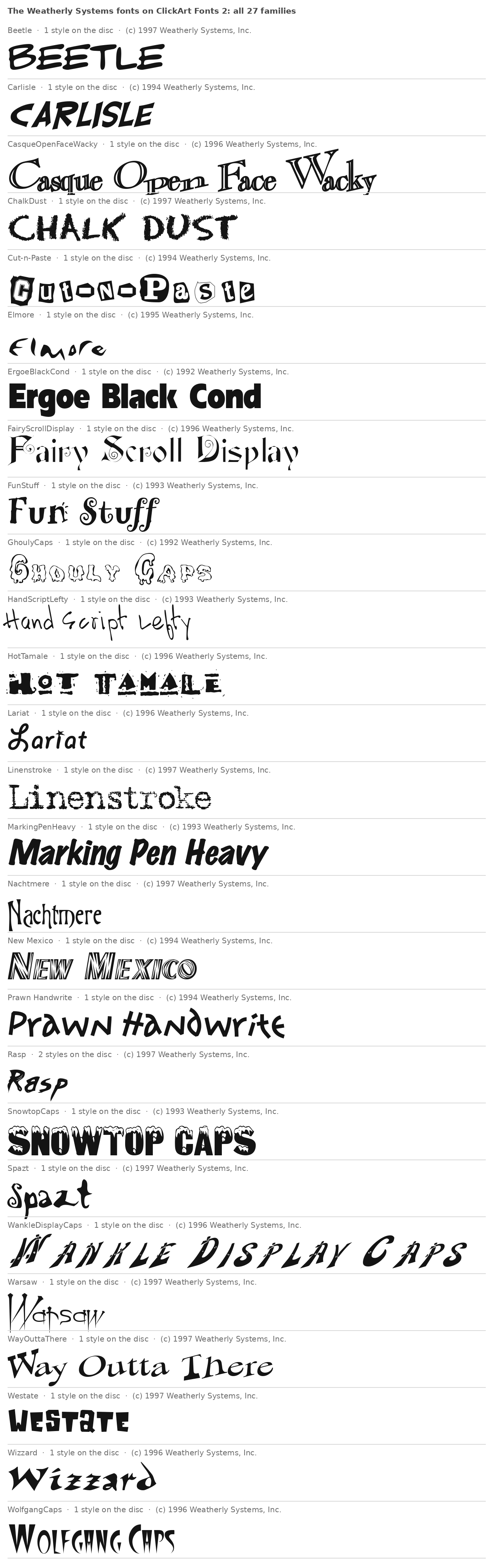
Our file-by-file inventory of ClickArt Fonts 2 found WSI in its familiar position, deep inside somebody else’s product. Twenty-eight of the disc’s 2,638 files, in 27 families, carry Weatherly Systems copyrights, the smallest of the three libraries on the disc. Every one of the 28 also carries a PrintMaster version stamp dated 1998 and credited to Mindscape, which means this slice of WSI reached the Broderbund disc by way of a PrintMaster package: the same PrintMaster line that had once been sued for imitating Broderbund’s Print Shop. The wholesale web had no loyalties.
The selection is telling, too. The ClickArt slice is nearly all novelty and display faces, Beetle, Chalk Dust, Ghouly Caps, Hot Tamale, Snowtop Caps, the party end of the catalog, plus Carlisle, whose model, per Long, is a font by David Rakowski. The famous text-face renames, the Bassets and Bostons, are absent. Consumer discs wanted fun fonts, and WSI’s novelty shelf is what traveled.
“Not freeware”
The withdrawal came with a notice, quoted in Devroye’s dossier: the company was no longer selling fonts to end users or licensing fonts for redistribution, and, in its own words, “WSI’s fonts are not freeware, but are commercial software protected by copyright.” Devroye reports that OEM work continued afterward. The files in the wild tell the rest of the story: after 2003 the library flooded the download sites, where much of it still sits, frequently mislabeled as free.
That mislabeling is the origin of the persistent rumor that WSI fonts may be distributed freely. Nothing in the surviving record supports it. No release, grant or public-domain dedication by Weatherly Systems has ever surfaced, and the evidence that does exist points the other way: the company’s own notice, and the words stamped inside the fonts themselves, where file after file reads “Redistribution strictly prohibited.” An owner who has stopped answering is not the same thing as an owner who has given the work away.
WSI is the reason so many rival products of the 1990s seemed to share a font menu. Under the different labels sat the same Huntsville library: the classics renamed, the novelties, the strangers’ handwriting, all of it moving by the pallet load. The company arranged never to be the name on the box, and in the end it got its wish completely. The boxes are gone. The fonts, and the fine print inside them, are what remain.