· tools, history, font forensics
Altsys Metamorphosis: the 1990s font converter

Altsys Metamorphosis was a utility from Altsys Corporation of Richardson, Texas, that converted fonts between PostScript Type 1, Type 3, and TrueType, and between Mac and PC, from 1989 into the mid-1990s. CD libraries were built with it, and it signed its work: the version string of 1,955 fonts in our archive still reads “Altsys Metamorphosis” plus a date.
What was Altsys Metamorphosis?
Altsys Corporation was founded in December 1984 in Richardson, Texas, by James R. Von Ehr II, to build graphics software for the new Macintosh. Its first font product was a bitmap editor called Fontastic, and its second changed the trade: Fontographer, released in January 1986, was the first commercially available bezier curve editing software for a personal computer, out before Adobe Illustrator. Designers who had needed a six-figure Ikarus system could suddenly draw PostScript fonts on a Mac. Altsys also wrote FreeHand, Aldus’s drawing program. The company’s second font tool is our subject. Where Fontographer created fonts, Metamorphosis moved them.
the first practical font editor for the Macintosh
and retrieves printer fonts
Free upgrade, list $149
weeks before System 7 ships it
Altsys becomes Macromedia's Digital Arts Group
Altsys in one line of dates: the editor came first, the converter followed, and Macromedia ended the story.
Version 1.0 arrived in 1989 and converted between Type 1 and Type 3, Adobe’s documented but unhinted format, in both directions. It could also reach into a connected PostScript printer and retrieve the fonts stored in it. Version 1.5, a free upgrade in the summer of 1990, learned to export Type 1 fonts compatible with Adobe Type Manager, hints included, at a list price of $149. Metamorphosis Professional 2.0 followed in March 1991 and added the format that mattered most: TrueType, weeks before Apple shipped it in System 7.
Why did fonts need a ferry?
Because the early 1990s font world was split by a format war and a platform war at the same time. Adobe’s Type 1 was the professional standard, licensed and encrypted, as our history of Adobe’s font business tells in full. Apple and Microsoft answered with TrueType, published and royalty-free. A foundry’s library usually existed on one side of that line only, and in one machine’s file format only: a Type 1 font for the Mac was useless to a Windows user, and a TrueType font did nothing for a PostScript imagesetter. The five separate files of a PC Type 1 font, taken apart in our post on archaic font formats, show how physical the split was.
Adobe published the Type 1 specification in March 1990, which made conversion legal and practical, but a specification is not a tool. Somebody still had to read one format, redraw its curves in the other format’s mathematics, rebuild its metrics, and write out the half dozen files each platform expected. That somebody, on the Mac, was usually Metamorphosis. TidBITS counted well over a hundred shareware typefaces circulating in Type 1 form by June 1991, and System 7 was about to make every Mac owner want them as TrueType. Altsys was already standing at the dock.
What could it convert?
Luc Devroye’s archive calls it “the premiere font conversion utility for the Macintosh”, and the specification backs the compliment. Professional 2.0 converted between seven outline formats: Type 1 for Mac, PC, and NeXT; Type 3 for Mac and PC; and TrueType for Mac and PC. Anything it read could also come out as an EPS file of raw outlines for Illustrator or FreeHand, as a PICT of smooth polygons, or as a Fontographer file for editing. PC Type 1 output meant generating the .pfb printer file and .afm metrics file Windows expected.
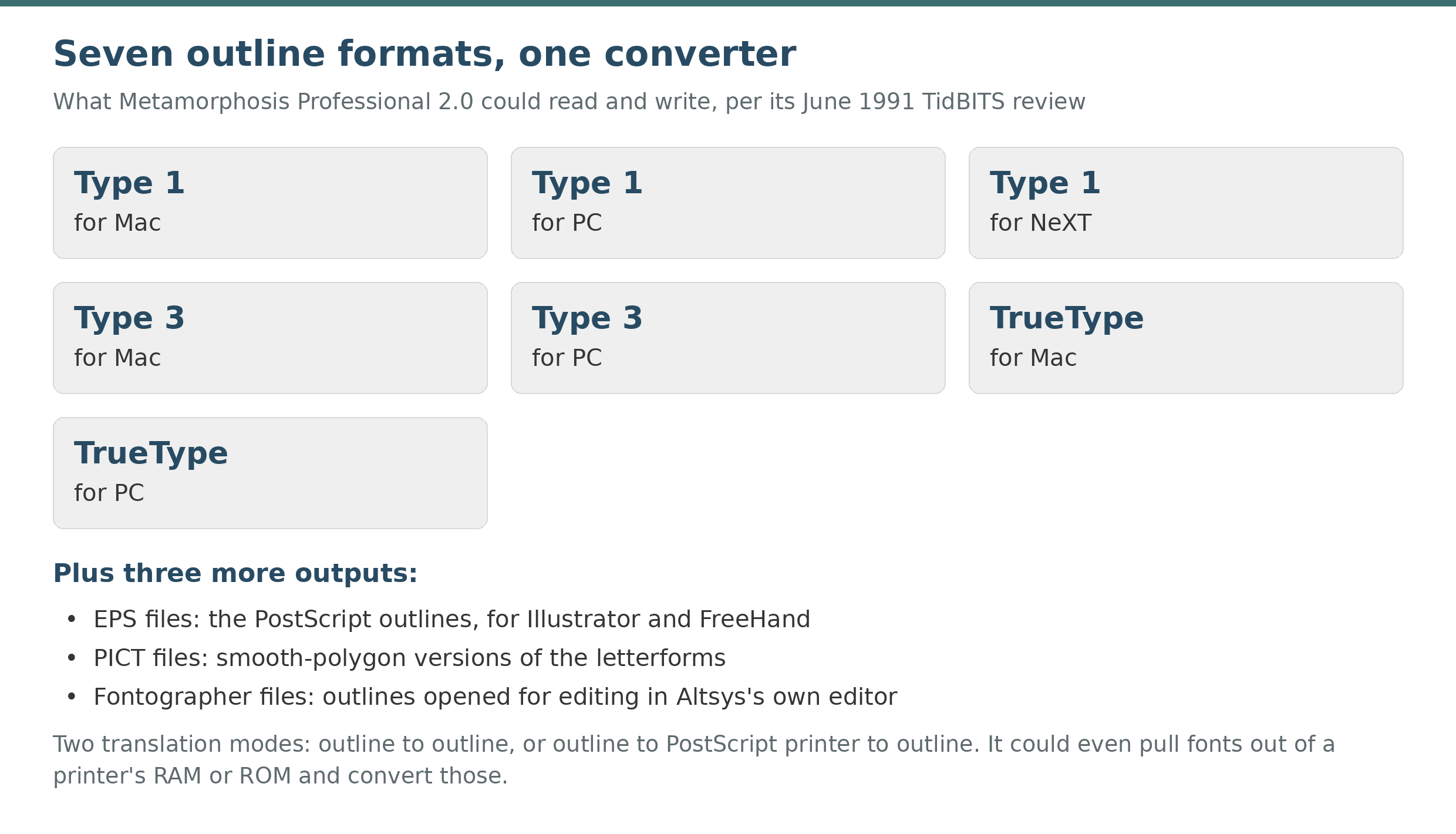
Metamorphosis read seven formats and wrote seven formats, plus outlines for the drawing programs.
It translated two ways. Ordinarily it converted outline to outline, reading one file and writing another. For Type 3 fonts in formats it could not parse, it would download the font to an attached PostScript printer and have the printer send the outlines back, then convert those. It could even convert fonts that existed only inside a printer’s RAM or ROM, a trick Apple’s own Technical Information Library was recommending by June 1990 for retrieving LaserWriter hard disk fonts. For a CD producer facing a thousand-font library, a tool that worked folder after folder was not a convenience. It was the production line.
What it felt like: an AI-generated illustration of a 1992 converter window, made for this article. No capture of Metamorphosis itself survives in the sources we searched, so this is an impression, not evidence.
The fingerprint it left in the files
Metamorphosis signed its conversions. Every TrueType file it produced carries a version string, name ID 5 in the font’s name table, that reads “Altsys Metamorphosis:” followed by the date of conversion. Its sibling did the same: Fontographer output reads “Altsys Fontographer 4.1” plus a date. These stamps were housekeeping, not advertising: a build string written by the tool that last saved the file. Thirty years later they are a font historian’s best evidence, because they survive every copy, repackaging, and change of hands afterward.
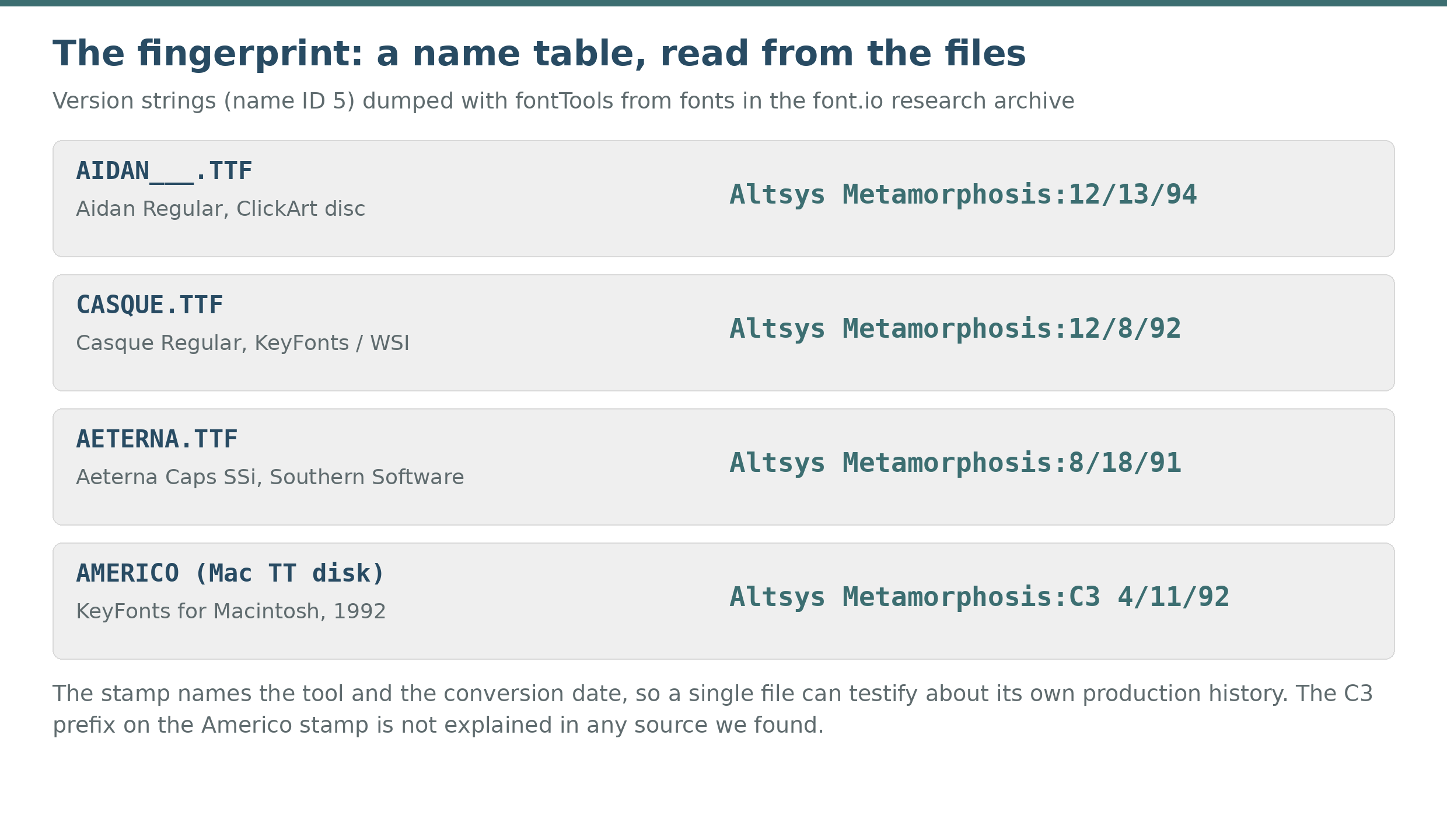
The four stamps each tell a production story, read straight out of the files.
Two sightings from our own shelves show the range. On the ClickArt CD, Bay Animation’s Aidan carries “Altsys Metamorphosis:12/13/94”, a Mac library being converted for a PC disc in December 1994; our ClickArt census is full of its relatives. On the 1992 KeyFonts TrueType disk, Americo reads “Altsys Metamorphosis:C3 4/11/92”, the earliest production line we have traced, from the set our KeyFonts history reconstructs. A researcher reading a stamp learns the tool, the direction of travel (the stamp only appears after a conversion), and the date, and can place a file inside a known production run. Font forensics runs on exactly this kind of residue: our provenance work attributes the toolchain behind a font by reading these name fields first. One more behavior matters. No file in our census carries both stamps. Converting a Fontographer-authored font replaced the editor’s version string with the converter’s, so the last tool to touch a file is the one it confesses to.
How popular was it? We counted.
Anecdotes say Metamorphosis was everywhere. We preferred to count. The font.io research archive holds the big 1990s font libraries on disc: the SoftKey and Southern Software collections, the ClickArt disc, and more. We read the name tables of every unique font file among them, 10,350 files after duplicates were collapsed by MD5, and searched the version and copyright strings for the two Altsys stamps.
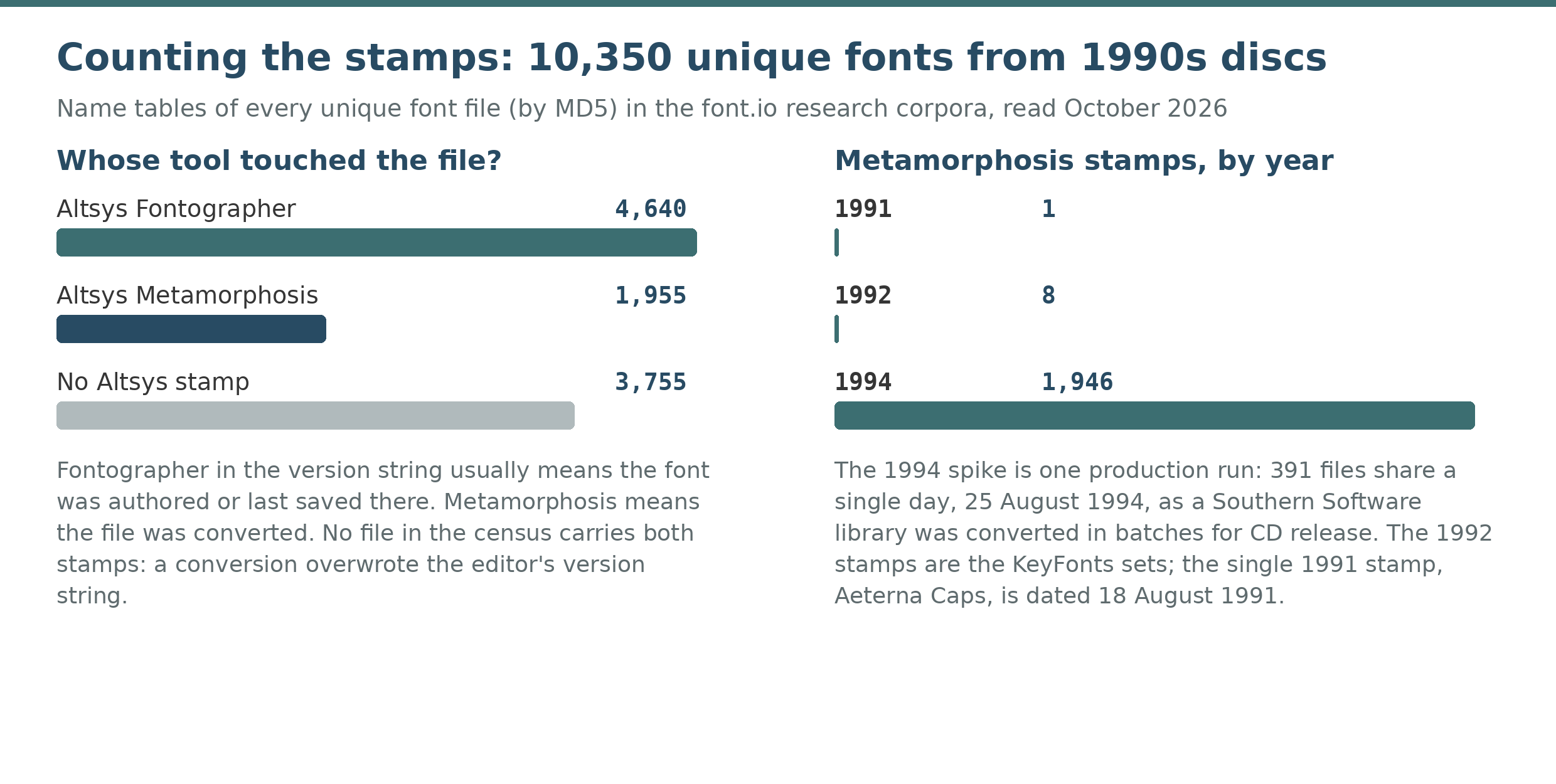
Nearly two of every three unique fonts in the archive passed through an Altsys tool and said so.
The converter alone accounts for 1,955 files, about one in five. Add Fontographer’s 4,640 and Altsys tools touched 6,595 of the 10,350 files, just under two thirds. The dates tell the production story. Only nine Metamorphosis stamps predate 1994: the 1992 KeyFonts sets, and a Southern Software font, Aeterna Caps, converted on August 18, 1991. The other 1,946 are all from 1994, and they cluster on a few late-summer days, 391 files on August 25 alone. That is the signature of a library being converted in batches for a CD release, the font CD economy at work: a single operator running one converter over a hard drive full of Type 1 fonts, against a deadline. Read the scope honestly: these corpora are 1990s CD libraries, which were Metamorphosis’s home market; the census measures its grip on that world, not on every font ever made.
Did conversion change the fonts?
Yes, a little, and the mathematics guarantees it. Type 1 outlines are cubic bezier curves; TrueType outlines are quadratic. A cubic span cannot be rewritten as a single quadratic span exactly, so a converter approximates it with two or more quadratic arcs, adding points and shifting the curve by small amounts. Hinting, the instructions that keep stems even at small sizes, does not translate at all: Type 1 hints and TrueType instructions are different systems, and a converter had to synthesize new ones or ship without. Converting back to Type 1 is kinder to shapes, since quadratics embed in cubics cleanly, but it discards the TrueType instructions.
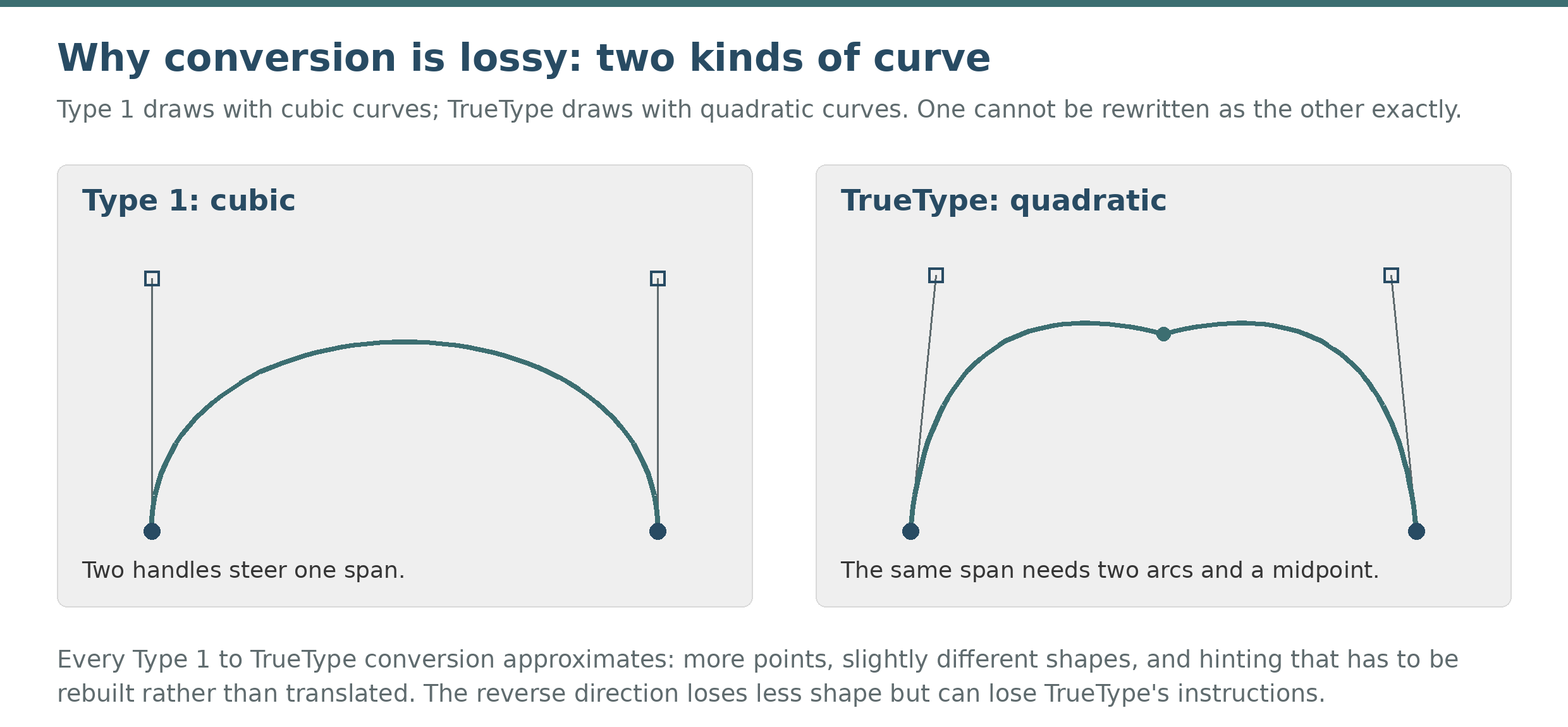
One span becomes two. Multiply by every curve in every glyph in a thousand-font library.
Contemporaries noticed. The comp.fonts FAQ of 1993 carried a standing section asking why converted fonts look so bad, and it listed no free tool that could convert between the formats at all. TidBITS put Metamorphosis Professional head to head with Ares Software’s FontMonger in a “Battle of the Font Converters” in June 1991 and treated both as serious production tools, priced at $149 and $99. The fair summary is that Metamorphosis was the respected end of an inherently lossy trade. Font.io has now run the direct experiment.
Was the 1992 conversion actually any good?
From the 1992 KeyFonts disks we took Americo Italic, whose Type 1 master survives on the PostScript disk, converted that master fresh with fontTools, and compared it glyph by glyph against the TrueType file Metamorphosis Professional 2.04 produced in April 1992: 145 glyphs are shared by all three. The hypothesis going in was that the 1992 job would prove sloppy. It did not.
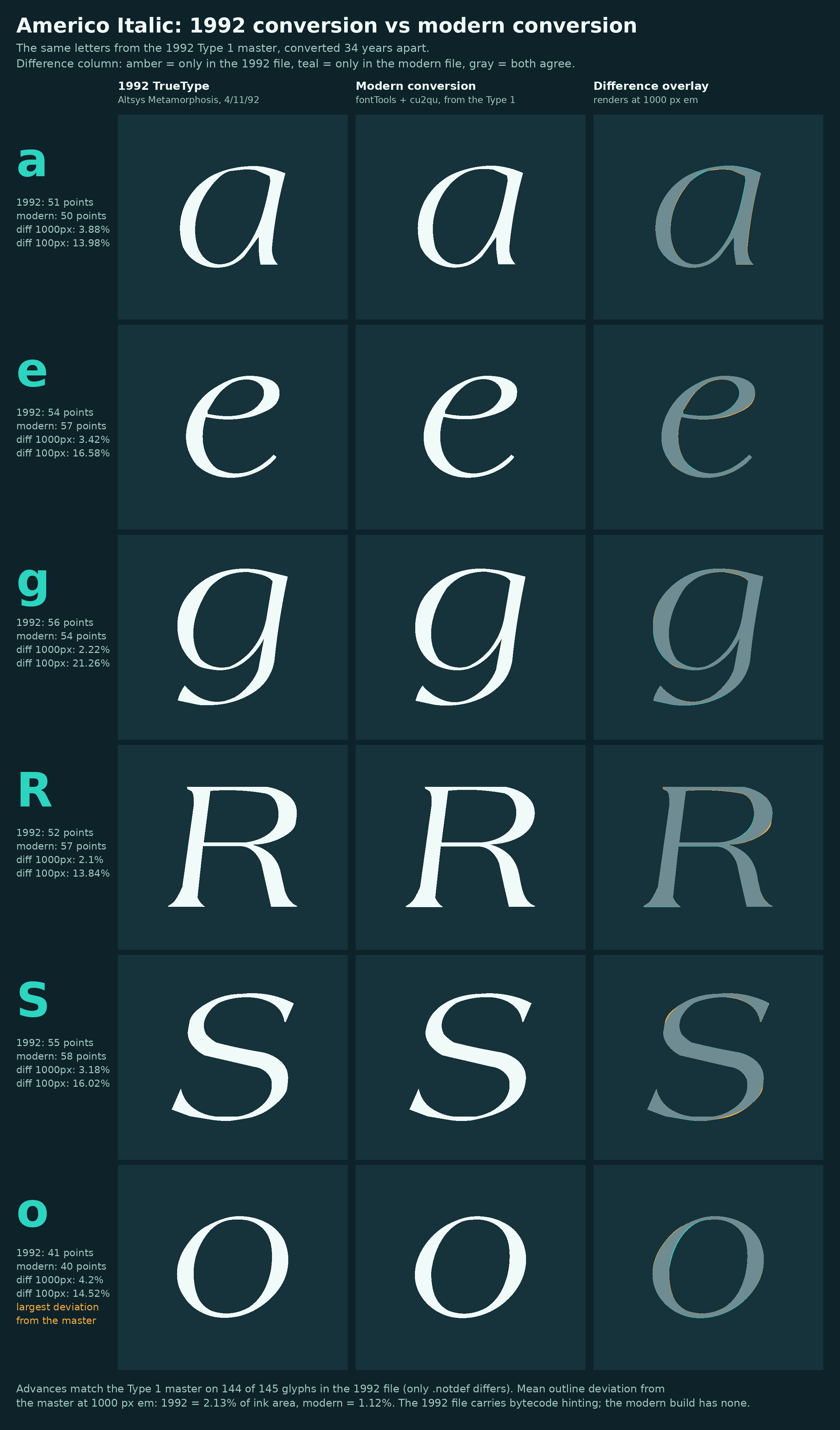
Six glyphs of Americo Italic in three columns: the 1992 Metamorphosis TrueType, a modern conversion from the Type 1 master, and a difference overlay. Gray means both agree, amber is ink only in the 1992 file, and teal is ink only in the modern file.
The 1992 file’s advance widths match the master’s on every real character. The single exception is .notdef: the master’s version is an empty glyph 280 units wide, and Metamorphosis substituted a drawn box 800 units wide, the same substitution it made in the Bold and Outline faces. On outlines the modern conversion is closer, but not by the landslide folklore predicts. Scored at 1,000 pixels per em against a near-lossless reference conversion of the master, the 1992 file deviates 2.13 percent of ink area on average and the modern build 1.12 percent, about half. Its worst glyphs are the round letters, o at 5.82 percent and q at 4.99. The old file is otherwise leaner and more finished: it uses fewer points, 5,631 against 6,122, with identical contour counts on every glyph and points placed at the curve extremes more strictly than the modern default places them, and it carries real TrueType hinting bytecode on 143 of its 148 glyphs, where the modern build carries none. No glyph in either file is collapsed, wobbled, or missing.
So converting from the masters today buys roughly half the outline deviation, and gives up hinting and point economy to get it. The experiment also exposed a mastering error no catalog records: the suitcase slot labeled Americo Regular on the TrueType disk provably contains the Outline design, its name table claiming Regular while its advances and contours match Americo Outline, which is why the test ran on the Italic, with the Bold verified genuine. The name table says one thing; the outlines say another, and the outlines are the evidence.
What replaced it?
Macromedia did. It agreed on October 26, 1994 to buy Altsys for about $71 million in stock, and the deal closed on January 23, 1995. Altsys became Macromedia’s Digital Arts Group, and the little converter that had ridden the format war faded from view inside a company selling web animation. Fontographer slowed after version 4.1, then found a third life: in May 2005 FontLab licensed it from Macromedia and kept developing it, which is why the Altsys editor is still sold today and still covered in our survey of professional font editors. The converter’s job went to FontLab’s TransType and then dissolved into the toolchain itself: FontForge opens Type 1 and writes TrueType as a menu item, and fontTools does it as a library call, for free.
Search interest tells the same story of a job outliving its tool. In Semrush’s US figures for October 2026, “altsys metamorphosis” draws about 20 searches a month, a trivia term. “Fontographer” still draws 210, because the editor still exists. And the task itself now lives under the generic name: “font converter” draws 2,400 searches a month, most of them people holding a font in the wrong format, as a 1991 Mac user did. Metamorphosis lost its name and won its argument. The files it converted are still in circulation, still signing its name in their version strings, one date at a time.
Sources: Luc Devroye’s Metamorphosis page; TidBITS #66 and its converter comparison, June 10, 1991; Apple Technical Information Library article 5707, June 1990; Fontasia, the Altsys newsletter, Fall 1990 (Internet Archive); Wikipedia on Altsys and Fontographer; the Macromedia Wiki’s Altsys and Metamorphosis entries; RoboFont’s Fontographer pre-history. Census and name-table readings are font.io’s own, October 2026.