· tools, history, font forensics
FontMonger: the converter of the freeware era
FontMonger was a font converter and editor sold by Ares Software Corporation starting in 1991 for Macintosh, with a Windows version following in 1992. Its specialty was moving fonts between the era’s warring formats, PostScript Type 1 and TrueType, and between Mac and PC. It also stamped its name into every file it generated, which is why anyone who examines old freeware fonts keeps meeting it: thousands of 1990s font files still carry the unique ID “FontMonger:” followed by the font’s name. In the landscape our guide to how to make your own font maps, FontMonger sits at the converter end: less a drawing desk than the bridge fonts crossed to reach a new format, with just enough editing to change them on the way.

What problem was it solving?
In 1992 the font world was split four ways at once. Adobe’s Type 1 format owned professional publishing. Apple’s TrueType, newly licensed to Microsoft for Windows 3.1, owned the office. Mac and Windows could not use each other’s files. And a fortune in Type 1 libraries sat stranded on the wrong side of every one of those lines.
Conversion was the product. Reviewing FontMonger alongside Atech Software’s rival AllType in January 1993, Compute! magazine catalogued the trick: FontMonger turned Type 1 fonts into TrueType, Type 3, Nimbus Q, and Intellifont files, and could build fonts for Macintosh and NeXT machines besides. If a format existed in 1992, FontMonger probably wrote it.
Editing came second, but it was real editing. The same review notes you could modify character outlines with built-in drawing tools, import EPS artwork into a font file to build decorative letters and drop caps, and export a character to a drawing program, embellish it, and slip it back in. That combination, conversion plus just enough drawing, is the whole story of what happened next.
Why did the freeware scene run on it?
Fontographer, from Altsys, was the professional’s editor, and priced and built like one. FontMonger was the utility within reach, and it made two things easy that had been hard: shifting a commercial font into whatever format your machine wanted, and assembling a new font out of artwork, scans, or another font’s converted outlines.
Nobody bought FontMonger intending to commit typographic history. They bought it to get a font working. But a tool that converts anything to anything, and lets you redraw the pieces, is also a tool for revival and imitation, and the 1990s freeware explosion ran on exactly that. Alan Carr, whose catalog of roughly 120 freeware fonts was built entirely in FontMonger, digitized the most copied display face of the phototype era with it, almost certainly traced from a printed specimen. He was one of hundreds.
What else did Ares bet on?
Ares Software, based in Foster City, California, had a second and stranger idea called FontChameleon. Instead of storing every font as its own 30 to 50KB outline file, FontChameleon kept one master outline file of about 200KB holding generic character descriptions, then generated any specific typeface from a descriptor file of about 2KB. Feed it the metrics of a font you did not own and it would construct a close match. Ares hoped to license the system to operating system makers and printer manufacturers.
It reads today like a rough draft of variable fonts and metric-compatible cloning, thirty years early, and like FontMonger it mostly survives as an idea other people eventually shipped. The company itself did not fade so much as get absorbed: Adobe bought Ares Software, and FontMonger and FontHopper were discontinued on June 6, 1997, with no upgrade path after that. The firm’s people left almost no public record at all, which is its own kind of epitaph: the tool is documented everywhere, its makers almost nowhere.
How can you tell a file passed through FontMonger?
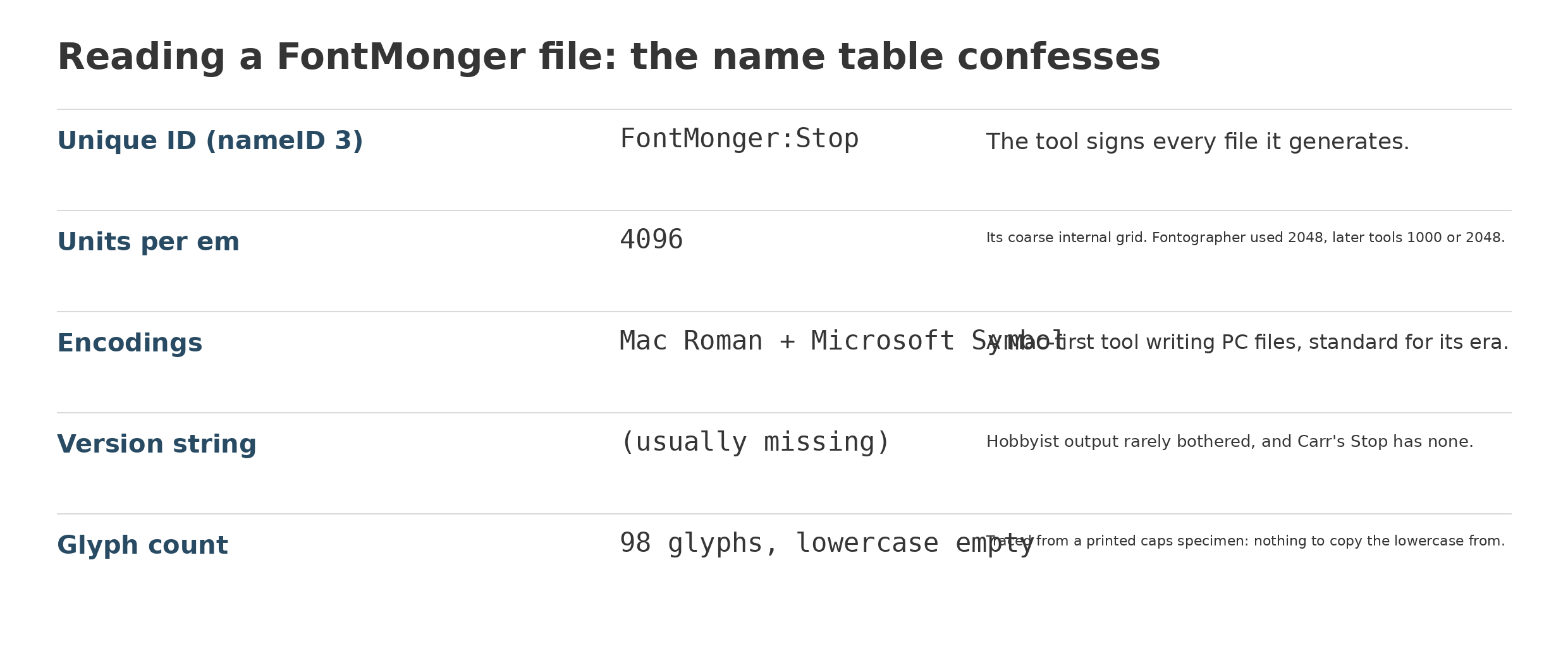
Open the name table. The unique ID (nameID 3) is the confession: “FontMonger:” plus the font name, written when the file was generated. Around it, the supporting evidence lines up:
- A 4096-unit grid. FontMonger built on 4096 units per em, coarser than Fontographer’s 2048. The grid alone dates a file’s tooling.
- Mac Roman and Windows Unicode encodings side by side, the signature of a Mac-first tool writing files for Windows.
- Thin metadata. Version strings are usually absent entirely. Carr’s Stop has none, and no credit to the design’s actual author.
- Character sets that stop where a printed page would. FontMonger files built from specimens carry what the specimen showed. Carr’s Stop has 98 glyphs and a completely empty lowercase: the printed sample he traced was set in capitals.
None of this proves wrongdoing; FontMonger was a legitimate tool doing legitimate conversions all day long. What the fingerprint tells you is process. A file stamped FontMonger was converted or assembled, not drawn natively in a professional editor, and its outlines came from somewhere else: another format, another font, or a printed page. For anyone cataloguing old fonts, that single line in the name table is the difference between a designer and a digitizer.
What survives?
The software itself survives as a disk image: FontMonger for Windows, version 1.0.7, preserved at the Internet Archive from the original November 1992 floppies, logo and all. Its output survives at far larger scale, embedded in the freeware libraries FontSpace and sites like it still serve every day. Ares built a converter. What it actually manufactured was evidence, stamped into a generation of fonts, still legible to anyone who opens the file and reads.