· reference
Broderbund: packaging everyone else's work
The name on the ClickArt box, and on The Print Shop, Carmen Sandiego and Myst, belonged to one of the defining software companies of the early PC era. Broderbund is worth understanding on its own terms, because its way of operating explains a whole shelf of software, fonts included: this was a company whose genius was not making things. It was finding things other people had made, packaging them better than anyone, and owning the retail shelf they were sold from. Here is how that worked, and how it ended.
A family business, on purpose
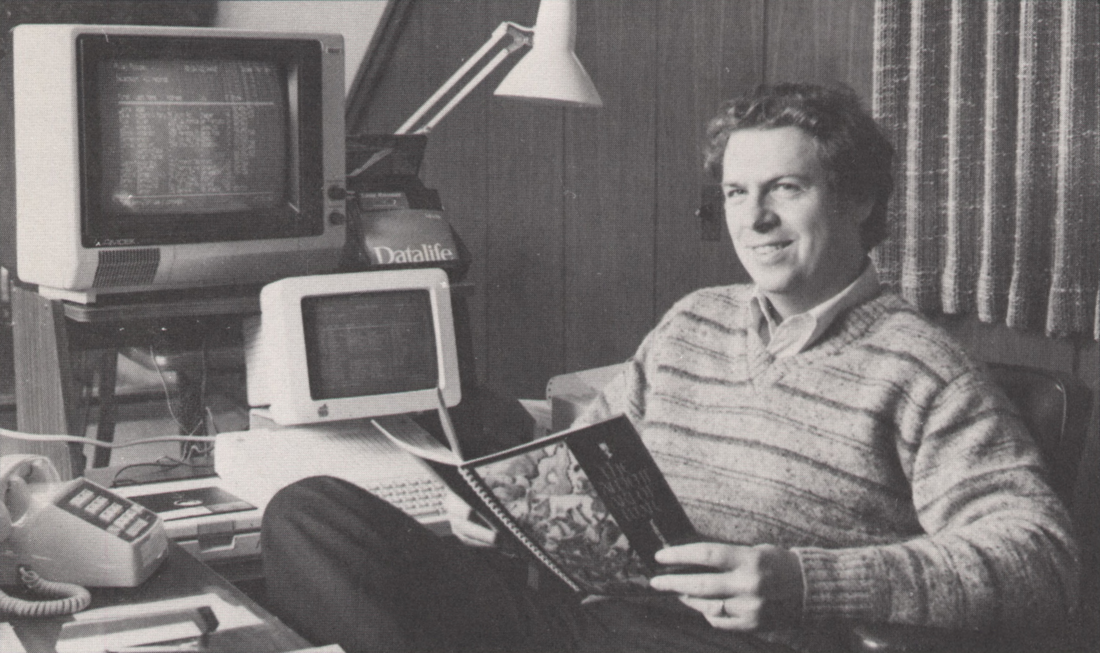
Broderbund was founded in 1980 in Eugene, Oregon, by brothers Douglas and Gary Carlston. Doug was a lawyer who programmed; his strategy games, the Galactic Saga series, had sold modestly through outside publishers, and the brothers started the company to market his work themselves, with early money from family and friends. Their sister Cathy joined in 1981. The name was a deliberate construction, Scandinavian “brøder” (brother) plus German “bund” (alliance), with the ø added partly to distance it from an unrelated South African organization of a similar name.
The publisher pattern was there from the start. An early distribution deal brought Japanese software from StarCraft to American shelves. The first big hits were other people’s games published under the Broderbund label: Dan Gorlin’s Choplifter (1982) and Doug Smith’s Lode Runner (1983). Broderbund developed in-house too, but its center of gravity was always the catalog, not the workshop. By early 1984 it was tied as the world’s tenth-largest microcomputer software company, and by 1992 it had sold 13 million copies of its titles.
The Print Shop: the model perfected
Nothing shows how Broderbund operated better than The Print Shop (1984), the greeting-card, sign and banner program that taught home computers to be useful. It was created by David Balsam and Martin Kahn of Pixellite Software. They were not Broderbund employees; Broderbund published their program, and reportedly earned them tens of millions in royalties while it became the company’s most profitable product for over a decade.
The numbers were absurd for the time: over 800,000 copies by 1987, a million by 1988, 4 percent of the entire United States software market in 1987, and 29 percent of Broderbund’s revenue in fiscal 1992. When a rival, Unison World, shipped a lookalike called PrintMaster, Broderbund sued, and the 1986 ruling that a program’s look and feel could be copyrighted became a landmark of software law. The asset being defended was not code Broderbund wrote. It was the package: the design, the flow, the shelf presence.
Carmen Sandiego (1985) extended the same logic into education, becoming a franchise with television shows and books. Myst (1993) was the pattern at its peak: a strange, beautiful CD-ROM game made by Cyan, a small studio in Spokane run by brothers Rand and Robyn Miller, which Broderbund published, promoted and distributed into the best-selling PC game in the world, a title it held until The Sims passed it in 2002. Its sequel Riven (1997), again Cyan’s work, was the best-selling game of its year.
Empire years: buying brands
By the mid-1990s Broderbund was doing to others what the market would soon do to it: acquiring. It bought PC Globe in 1992. In January 1997 it took full control of Living Books, its children’s book joint venture with Random House. And on August 6, 1996, it completed the acquisition that matters most to this site’s readers: T/Maker Company, creator of ClickArt, for about $19.9 million, a figure recorded in Broderbund’s own SEC filing.
T/Maker made Broderbund the owner of the biggest name in clip art, and the ClickArt line became a font business too: the ClickArt Fonts series (four editions through the following decade), each one a licensed library in a Broderbund box. Our file-by-file inventory of ClickArt Fonts 2 shows the model in cross-section: 2,638 font files from Bay Animation, MicroLogic and Weatherly Systems, a Font Browser program and a famous name supplied by Broderbund, and not one font designed by the company itself. In 1999 the Broderbund unit licensed over a million clip art and photographic images from Corel in a single deal. Content was inventory; the brand was the business. Annual revenue reached about $190 million by 1997. Our guide to the era’s font CDs puts the ClickArt discs in their shelf context.
The roll-up arrives
The end came quickly, and it came through the same consolidation Broderbund had practiced. In 1995 Broderbund tried to buy The Learning Company and was outbid by SoftKey, which paid $606 million and took The Learning Company’s name. On June 22, 1998, that company bought Broderbund for about $420 million in stock, and fired 500 Broderbund employees the same year, 42 percent of the workforce, closing the Petaluma plant.
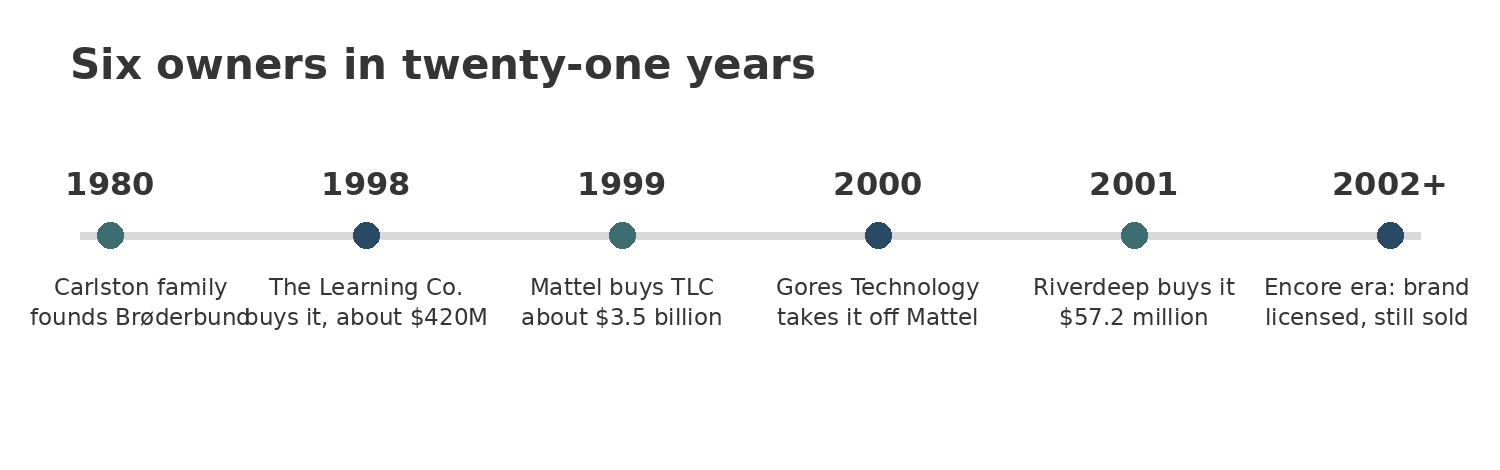
In 1999 Mattel bought The Learning Company for roughly $3.5 billion, one of the notorious acquisitions of the era; the losses forced out Mattel’s CEO and Mattel handed the whole division to Gores Technology Group in September 2000. Gores sold the games (Myst among them) to Ubisoft, and in 2001 sold Broderbund’s education assets for about $40 million. The Broderbund name followed in a separate deal with the Irish publisher Riverdeep in August 2002, at $57.2 million, about an eighth of what the company had fetched in 1998. Riverdeep’s line eventually passed to Houghton Mifflin Harcourt, which offered the Broderbund brands for license in 2017. The products themselves never stopped selling. Encore, Inc. publishes the Broderbund line under license to this day (spelling the name with a plain o), and The Print Shop and ClickArt collections still sit on the shelf Broderbund built.
The record
What remains of the company sits in Rochester, New York. The Strong, the national museum of play, holds the Broderbund Software collection at its Brian Sutton-Smith Library and Archives of Play: fourteen archival boxes of corporate records donated by Doug Carlston in January 2014, correspondence, minutes, sales reports, product development notes and internal newsletters spanning 1980 to 1998, alongside a donation of the software itself.
It is a fitting archive, because Broderbund’s real product was never any single program. It was a way of doing business that the whole industry now takes for granted: license excellent content, package it under a trusted name, and own the customer’s shelf. The fonts on its most famous font CD follow the formula exactly, which is why the credit lines inside those files name three other companies. The name on the box was the one thing Broderbund ever had to make itself, and it made that very well.