· reference
The font lawsuit bench: what the cases decided
Between 1993 and 2023, American courts built a bench of font decisions. Foundries that sued each other got rulings: a contract judgment behind the Windows core fonts, two Chicago technology trials, one name injunction known only from a book. Foundries that sued customers over license scope got settlements, every time.
The bench, by claim type
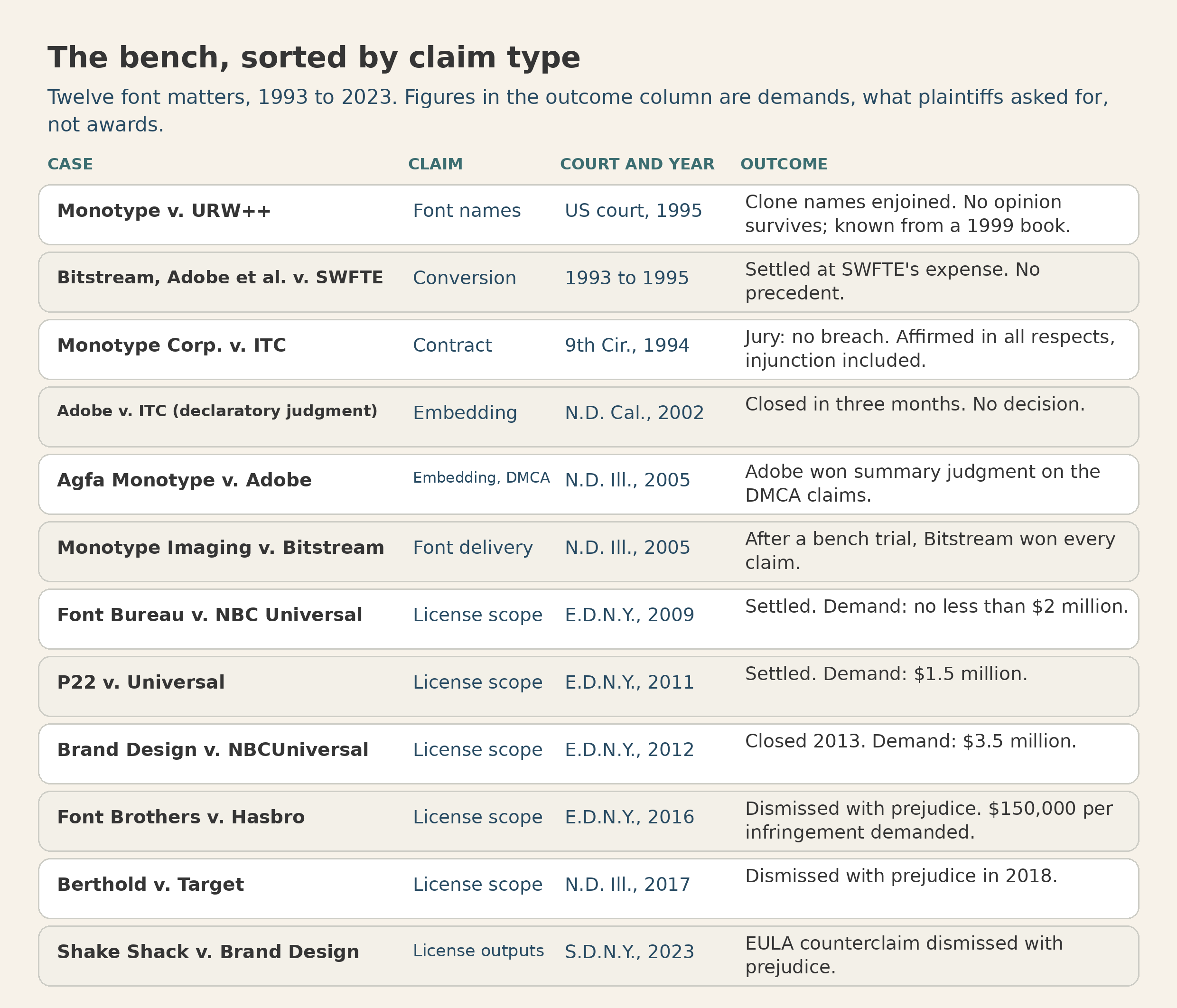
Sorted by claim, the bench has four rows: names, contract, technology, license scope. May a clone borrow the original’s name? What did a foundry promise in 1979? Do format tools infringe by existing? Did a customer’s use outgrow its license? The first three rows carry judges’ signatures. The fourth carries settlements and silence.
One cast member recurs: Chicago lawyer Paul F. Stack argued the 1994 contract case, sent the 2002 embedding letters, and was plaintiffs’ counsel in both 2005 technology rulings.
Demand, settlement, or judgment?
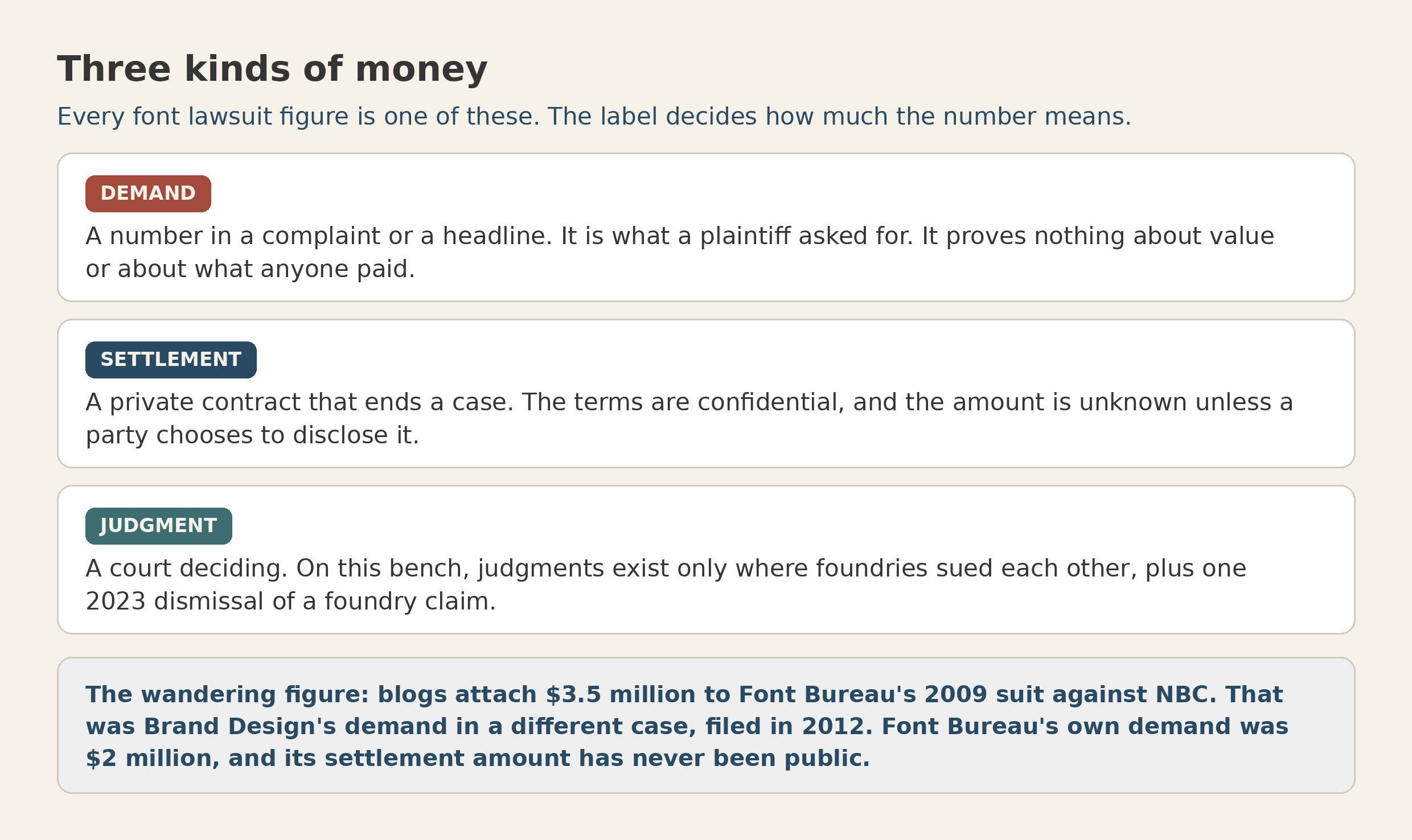
A demand is what a complaint asks for; it proves nothing about value. A settlement is a private contract whose terms are almost never public. A judgment is a court deciding; on this bench they exist only where foundries sued each other, plus one dismissal in 2023.
The cautionary tale is a wandering figure: the $3.5 million blogs attach to Font Bureau’s 2009 NBC suit was Brand Design’s demand in a 2012 case. Font Bureau demanded $2 million, and its settlement has never been disclosed. Every figure below is labeled.
Can a lawful clone carry an unlawful name?
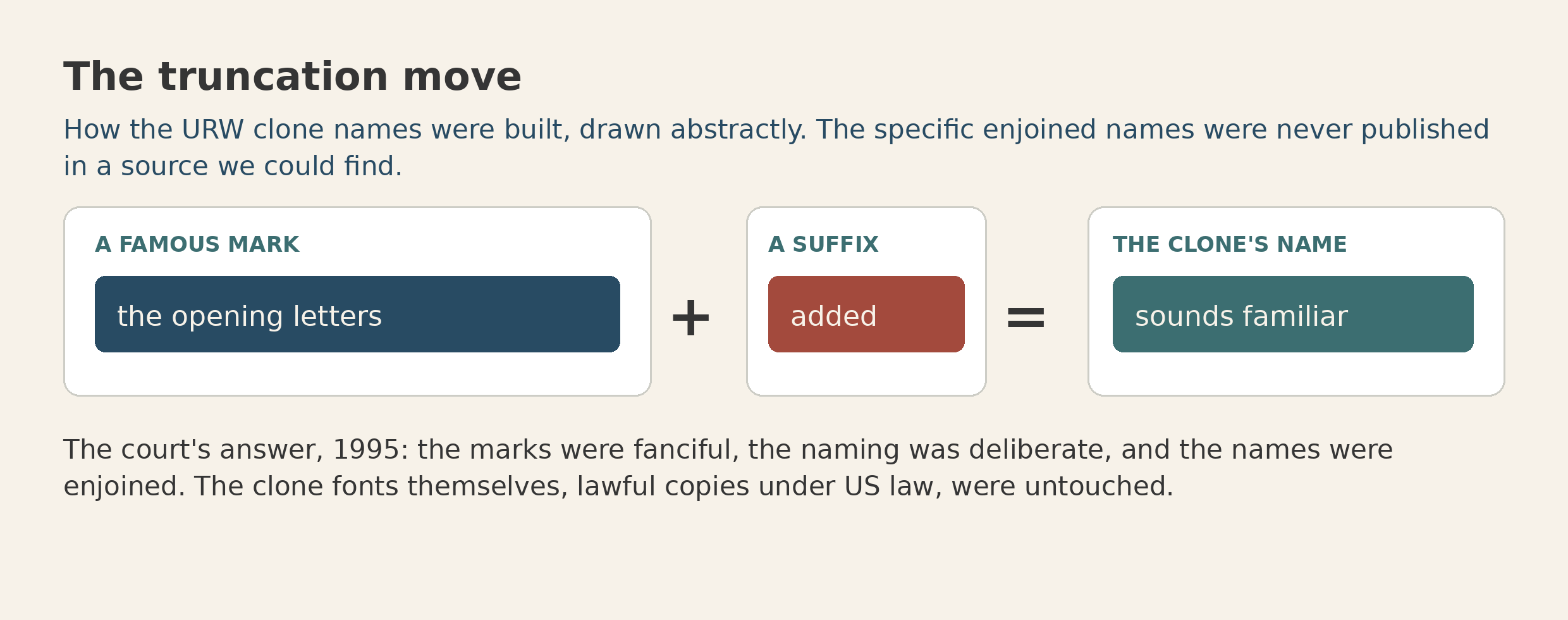
URW of Hamburg sold clones of Monotype typefaces, lawful in the United States, under names built from the opening letters of Monotype’s marks plus a suffix, which was not. In 1995 a court held the marks fanciful, the strongest trademark category, found deliberate confusion in the naming, and enjoined the names. The clone fonts were untouched. The doctrine is in our guide to font trademarks and design patents; this is its only font-versus-font case.
No published opinion, caption, or docket survives. The holding comes through Lawrence Graham’s 1999 book Legal Battles that Shaped the Computer Industry, and the sentence it preserves: “the purloining of the first part of a well-known trademark and the appending of it to a worthless suffix is a method of trademark poaching long condemned by the courts.” We report it as a holding preserved in a book, not an opinion we have read.
The same era’s other clone fight decided even less. From 1993 to 1995, Bitstream, Adobe, and more type companies sued SWFTE International, a Delaware converter house, over its conversion and renaming tools. It settled at SWFTE’s expense, with no precedent, leaving whether an editor pass makes a copy for Adobe v. Southern Software, the case at the center of our font copyright law hub.
Who owns a metric-compatible substitute?
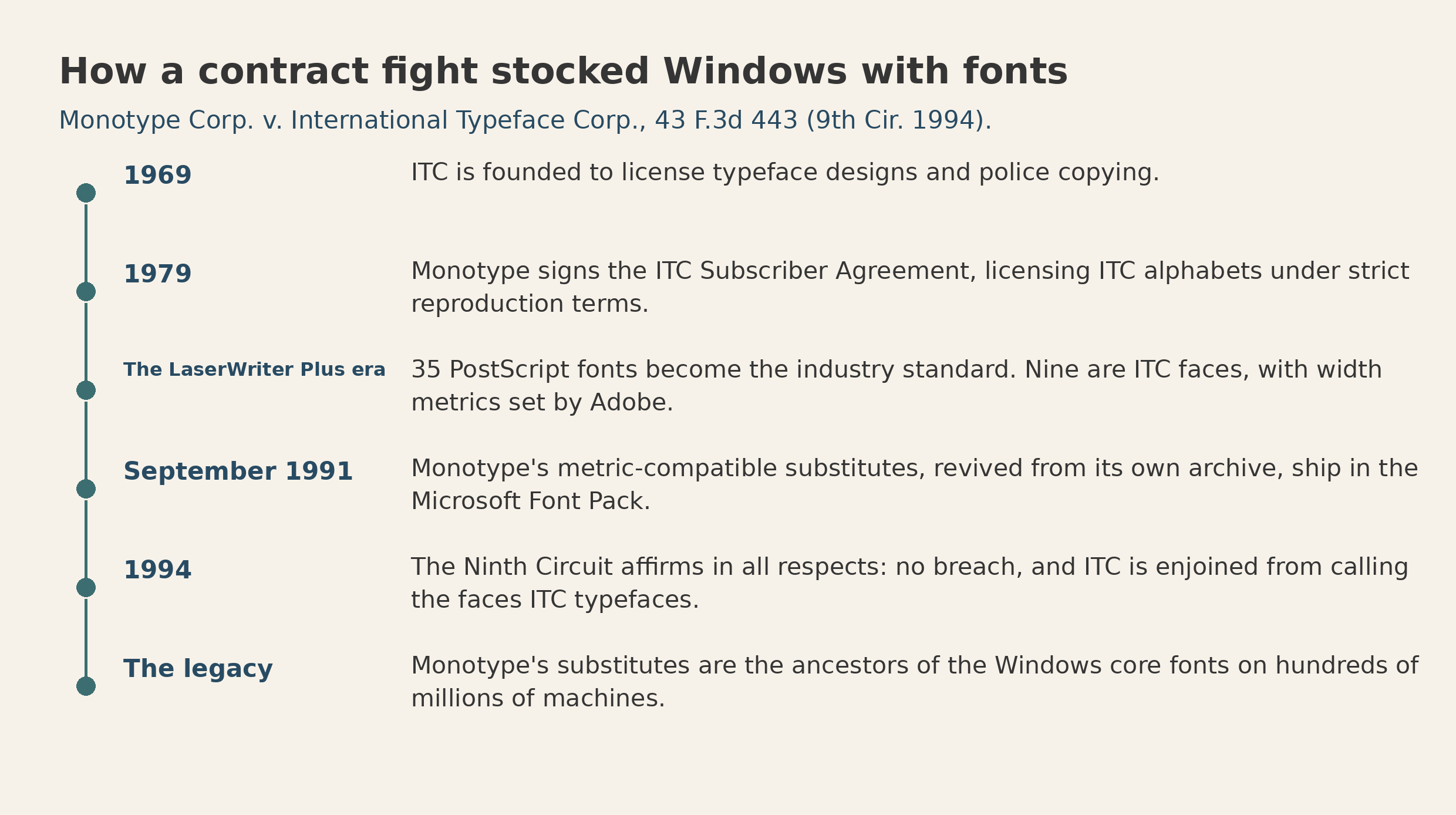
ITC was founded in 1969 to license typefaces. Under its 1979 Subscriber Agreement, Monotype licensed ITC alphabets and promised to reproduce them only from ITC artwork, never offering a weight or version ITC did not sell.
Then the LaserWriter Plus made 35 PostScript fonts the standard, nine of them ITC faces with Adobe-set width metrics. Microsoft wanted a TrueType set for Windows with identical metrics, so documents would print the same on either system. ITC’s royalties pushed it elsewhere. Monotype supplied substitutes revived from its own pre-ITC archive, shipped in the Microsoft Font Pack in September 1991: the ancestors of the Windows core fonts.
In court, ITC argued that a metric-matched lookalike is a “version” whatever its maker calls it. A jury found no breach. The district court enjoined ITC from calling Monotype’s faces ITC typefaces to the trade, and the Ninth Circuit affirmed in all respects in 1994. Copyright could not reach the letterforms, so everything turned on two words defined in 1979: “Alphabet” and “version.”
Is an embedding bit a DMCA lock?
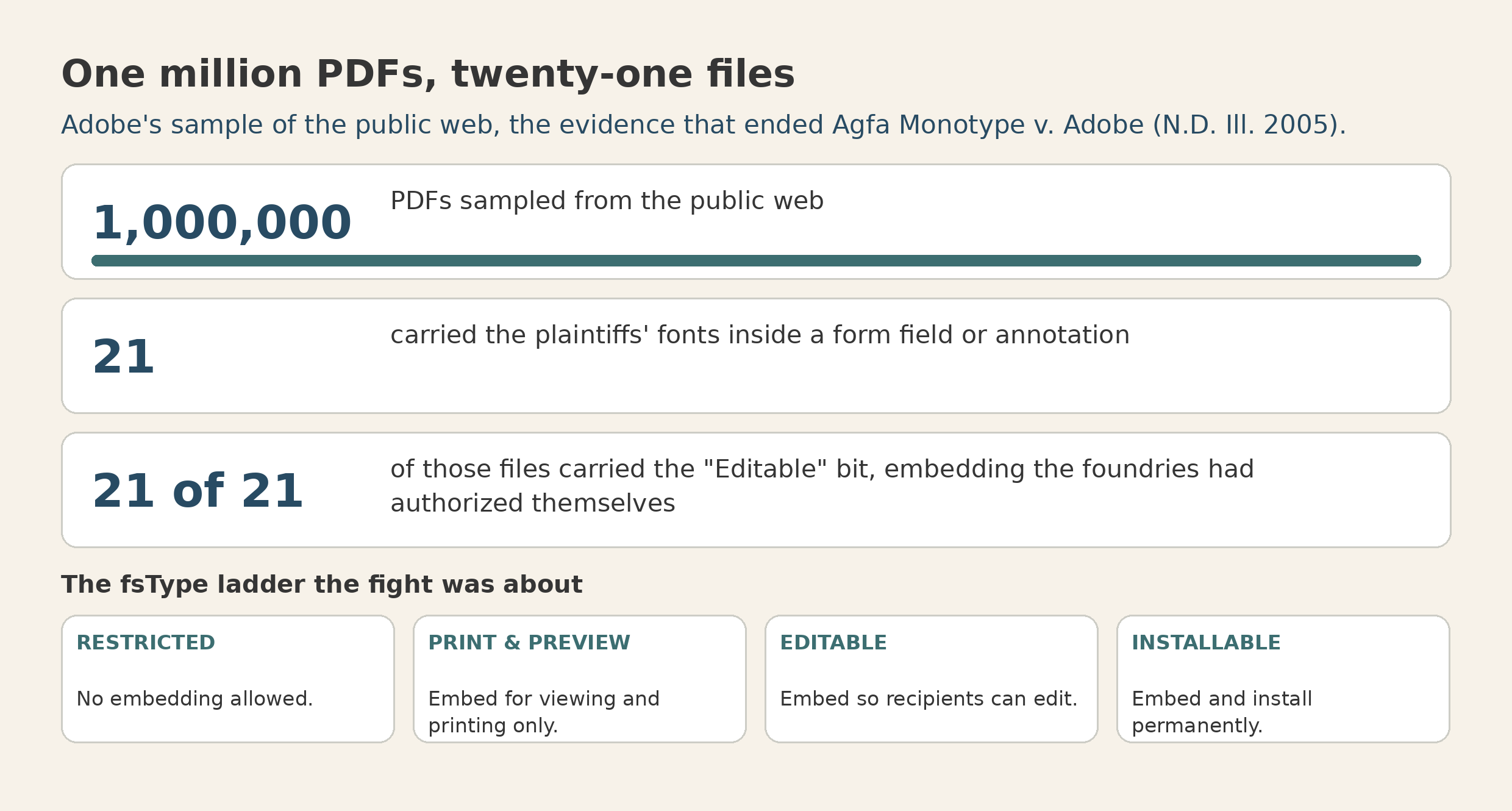
The fsType bits in a font’s OS/2 table tell software how the font may travel inside a document: restricted, print and preview, editable, or installable. Our fonts in PDF guide covers the mechanics. In 2002, the bits became a legal theory. Counsel for Monotype and ITC demanded Tom Murphy, a Carnegie Mellon student and free font designer, remove his Embed utility, which reset his own fonts’ bits. Agfa Monotype publicly defended the theory that the bits were a DMCA technological measure. Murphy refused. No suit followed, and the tool stayed up.
Adobe forced the question, suing ITC for a declaratory judgment in California in September 2002; it closed that December with no decision. The merits arrived in the foundries’ own suit, Agfa Monotype v. Adobe (N.D. Ill. 2005), over Acrobat 5.0’s form feature, which embedded fonts where the foundries said the bits forbade it. Adobe won summary judgment on the DMCA claims: its marketing never sold Acrobat as a circumvention tool, and knowing a bad outcome is possible is not designing for it. The evidence was worse than the law. Adobe’s sample of a million public-web PDFs found 21 carrying the plaintiffs’ fonts in a form field or annotation, every one bearing the “Editable” bit the foundries had set.
When is a delivery system an infringement business?
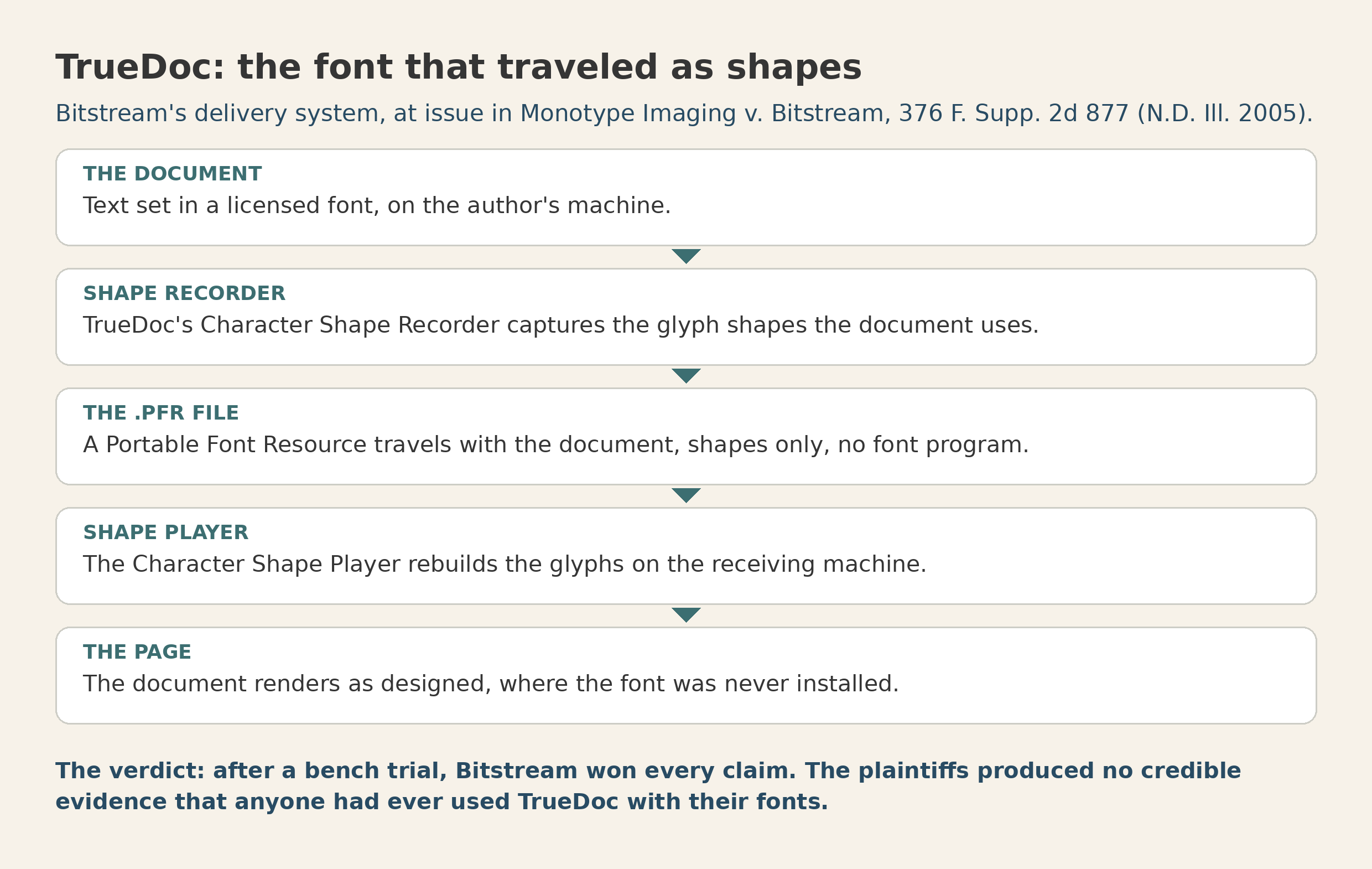
Bitstream’s TrueDoc solved a 1990s problem: a document should look right where its font was never installed. Its Character Shape Recorder captured glyph shapes into a Portable Font Resource file; a Character Shape Player at the other end rebuilt them. TrueDoc could technically process any foundry’s fonts; in 2003 Monotype and ITC sued over that capability, alleging copyright, trademark, and DMCA claims.
Capability turned out not to be liability. Partial summary judgment followed in April 2005, a bench trial in June, and on July 12 a finding for Bitstream on every claim. The plaintiffs had produced no credible evidence that any licensee had ever used TrueDoc with their fonts, or that Bitstream knew of such use. Their 1998 internal test, which had cleared TrueDoc, did not help. Every converter, subsetter, and preview renderer today operates inside that proof rule: show an actual infringing use.
What happens when foundries sue their customers?
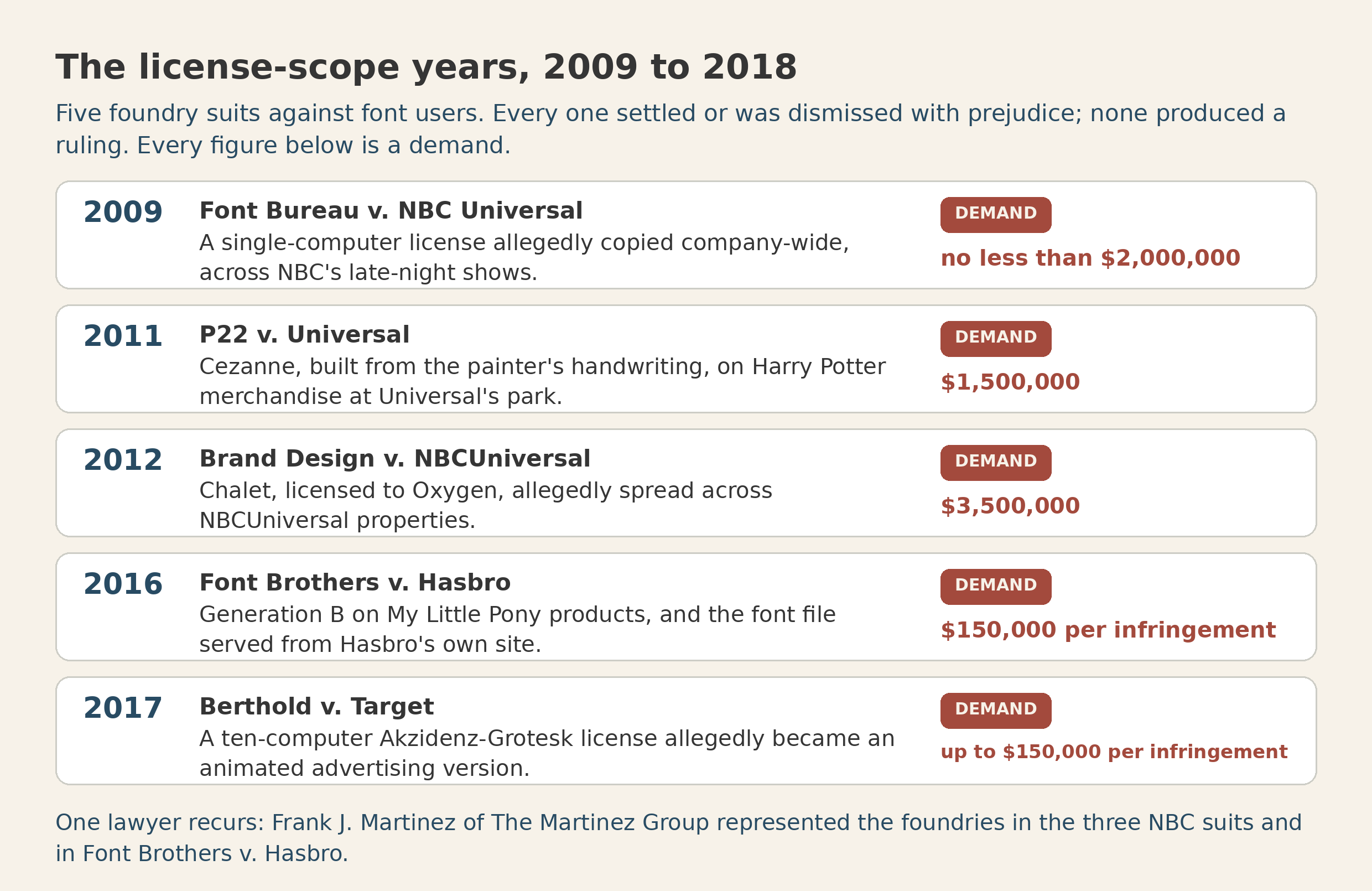
After 2005 the defendants changed: foundries stopped suing each other and started suing customers whose use had outgrown a license. One Brooklyn lawyer, Frank J. Martinez of The Martinez Group, represented the foundry in case after case.
NBCUniversal was sued three times. Font Bureau (2009) alleged a single-computer license had been copied company-wide and used in promoting NBC’s late-night shows, demanding no less than $2 million. P22 (2011) alleged its Cezanne, built from the painter’s handwriting, appeared on Harry Potter merchandise at Universal’s park; the $1.5 million demand asked the court to destroy the merchandise. Brand Design (2012) alleged its Chalet, licensed to Oxygen, had spread across NBCUniversal; its demand was the famous $3.5 million.
Font Brothers v. Hasbro (2016) targeted Generation B on My Little Pony products and the font file on Hasbro’s own servers, demanding $150,000 per infringement. Berthold v. Target (2017) alleged that a ten-computer, internal-use Akzidenz-Grotesk license had become an animated version built for Target’s advertising by its outside design firm.
Every one settled or was dismissed with prejudice. None produced a ruling on whether the use infringed; the credible threat was the product. The line taught buyers the four tripwires: seat counts, subsidiary boundaries, merchandise exclusions, and files handed to outside firms.
Can a license police what the glyphs print?
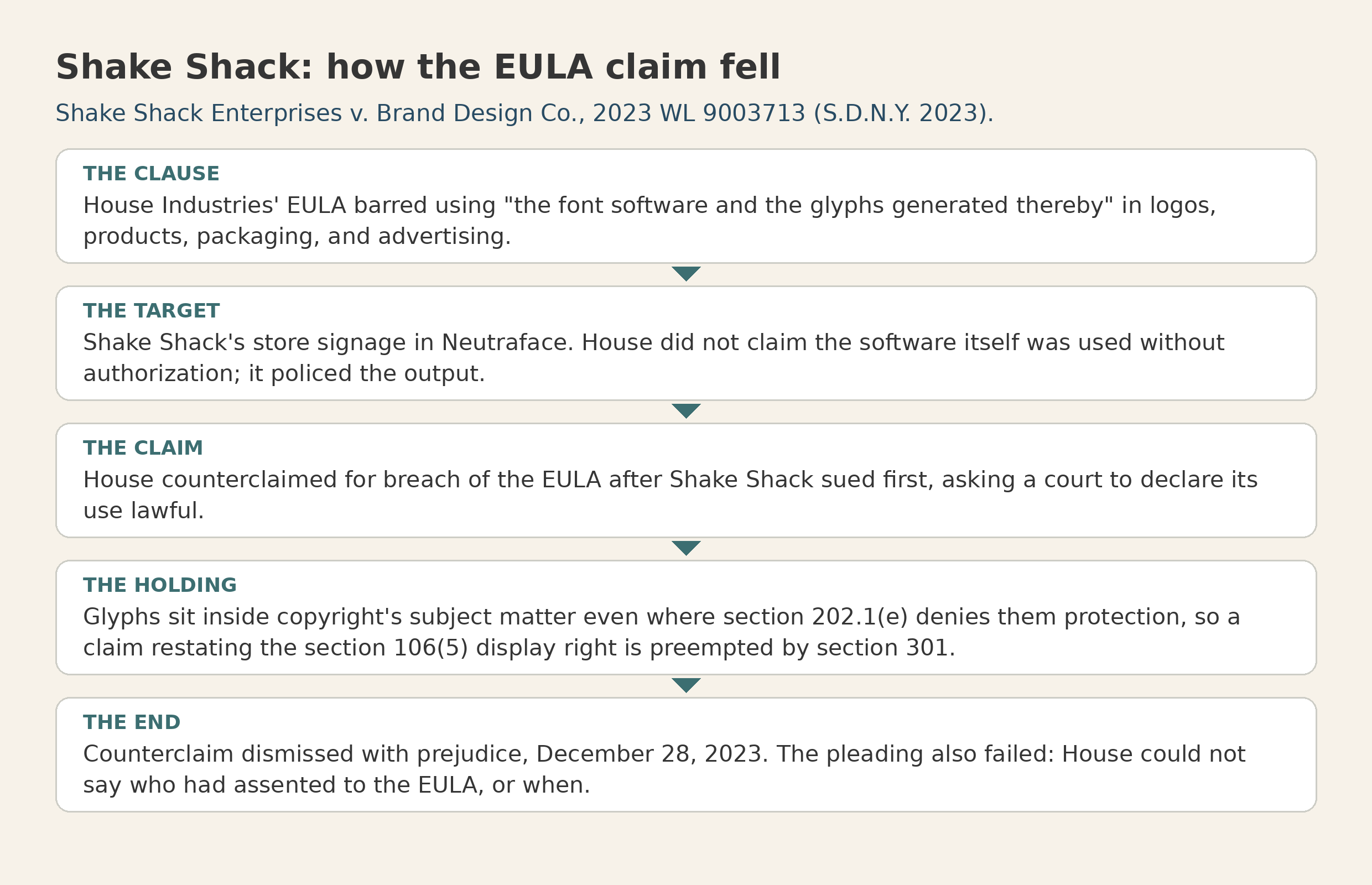
The bench’s only modern decision began with the customer suing first. Shake Shack asked a court to declare its use lawful after House Industries accused it of misusing Neutraface on store signage. House counterclaimed under a EULA barring use of “the font software and the glyphs generated thereby” in logos, products, packaging, and advertising. House did not claim the software itself was used without authorization; it policed the output.
On December 28, 2023, the Southern District of New York dismissed the counterclaim with prejudice on two grounds. House could not identify who at Shake Shack had assented to the EULA, or when. And the claim was preempted: the glyphs sit within copyright’s subject matter even though 37 CFR 202.1(e) denies typefaces protection, so a contract claim restating the section 106(5) display right is preempted by section 301.
One district court’s reasoning is not settled national law, and the pleading failure disposed of the claim by itself. It remains the first modern decision limiting license overreach into outputs. The 1994 case said draft your definitions carefully; 2023 answered that careful drafting cannot contract around the Copyright Act’s allocation.
The bench’s lesson is about evidence, not drama. The decided cases turned on contract definitions, marketing copy, a million-file sample, and a use nobody could prove. The undecided ones turned into checks nobody can see. Font law’s loudest numbers are the ones no judge ever reviewed.
General information, not legal advice.