· reference
The embedding wars: when a bit became a court case
From 2002 to 2005, Monotype, ITC, and Agfa Monotype argued that a font’s embedding bits, a small permission field in its OS/2 table, were a DMCA technological measure, making tools that changed them contraband. A student defied the letters, Adobe sued first, and the one court to reach the merits ruled for Adobe.
What is an embedding bit?
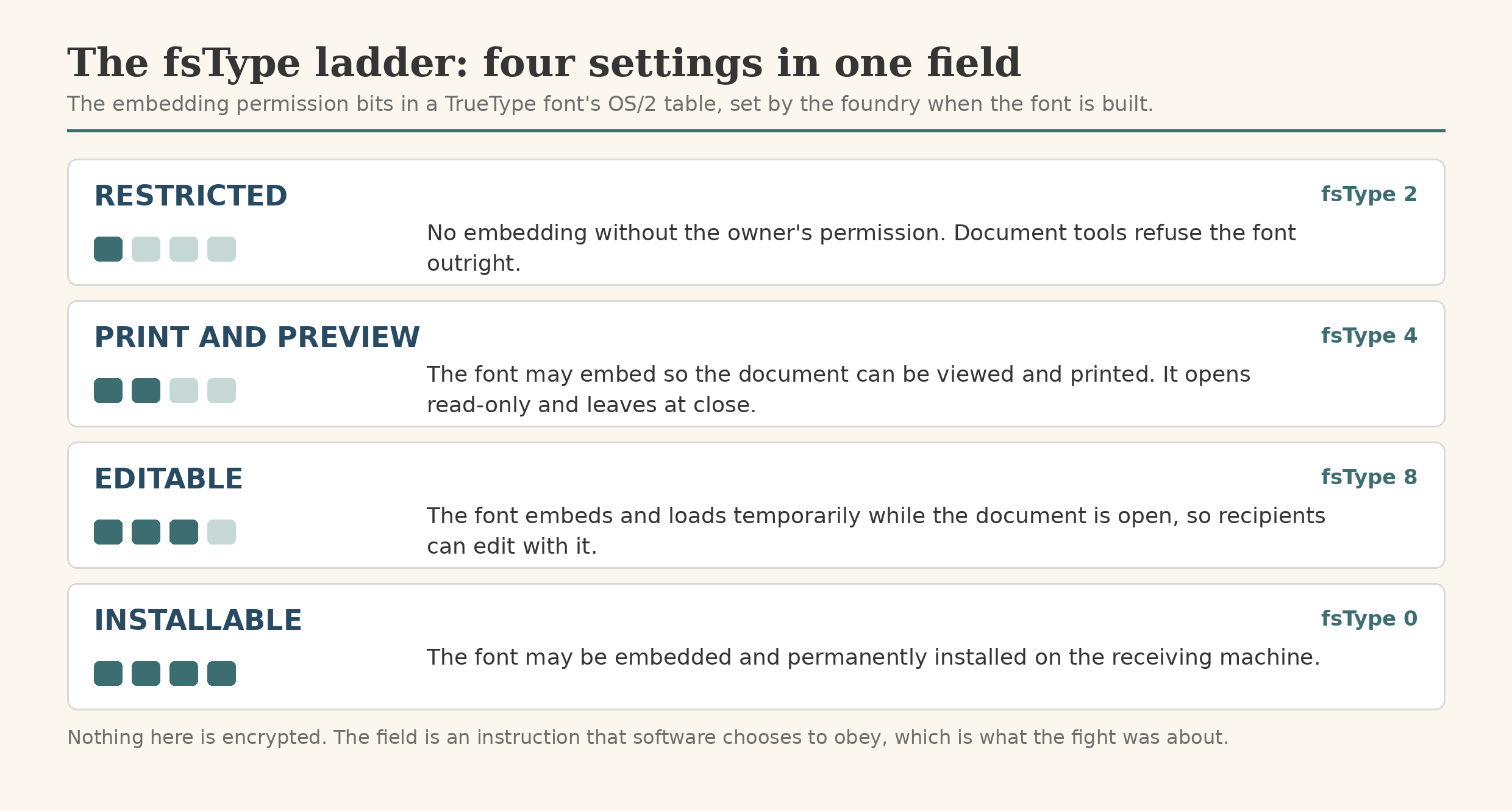
Every TrueType font carries an OS/2 table, and in it a field called fsType: the foundry’s standing instruction for how the font may travel inside a document. Restricted (value 2) forbids embedding. Print and Preview (4) lets the font embed for viewing and printing only. Editable (8) lets it embed so recipients can edit the document with it. Installable (0) lets it embed and be permanently installed at the other end. The foundry sets the field at build time; editors expose it as a setting; document software reads it before embedding anything. Our fonts in PDF guide covers how that obedience works in practice, down to the tools that refuse a restricted font outright.
Two properties of the field matter for everything that followed. It enforces nothing by itself: nothing in the font is encrypted, the file copies like any other file, and its fsType value is readable by anyone. The system runs on obedience by software, not on locks. And changing the field is trivial: it sits at a known place in the file, and a small utility can rewrite it in bulk. That is all Tom Murphy’s Embed program did. Its descendant on this site is our Font Embedding Fixer, which performs the same rewrite in your browser.
Section 1201 of the DMCA supplied the legal frame: it forbids circumventing a technological measure that effectively controls access to a copyrighted work, and separately forbids distributing technology primarily designed to do the circumventing. Cast the bit as such a measure, and a tool that resets it becomes contraband. That was the foundries’ theory. No court ever decided that flipping an embedding bit violates section 1201; the one time the theory reached a judge, it lost.
Who got the letters?
Tom Murphy, who publishes as Tom 7, was a Carnegie Mellon student and a prolific free font designer. In 1997 he noticed his own fonts disallowed embedding, a default his font editor had set, and a pointless restriction on fonts he gave away. He wrote Embed to reset all their bits at once, then posted it for other free font developers.
On January 30, 2002, a letter arrived from Paul F. Stack of Stack & Filpi in Chicago, for Agfa Monotype and ITC: distributing Embed infringed the foundries’ federal copyrights, exposing Murphy to statutory damages, an injunction, and attorneys’ fees. He was to remove the program. Murphy answered the same day: his page contained none of their copyrighted material, and he asked Stack to “explain how precisely I am violating your clients’ copyrights.”
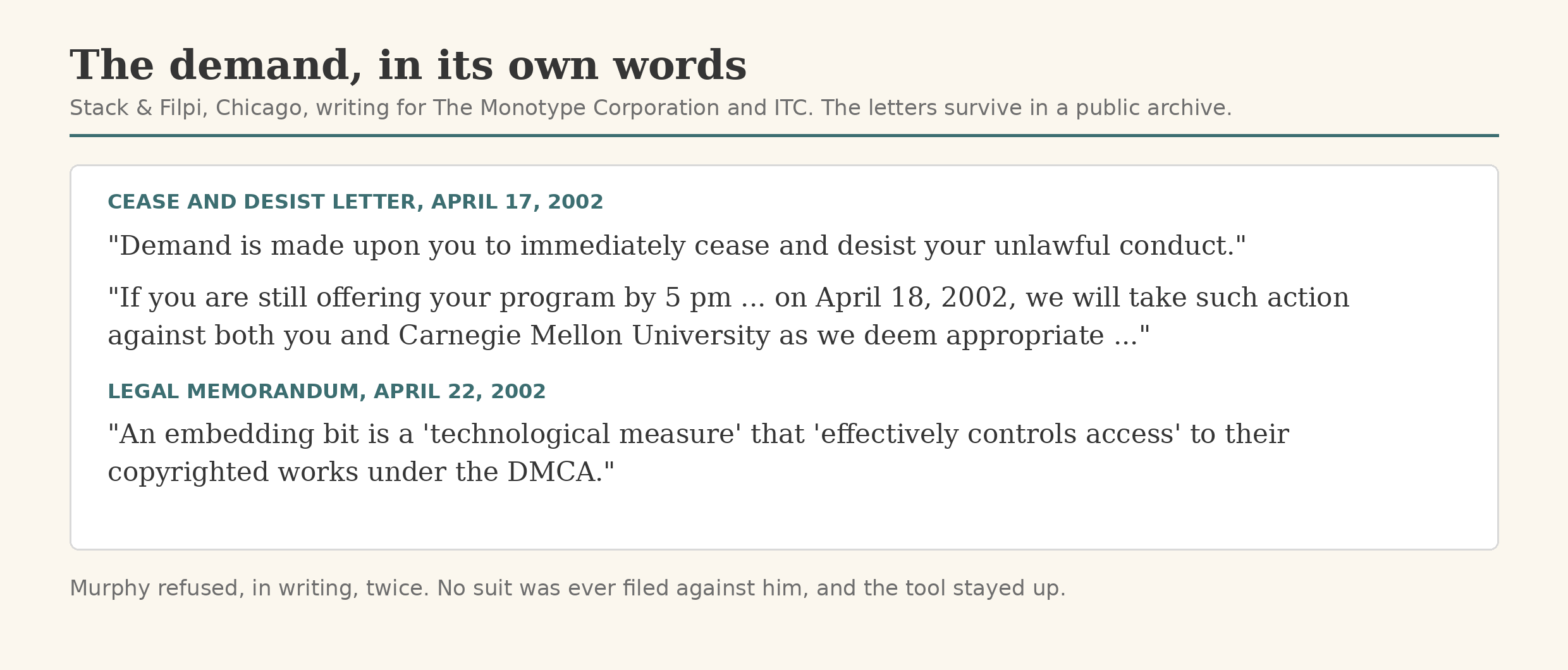
The explanation took three months and arrived with a deadline. On April 17, Stack wrote again, now for The Monotype Corporation and ITC, demanding Murphy cease and desist by 5 p.m. the following day, after which the foundries would act against both Murphy and Carnegie Mellon University. Murphy refused in writing: he would not remove the program unless convinced he was breaking the law, or ordered to by a court. He forwarded the letter to a cease and desist clearinghouse, and colleagues volunteered to host copies. On April 22, Stack sent a legal memorandum arguing in full: an embedding bit is a technological measure that effectively controls access, Embed’s use is a clear DMCA violation, and statutory damages run from $200 to $2,500 per act of circumvention. Murphy’s written rebuttal, three days later, went to the statutory definition: the bits require no information, process, or treatment to gain access, and fonts stay fully usable and copyable whatever the bits say.
Agfa Monotype then defended the theory in public, on the Politech mailing list in May: embedding bits are “obviously” such a technological measure. There the matter ended. No suit was ever filed; the deadline passed, and the tool stayed up.
Why did Adobe sue its own font partners?
Stack & Filpi, for Monotype, ITC, and Agfa Monotype, demand that Tom Murphy remove his Embed utility. He refuses in writing. No suit is filed.
Adobe files for a declaratory judgment against ITC in San Jose, and opens a London arbitration against Agfa Monotype in parallel.
The California case ends after three and a half months. No decision issues from it, and the arbitration's outcome is not public.
Agfa Monotype and ITC sue Adobe in Illinois over Acrobat 5.0's form feature, No. 02 C 6320.
Summary judgment for Adobe on the DMCA claims: Agfa Monotype Corp. v. Adobe Systems, 404 F. Supp. 2d 1030.
The same theory hung over Adobe, whose Acrobat embedded fonts in documents every day. On September 3, 2002, Adobe struck first, filing Adobe Systems Inc. v. International Typeface Corp., No. 5:02-cv-04176, in federal court in San Jose. A declaratory judgment asks a court to declare the filer’s conduct lawful before anyone sues. Adobe filed a London arbitration against ITC’s parent, Agfa Monotype, the same day, because the Monotype font rights sat in a different contract.
Adobe asked for two declarations. The first was contractual: the embedding rights it had obtained from its font partners years earlier entitled it to permit Acrobat customers to embed ITC fonts in documents. The second answered the foundries’ DMCA claim head-on: Acrobat is not a circumvention device merely because it does not always obey embedding bits. Adobe’s senior vice president Jim Heeger framed the filing as defending rights obtained for its customers “to continue to conduct business in the electronic age.” The foundries’ position, in plain terms, was that a font marked restricted is marked restricted whatever an old contract says, and that section 1201 gave them leverage over Adobe’s software that the contract alone never had. Trade coverage noted the oddity: Monotype had not actually claimed that Adobe alters embedding bits, and Agfa Monotype’s public statement of the theory had been aimed at Murphy’s student utility, not at Acrobat.
The case produced nothing. The docket closed later in 2002 without a reported decision on either question; the London arbitration’s outcome is not public. The courthouse door opened and closed. The DMCA question would instead be answered in the foundries’ own lawsuit, on evidence they could not survive.
What happened when a court finally ruled?
Agfa Monotype Corp. v. Adobe Systems, Inc., 404 F. Supp. 2d 1030 (N.D. Ill. 2005), was the mirror case, brought by Agfa Monotype and ITC in Illinois, with Stack again among the plaintiffs’ counsel. The accused feature was narrow. Acrobat 5.0, released in March 2001, let a form author build PDF forms, and its Any Font behavior could embed a TrueType font into a form field or annotation so recipients could complete the form, in circumstances the foundries said ignored the fonts’ embedding bits. Adobe had withdrawn 5.0 in December 2001, replaced by 5.05; no other version was accused.
Judge Leinenweber granted Adobe summary judgment on the DMCA claims, including the section 1201(b) trafficking claim. The statute asks whether the technology was primarily designed or produced for circumvention, and the record would not carry it: nothing in Adobe’s extensive marketing mentioned embedding bits, circumvention, or the Any Font feature. Knowing a product can produce an outcome is not designing it to produce that outcome.
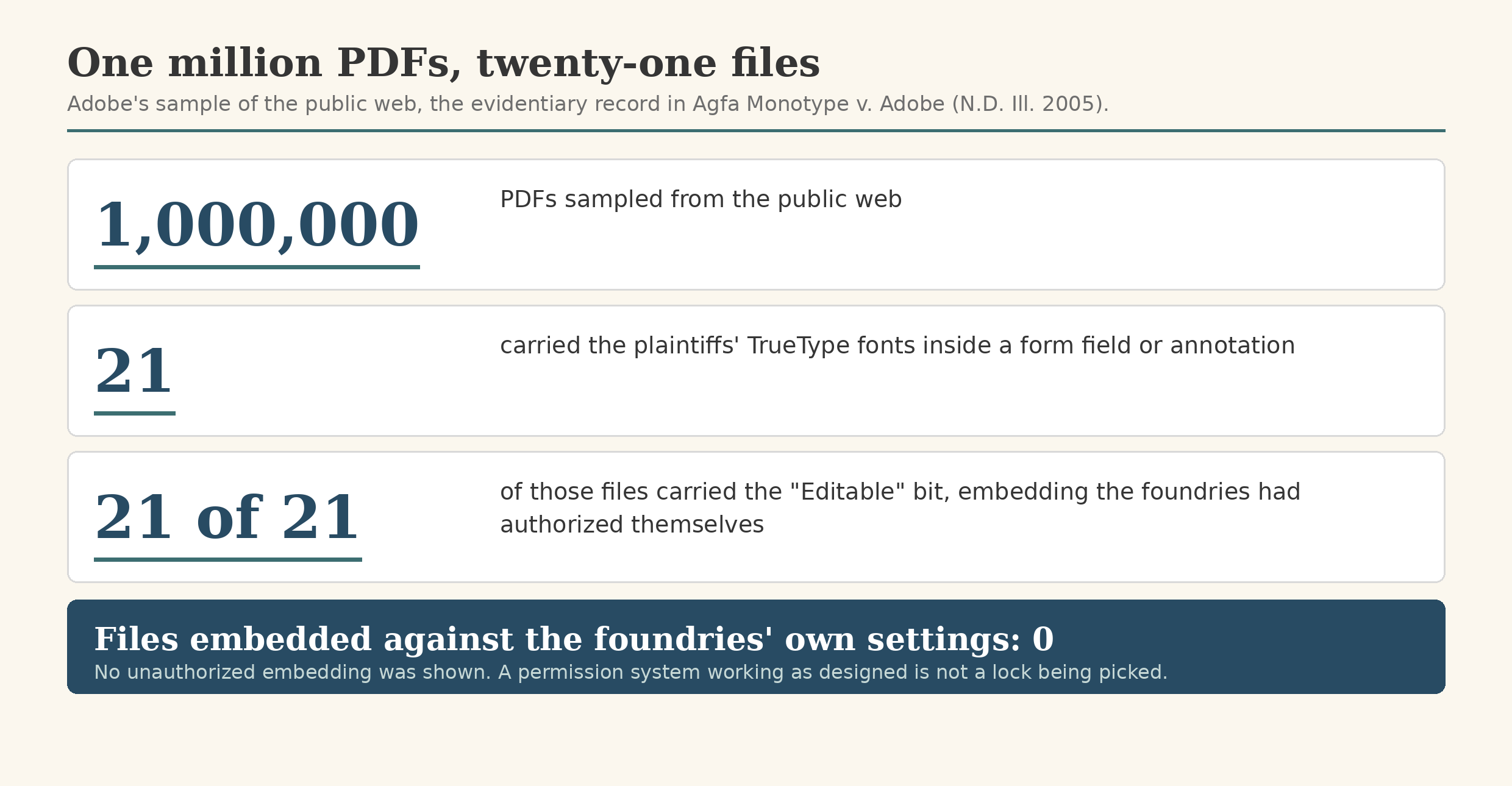
The evidence was worse for the foundries than the law. Adobe sampled one million PDFs from the public web, searching for the plaintiffs’ TrueType fonts embedded in a form field or annotation. It found 21 files. Every one carried the Editable bit: the embedding being sued over had been authorized by the foundries’ own settings. The circumvention theory needed a defeated measure, a font carried somewhere its bits forbade. The only sample anyone produced showed the permission system granting permission, every time it appeared at all.
What survives today?
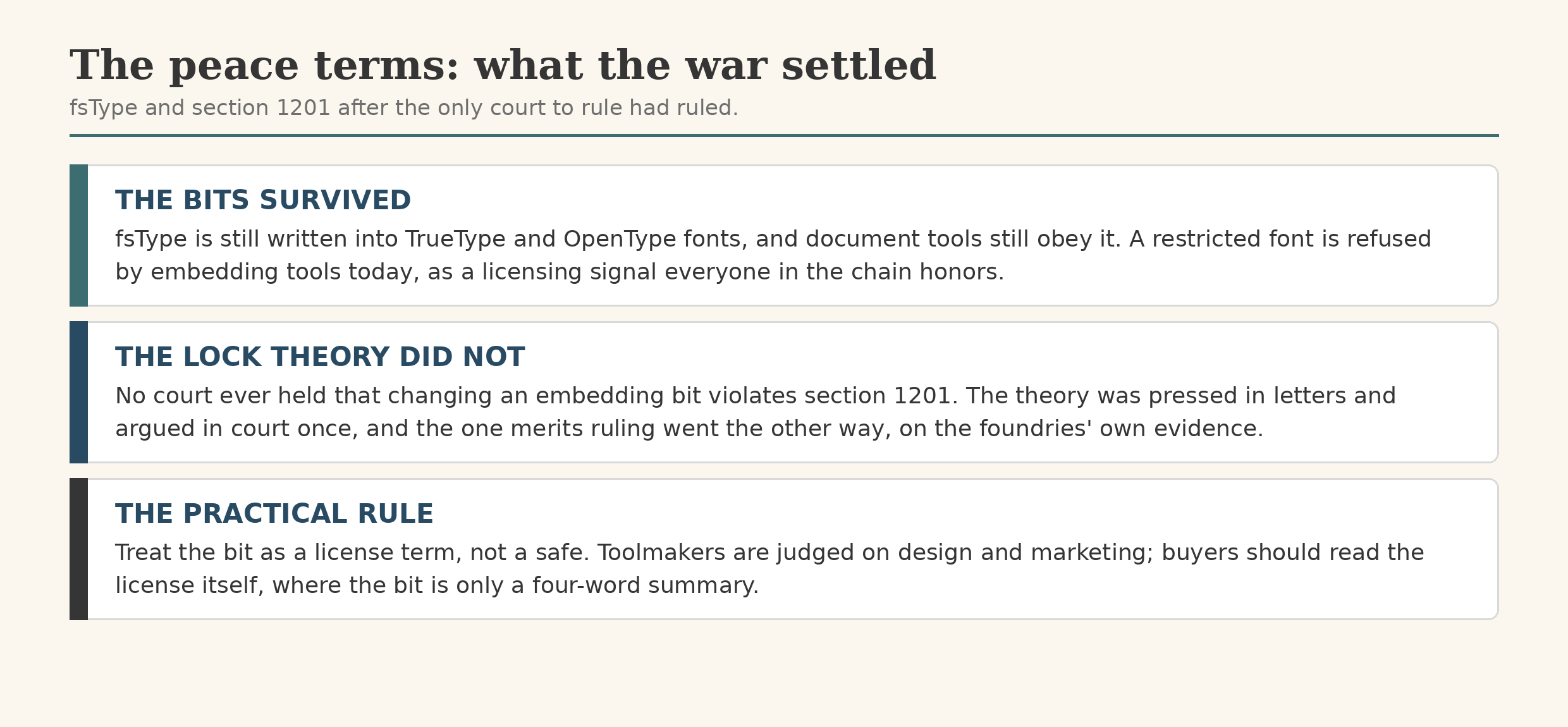
The bits survived intact: fsType is still set in every TrueType and OpenType font, still read by every serious document tool, and still obeyed. A restricted font is refused today exactly as in 2002. What the war settled is the field’s legal character: it endures as a licensing convention software honors, not as a court-blessed access control, and this fight sits in the technology row of our font lawsuit bench for that reason.
Section 1201’s limits, as this record draws them, are practical ones. The anti-trafficking rule turns on design and marketing: a general font tool that exposes the embedding field is ordinary software, while a product built and sold as a way around foundries’ permissions is what the statute aims at. And the underlying conduct still has to exist. A circumvention case built on authorized embedding is a case about nothing, however large the sample.
For font buyers, the working rule is to read the bit as a summary, not the document. An Editable bit in the file is the foundry’s own yes to editable embedding; a Restricted bit is a stop sign that tools will honor whether or not a court would call it a lock. The license text is where the actual terms live. Our font copyright law hub covers the neighboring DMCA machinery: the section 512 takedown system and the section 1202 rule against stripping a font’s embedded name and copyright strings.
General information, not legal advice.