· emoji, guides
Your emoji is a font
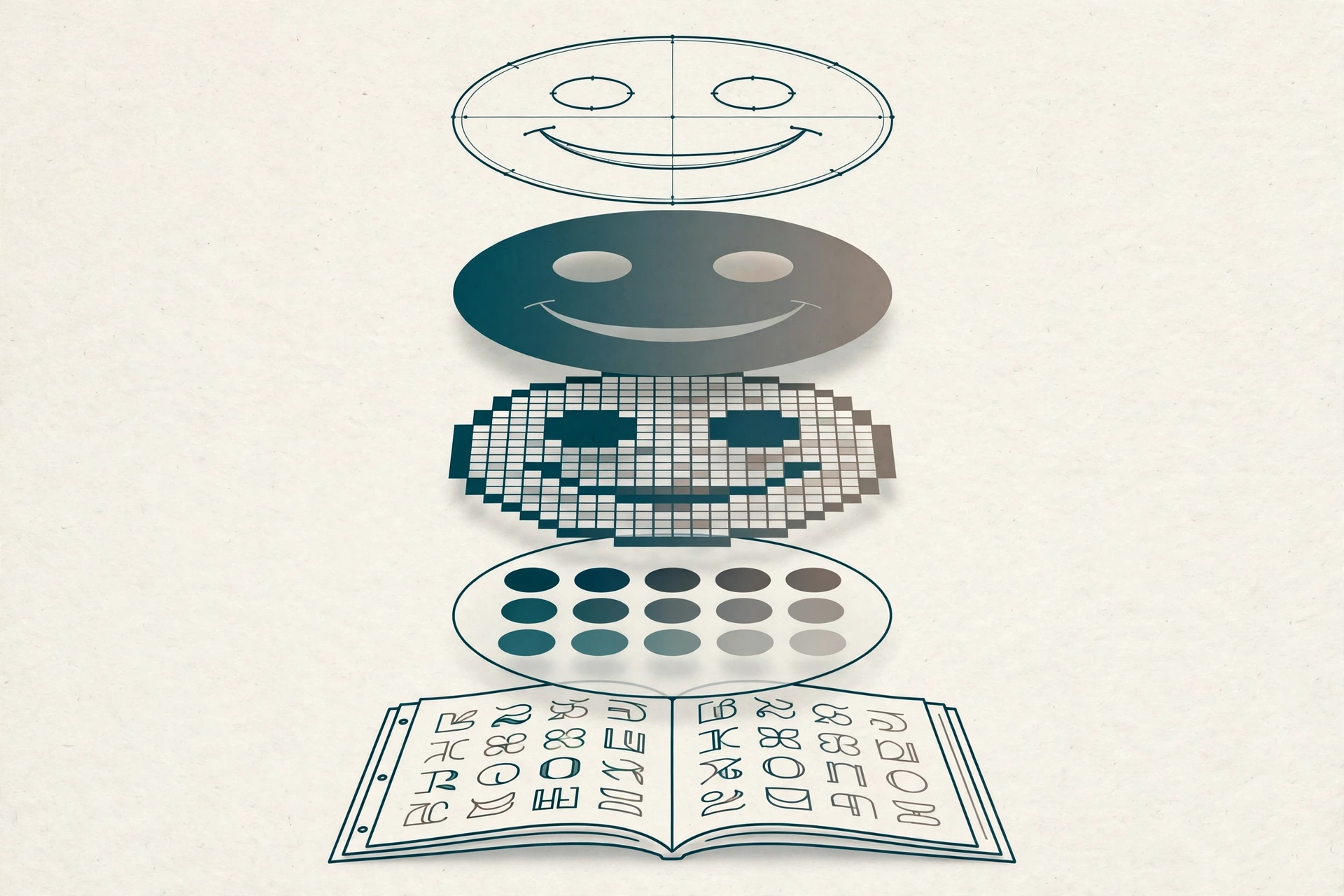
Every emoji is a glyph in a color font. Unicode assigns the character a number, and a font already on your device supplies the picture: Apple Color Emoji on iPhone, Noto Color Emoji on Android, Segoe UI Emoji on Windows. That is why the same emoji looks different on every platform, and why a new emoji arrives as an empty box until the font updates.
Tap an emoji and you have used a font. The character you sent is just a number from the Unicode standard, U+1F600 for the grinning face, and numbers have no appearance. The picture came from a glyph inside a color font installed on your device, selected silently by the text engine through a process called font fallback: your regular typeface has no drawing for that number, so the system goes looking for a font that does, and finds its emoji font.
That is why emoji behave like fonts in every way that matters. They have foundries, versions, and release schedules. They render differently on different systems. They fall back, go missing, and show the empty box called tofu when no installed font can answer for the codepoint. The only unusual thing about them is that you never chose them. Your device did.
Which font draws the emoji on your screen?
Four fonts draw nearly every emoji in the world, one per platform, and this table is the whole map.
| Your screen | The font | The format | The house style |
|---|---|---|---|
| iPhone, iPad, Mac | Apple Color Emoji | Stored bitmaps (sbix) | Glossy, detailed, the reference others converge on |
| Android, ChromeOS | Noto Color Emoji (Google) | Bitmaps (CBDT), with a vector (COLRv1) twin | Flat, rounded, friendly |
| Windows | Segoe UI Emoji | Layered vectors (COLR) | Flat Fluent faces since 2021, 3D in some apps |
| Discord, X on the web, many apps | Twemoji or image swaps | Web fonts and images | Bold outlines, designed for small sizes |
The formats are the four color font technologies, and the split explains most of emoji’s odd behavior. Bitmap formats are photographs of drawings at fixed sizes, simple and fast but heavy and unscalable: the full Noto set in bitmap form runs about nine megabytes. The vector COLRv1 format draws the same set in under two megabytes and scales to any size, which is why the web is migrating to it. Google maintains Noto Color Emoji in both builds under the same family name, two different files answering to one name, a trap for anyone identifying fonts professionally.
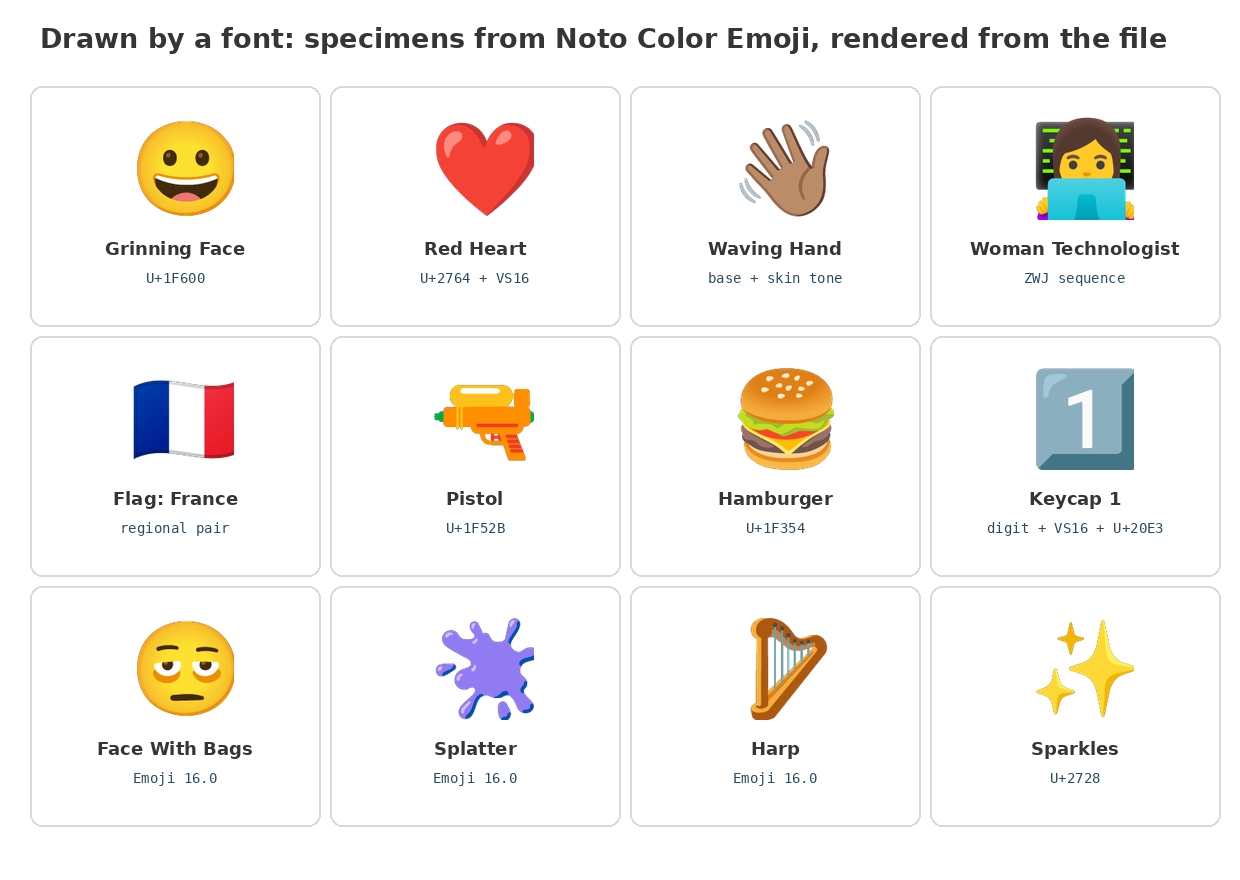
These specimens were rendered on our machine from the actual Noto Color Emoji file:
Why does the same emoji look different on another phone?
Unicode standardizes the character, never the artwork. Each vendor draws its own glyphs, in its own font, on its own schedule, and the differences are sometimes just style and sometimes meaning. The canonical case is the pistol, U+1F52B. For years nearly everyone drew a revolver. In August 2016 Apple replaced its glyph with a green water pistol, and through 2018 Google, Samsung, Facebook, and Twitter all followed, partly so that a playful squirt gun sent from an iPhone would not arrive as a weapon on another phone. Then in July 2024, X reversed its web set back to a realistic handgun, and the disagreement opened again. A single character drew four public decisions, all of them made by font designers. You can watch the split happen with any emoji you like: emoji.party renders a string you build in your own device’s emoji font, Google’s Noto font, and Twemoji at the same time, and the same character arrives as three or four different drawings.
Microsoft draws a toy ray gun.
Microsoft goes the other way.
The open Twemoji fork keeps the toy.
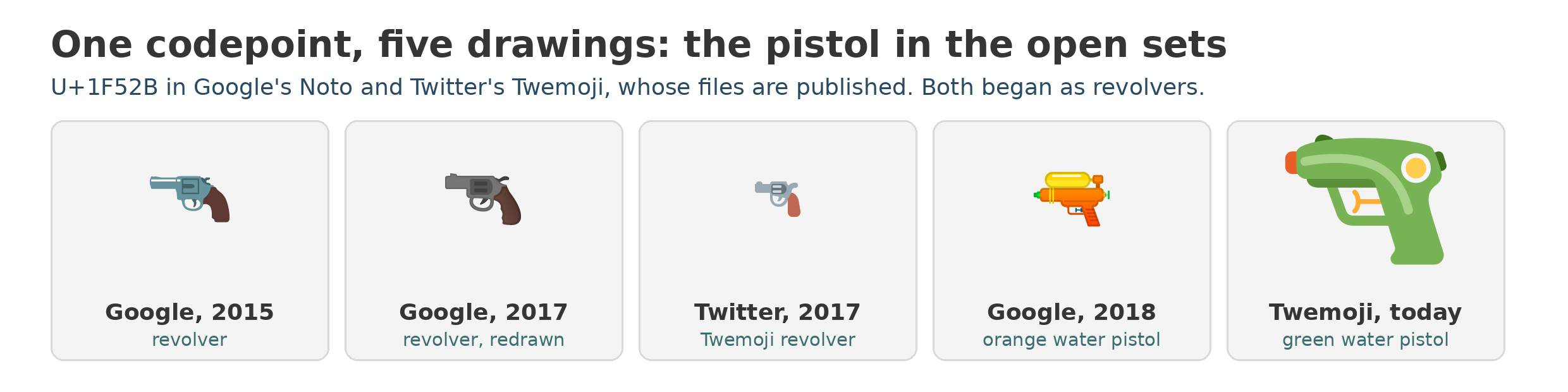
The drawings themselves, from the two sets that publish their files. Apple’s revolver, Microsoft’s ray gun, and X’s 2024 handgun are proprietary designs; Emojipedia’s pistol page shows every vendor’s version side by side.
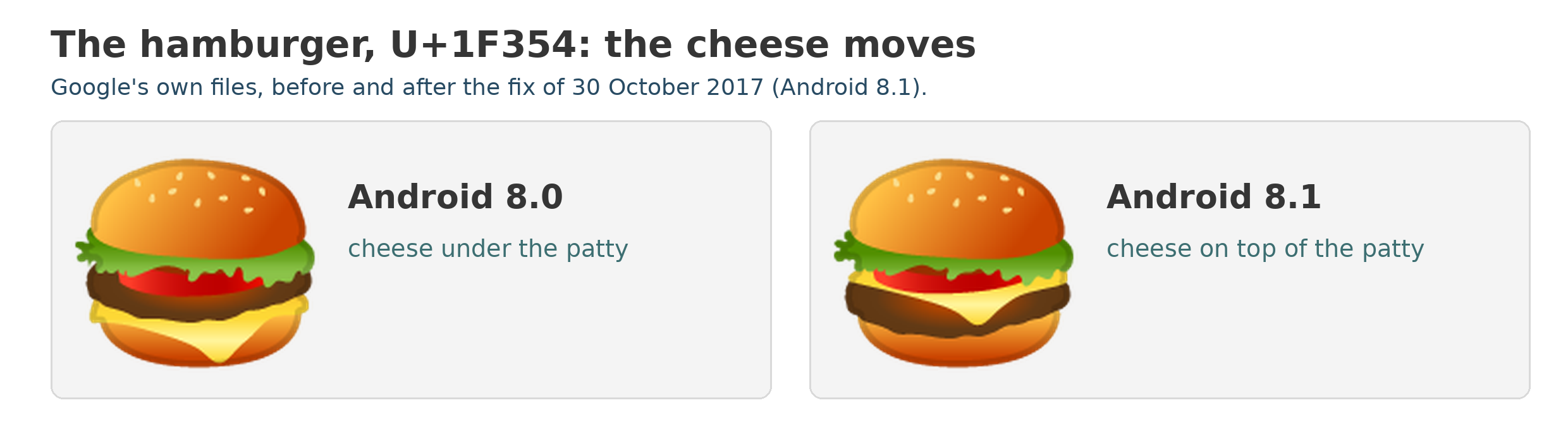
Smaller cases make the same point. In October 2017 the internet noticed that Google’s hamburger put the cheese under the patty while Apple’s sat on top; Google’s CEO promised a fix in public, and Android 8.1 moved the cheese. And one gap is structural rather than stylistic: Segoe UI Emoji ships no country flag glyphs at all, so a flag sent to a Windows machine renders as two boxed letters, FR instead of the French tricolor. Developers routinely ship a small flag-only web font just to patch that one hole.
Which emoji fonts may you use?
This is where designers get caught, because “open emoji” is often wrong:
| Set | License | The catch |
|---|---|---|
| Noto Color Emoji | Open Font License 1.1 | The safe default: use, embed, and redistribute freely |
| Twemoji | Code MIT, artwork CC BY 4.0 | Twitter’s own repo stalled at Emoji 14.0; the maintained fork is jdecked/twemoji, and attribution is required |
| OpenMoji | CC BY-SA 4.0 | Share-alike: derivatives must carry the same license, the term teams miss most |
| JoyPixels | Free for personal use with attribution; paid for commercial | Often described as open source. For current artwork, it is not |
| FrankMoji | CC BY-NC-ND 4.0 | Free to download and use, but non-commercial only, no derivatives, attribution required |
| Microsoft Fluent emoji assets | MIT | Covers the released asset files, not the Windows system font |
| Apple Color Emoji, Segoe UI Emoji | Proprietary | Render with them on the device all you like; extracting or serving them as web fonts is not licensed |
The newest entry is the strangest: FrankMoji, a complete emoji set hand-drawn by one person, Berlin typographer Frank Rausch, and shipped as a real COLRv1 color font in September 2026: 3,684 emoji in a loose clip-art style, already covering Unicode 18.0, still in beta at version 0.012 and licensed CC BY-NC-ND 4.0. Being COLRv1 only, it works today on Linux, Android, Windows, Firefox, and Chrome, and not on Apple platforms, where Apple’s stack has no COLRv1 support, the format divide above acting on a font you can download right now.
Are icon collections fonts too?
Sometimes, and the difference decides how the pictures behave. An icon collection ships in one of two forms. As an icon font, it is a genuine font: Font Awesome and Google’s Material Icons map their symbols to codepoints in Unicode’s Private Use Area, draw in one flat color, and work exactly like the emoji fonts above, fallback, tofu, and all. As an asset pack, the same artwork ships as a folder of individual SVG and PNG files: the Twemoji and OpenMoji graphics sets, Font Awesome’s SVG downloads, and Noto’s own per-emoji files, which is where this post’s plates came from.
The asset route is why Discord’s emoji look identical on every device: the app inserts Twemoji pictures, not your font’s glyphs. In exchange for that consistency, assets stop being text. They cannot be copied and pasted, they do not travel inside a message, a screen reader needs alt text for each one, and a page pays for them one file at a time. A font glyph makes the opposite trade: it travels with the text forever and renders in whatever set the reader’s device carries. The rule of thumb: if it has to survive copy and paste, it must be a font. If it has to look identical everywhere, ship assets.
The pattern is the one this site exists to document. An emoji is a font glyph with a license, a version history, and a designer making judgment calls, and treating it as a free-floating picture is how projects end up shipping someone else’s font. The characters underneath are universal. As ever, the drawings are property.