· unicode, reference
Unicode: every character gets a number
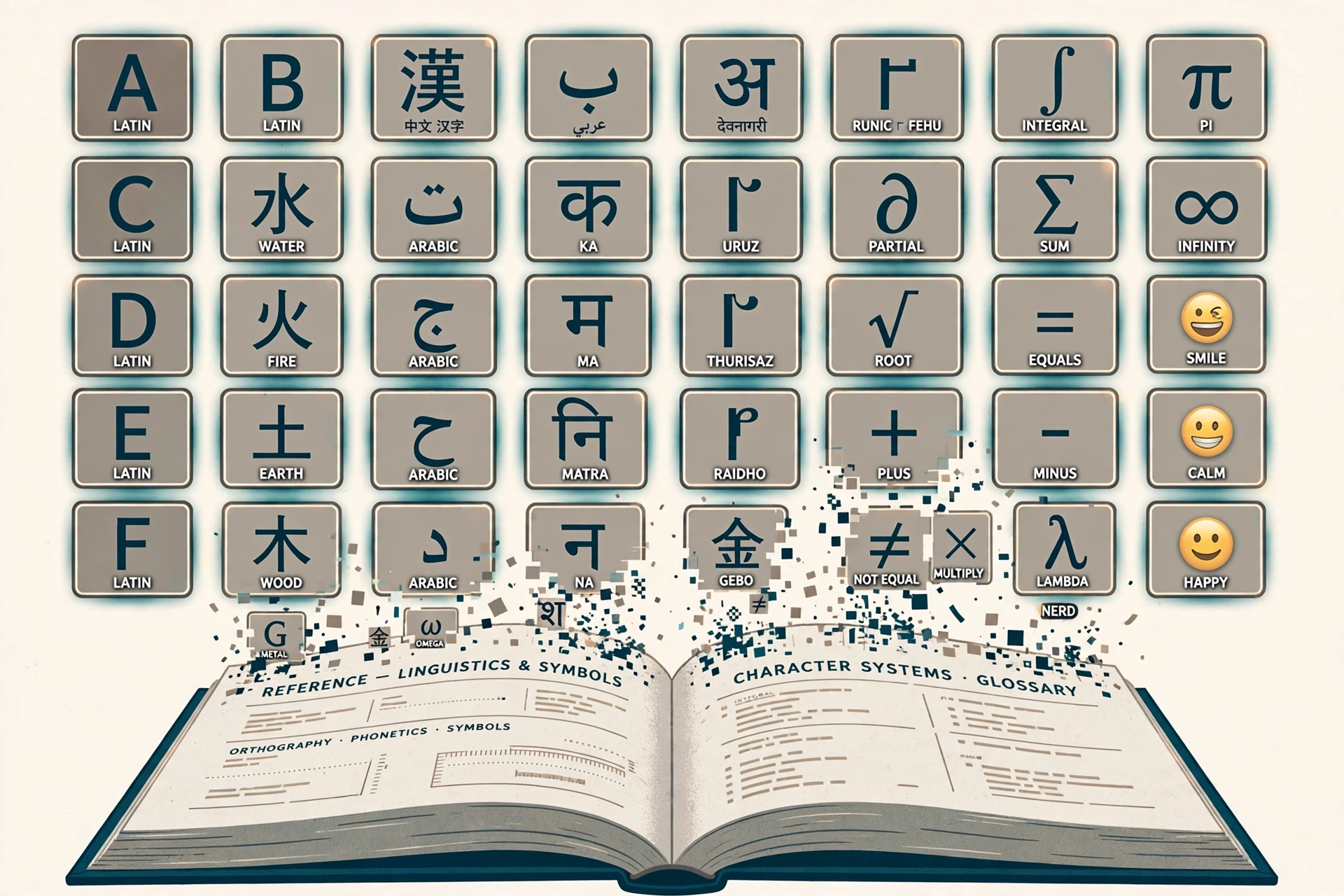
Unicode is the standard that assigns every character in every writing system a permanent number, called a codepoint, so text means the same thing on every device. Version 1.0, in 1991, covered 7,129 characters; version 18.0, published in September 2026, covers 172,808. Unicode standardizes the characters themselves, never their appearance: drawing them is the font’s job.
Every character on your screen is a number before it is a picture. The capital A is U+0041, the euro sign is U+20AC, the grinning face is U+1F600, and the font’s job is to look the number up and draw what it finds. That numbering system is Unicode, and nearly everything on this site quietly depends on it.
It is easy to forget how recent, and how necessary, the fix was. The personal computer era began with ASCII, 128 slots covering English and little else. Countries filled the remaining space in the 8-bit code pages with their own letters, so the same byte that meant é in France meant something else in Russia and something else again in Greece. A document moved across a border arrived as mojibake, the garbled text of a file read with the wrong table. Text was not portable because nobody had agreed on what the numbers meant.
The bargain of 1991
Unicode began as a proposal inside Xerox and Apple in the late 1980s, and the Unicode Consortium was incorporated in January 1991 to settle the numbering once, for everyone. Version 1.0 appeared that October: 7,129 characters covering 24 scripts, from Latin and Cyrillic to Devanagari, Hangul, and Tibetan.
The founding decision is the one this site is built on: Unicode encodes characters, not glyphs. It assigns each abstract character a number and a name, and publishes a plain black and white reference drawing. What the character actually looks like, its weight, its style, whether it is drawn by a serif face or a rounded one, is the font’s business. One standard for identity, total freedom for appearance. Every font file is, in effect, a set of answers to Unicode’s questions: here is our drawing for U+0041.
Two early fights shaped the standard. In 1993 Unicode merged its numbering with the international ISO/IEC 10646 standard, ending the prospect of two rival universes. And its treatment of Chinese, Japanese, and Korean writing, unifying characters that share a historical origin into single codepoints (Han unification), drew protests from East Asian experts who saw national letterforms being merged. The unification held, with the compromise that fonts, again, carry the regional differences: one number, several national drawings.
How did Unicode outgrow its 16-bit plan?
The original design assumed 16 bits would be enough, 65,536 slots for all the world’s text. By 1996 that was already doubtful, so version 2.0 added the surrogate mechanism and the idea of planes, seventeen of them, for a total address space of 1,114,112 codepoints. Around the same time Ken Thompson and Rob Pike designed UTF-8, the encoding that stores those numbers in one to four bytes, and the web eventually standardized on it. The address space turned out to be the right size. A third of a century later, about 15 percent of it is assigned.
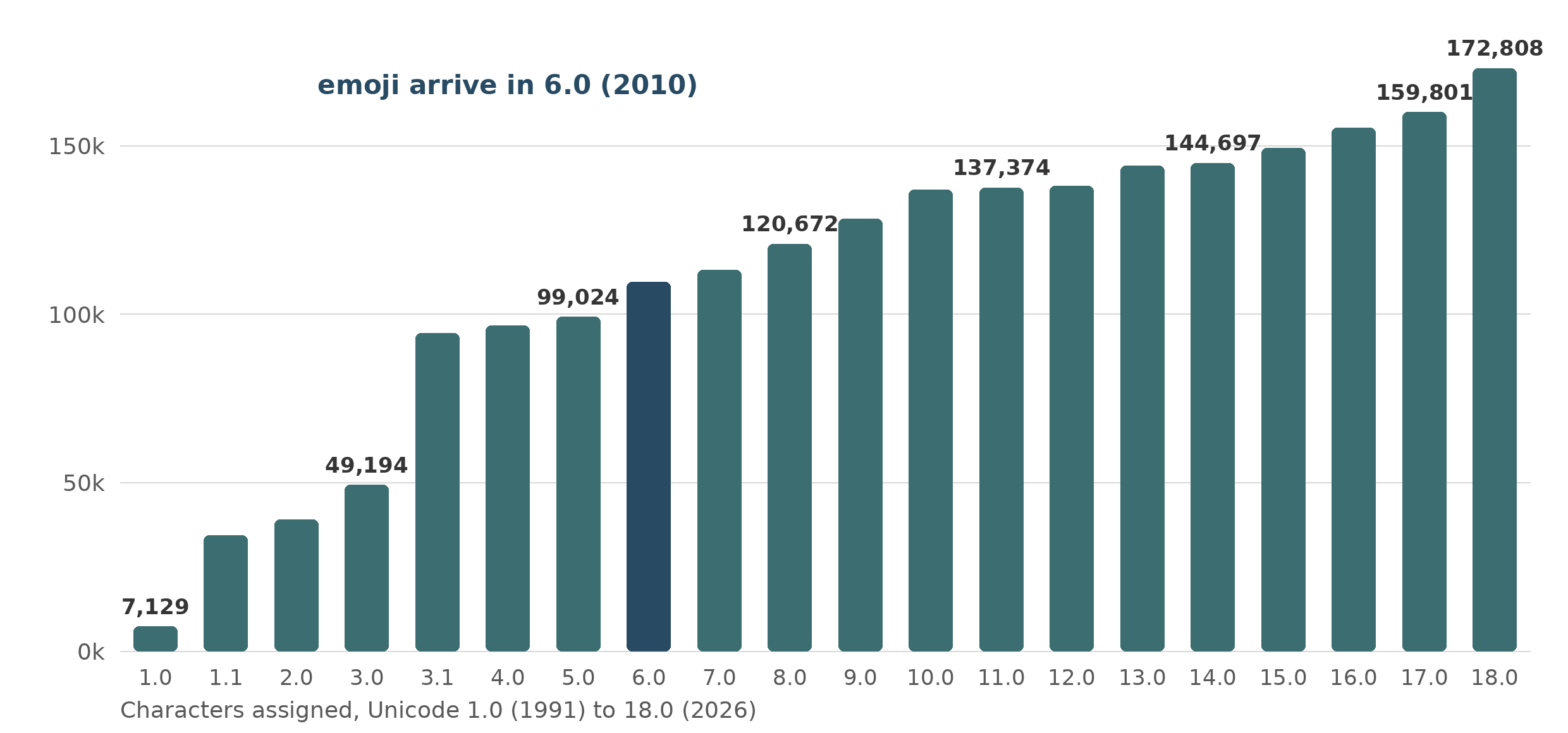
| Version | Released | Characters | Known for |
|---|---|---|---|
| 1.0 | Oct 1991 | 7,129 | The first standard: 24 scripts |
| 1.1 | Jun 1993 | 34,168 | Merger with ISO 10646; the CJK set |
| 2.0 | Jul 1996 | 38,885 | Hangul rebuilt; surrogates and planes |
| 3.0 | Sep 1999 | 49,194 | Bidirectional text, more scripts |
| 3.1 | Mar 2001 | 94,140 | A huge CJK extension doubles the total |
| 4.0 | Apr 2003 | 96,382 | Cypriot, Limbu, Linear B |
| 5.0 | Jul 2006 | 99,024 | The last print edition era |
| 6.0 | Oct 2010 | 109,384 | Emoji encoded for the first time |
| 7.0 | Jun 2014 | 112,956 | Ruble sign, many historic scripts |
| 8.0 | Jun 2015 | 120,672 | Skin-tone modifiers for emoji |
| 9.0 | Jun 2016 | 128,172 | Adlam and other living scripts |
| 10.0 | Jun 2017 | 136,690 | The bitcoin sign |
| 11.0 | Jun 2018 | 137,374 | Copyleft symbol, more CJK |
| 12.0 | Mar 2019 | 137,928 | Accessibility emoji groundwork |
| 13.0 | Mar 2020 | 143,859 | Four new scripts |
| 14.0 | Sep 2021 | 144,697 | Delayed six months by the pandemic |
| 15.0 | Sep 2022 | 149,186 | Kawi and Nag Mundari scripts |
| 15.1 | Sep 2023 | 149,813 | Mostly CJK additions |
| 16.0 | Sep 2024 | 154,998 | Garay and other new scripts; 8 emoji |
| 17.0 | Sep 2025 | 159,801 | Only 7 of its 163 “new emoji” are new codepoints |
| 18.0 | Sep 2026 | 172,808 | 13,007 characters added in one release |
When did emoji join the standard?
For its first two decades Unicode was an infrastructure project, invisible and faintly academic. Version 6.0 changed that by encoding the emoji that Japanese phone carriers had been exchanging in private encodings since 1999. Once emoji had permanent numbers, every platform had to support them, and the standard acquired a pop culture: annual announcements, campaigns for a dumpling and a hijab, and eventually a World Emoji Day. The skin-tone modifiers of 8.0 made the standard an instrument of representation as well as communication. How a handful of new codepoints becomes hundreds of “new emoji” is a story of its own, told in our emoji combos post. The everyday end of the same standard is the copyable character shelf: emoji.party’s symbol collections gather the arrows, Greek letters, math signs, and zodiac glyphs the standard maintains, each one a codepoint with a permanent number behind it.
The growth since has been steady and unglamorous in the best way: a major release every September, each adding scripts that scholars and native speakers petitioned for, historic writing systems alongside living ones, thousands of CJK characters at a time. Version 18.0, published on September 16, 2026, added 13,007 characters in a single release and brought the total to 172,808.
Two rules keep the whole edifice trustworthy. Once a character is encoded it can never be removed or renumbered, because documents written against the standard must stay readable forever. And nothing gets in without evidence of use, which is why the new emoji pipeline takes a year or more of review before a single codepoint is granted.
Why a font site keeps this table
Unicode is the addressing system underneath every font we catalog. A font’s coverage, the set of numbers it can answer for, decides whether your text renders or collapses into blank boxes. The characters are permanent and universal; the drawings are local, versioned, and endlessly varied. That gap between the number and the picture is exactly where fonts live.