· history, reference
Dead and deprecated font formats: extinct, absorbed, and lingering
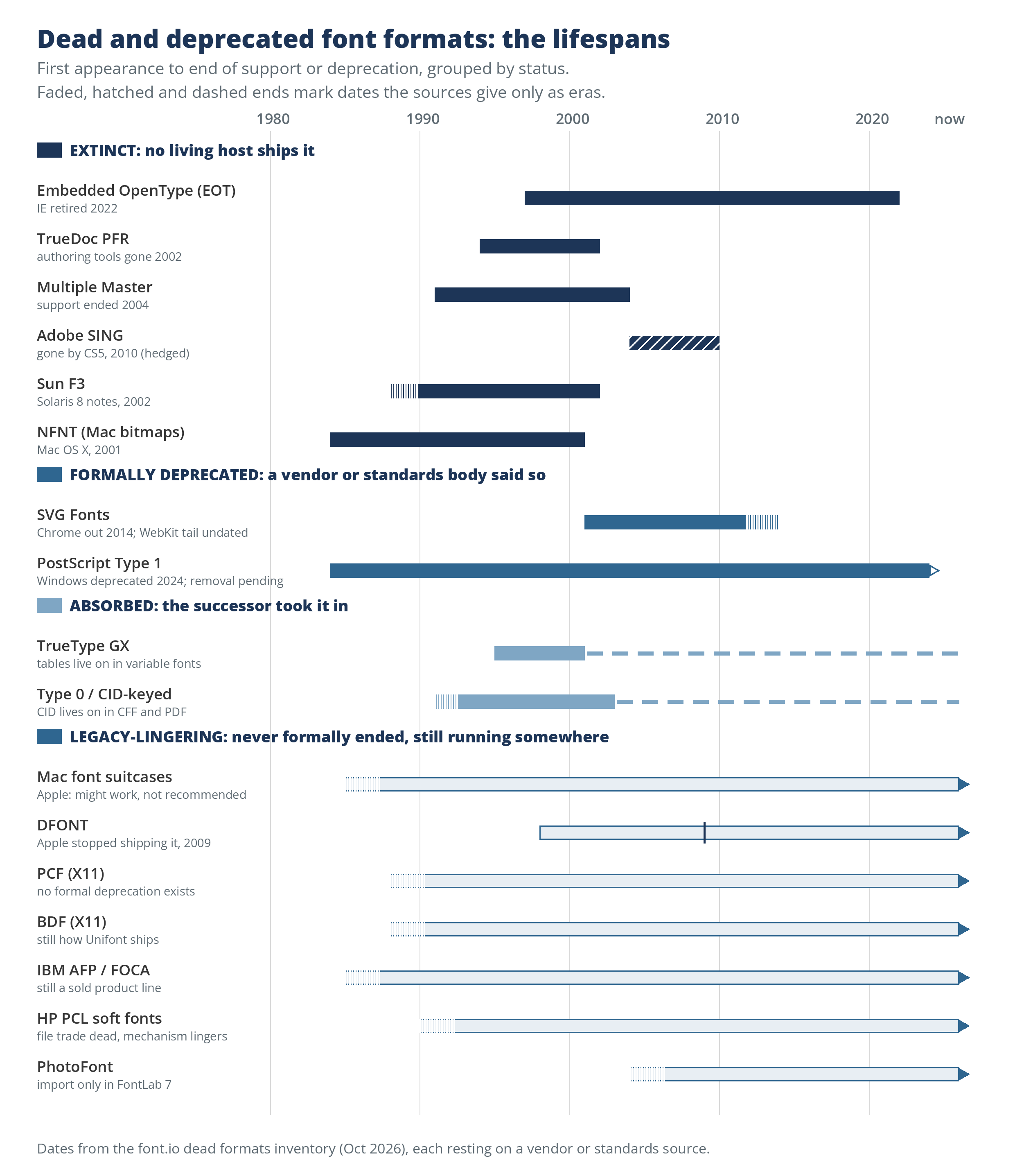
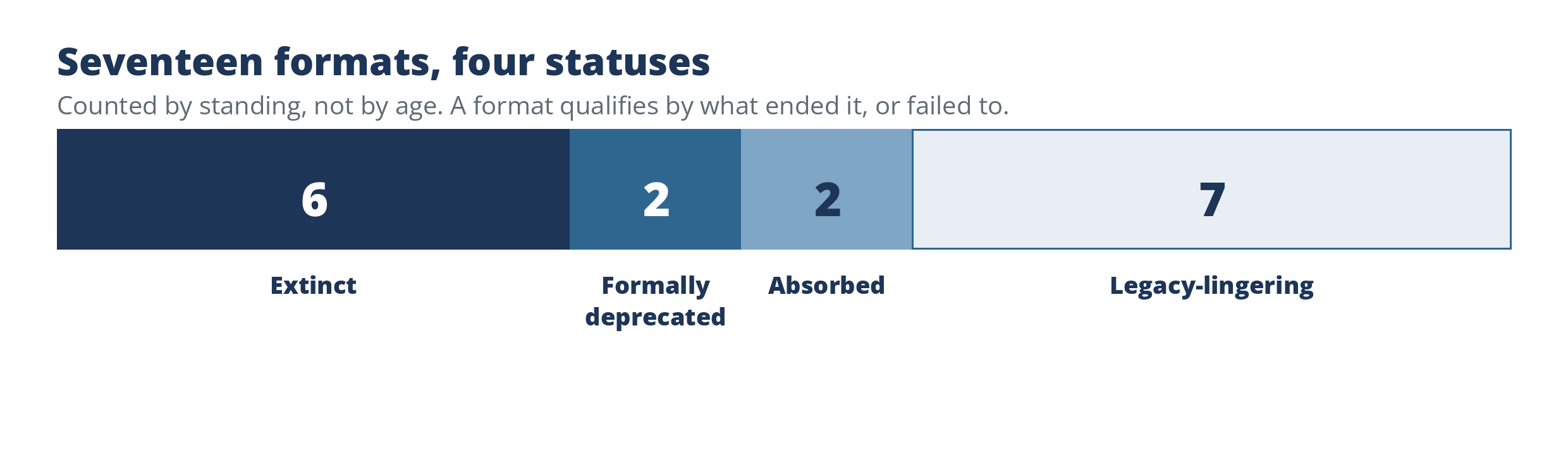
A font format does not have to be old to be dead, and being old does not make it dead. This inventory counts 17 formats by status rather than age: six extinct, two formally deprecated, two absorbed into OpenType, and seven lingering past their era, each with the vendor or standards record that settled it.
Three font.io guides divide this territory. Font file types covers the formats that live; archaic font formats covers the old era. This one covers status. Where the record disagrees, the disagreement is printed; where no date exists, none is invented.
SVG Fonts: the font that was markup
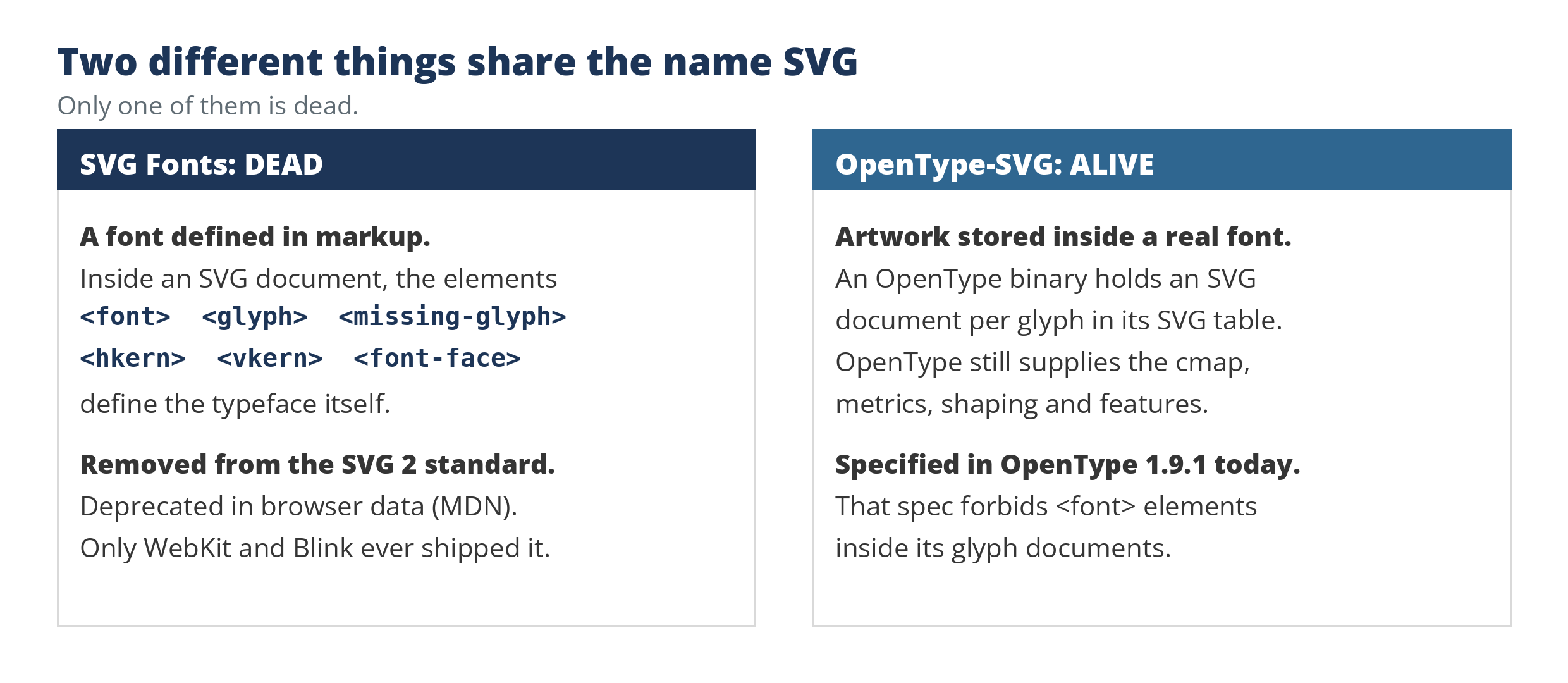
An SVG Font was a typeface defined in an SVG document with the SVG 1.1 elements <font>, <glyph>, <missing-glyph>, <hkern> and <font-face>: markup, not a binary file. As a webfont it was an .svg file referenced from @font-face with format('svg').
MDN’s compatibility data records the @font-face SVG fonts feature as deprecated and off the standards track. The W3C removed the entire Fonts chapter in SVG 2, writing a WOFF requirement in its place. Chrome removed it in Chrome 38 (October 2014), Opera’s Chromium build following. Only WebKit and Blink ever shipped it: Firefox, Internet Explorer and Edge never did, Mozilla citing weak shaping, no stylistic alternates, and a broken style model. No source records when Safari or WebKit ended support, so no date is printed here.
The distinction that matters: OpenType-SVG is not SVG Fonts. It is an optional SVG table inside an OpenType binary, an SVG document per glyph, with OpenType supplying the map, metrics and shaping. Specified in OpenType 1.9.1 today and descended from Mozilla’s proposal to salvage SVG Fonts on an OpenType chassis, its spec forbids <font> elements inside glyph documents. SVG the image format never died; only its Fonts chapter did.
Embedded OpenType: the format that died with its browser
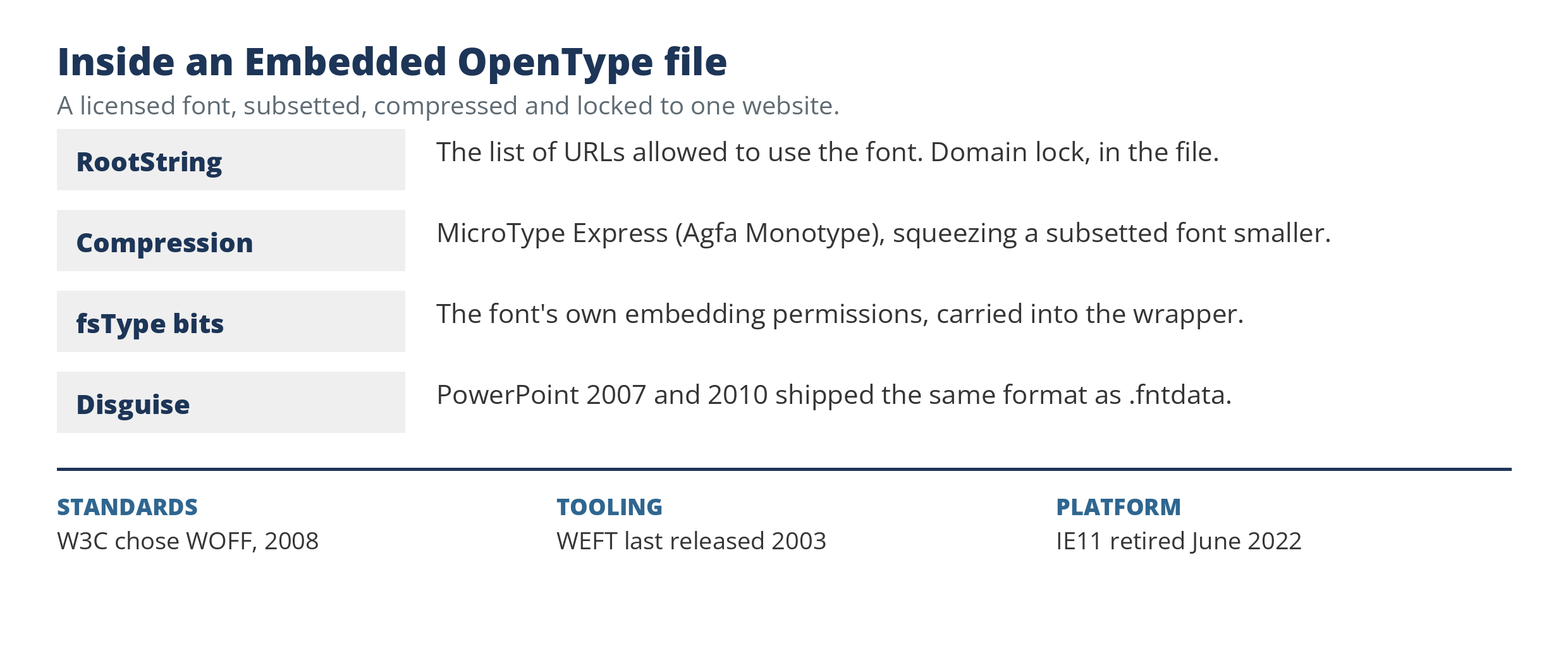
Embedded OpenType (EOT) was Microsoft’s 1997 web font format for Internet Explorer 4: a font subsetted, MicroType Express compressed, and locked by a RootString listing the URLs allowed to use it. A foundry’s font could appear on a page without becoming a copyable desktop font.
EOT died three times. In standards: submitted to the W3C in 2007 and resubmitted in March 2008, it was passed over when the W3C chose WOFF. In tooling: WEFT, its only authoring tool, last shipped in February 2003 and was undownloadable by 2019. In platform: only Internet Explorer ever supported it, Edge never did, and IE11 support ended June 15, 2022, the app permanently disabled in February 2023. IE9 already supported WOFF, so EOT spent its last decade as a fallback for IE8 and earlier.
Type 1: how to tell you have one, and how to convert it
PostScript Type 1 is the bridge case. Its five-file kit is covered in archaic font formats . Its deprecation is modern, the cleanest proof here that dead is a status, not an age: the desktop publishing standard from 1984 into the 2020s.
How to identify a Type 1 font: look at the files. On Windows, a .pfb with a .pfm metrics file, often an .afm beside it. On Unix, a .pfa. On a classic Mac, an LWFN printer file paired with a font suitcase. Current Photoshop shows an installed Type 1 font as missing. And an .otf is not Type 1, even CFF-flavored: Adobe’s FAQ calls OpenType CFF “a compact representation of Type 1 that we will continue to support,” a different, unaffected format.
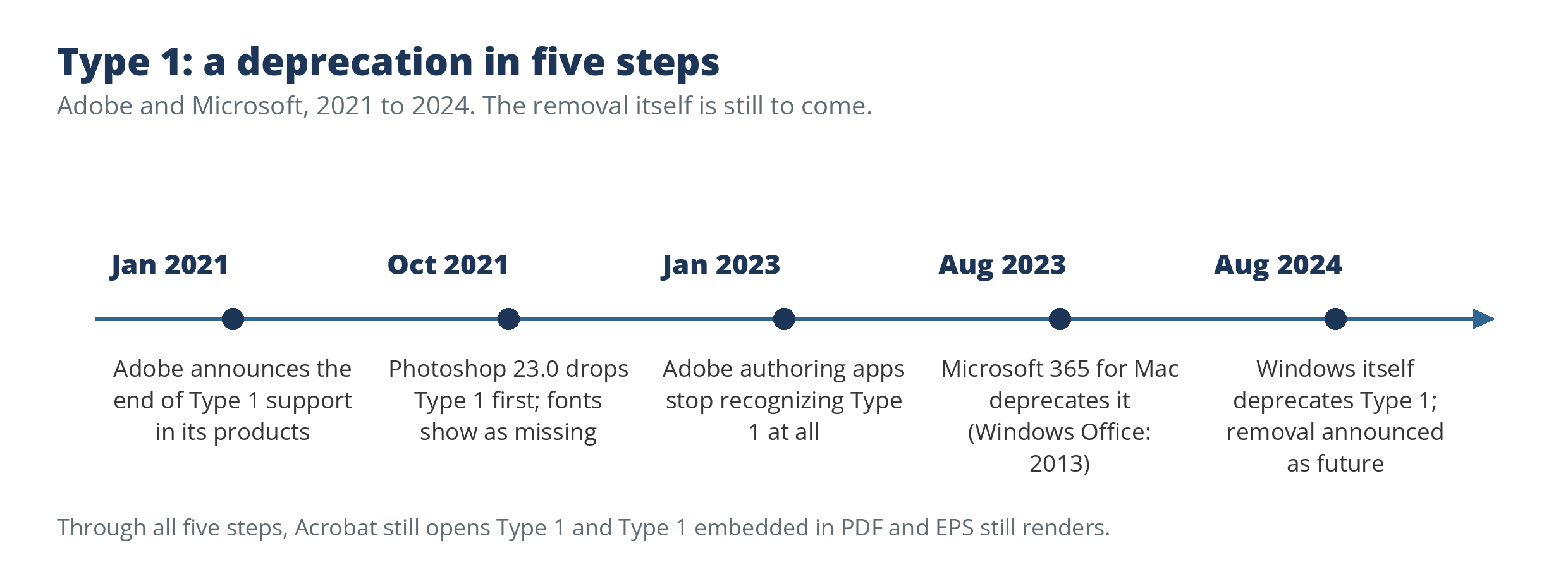
The deprecation, in steps: the plate draws it: Adobe’s announcement (January 2021), Photoshop first (October 2021), the authoring apps (January 2023), Microsoft 365 for Mac (August 2023), Windows itself (August 2024), removal still to come. Dropped is not stopped working: Acrobat still works with Type 1, embedded Type 1 still renders, FreeType still ships a driver.
How to convert a Type 1 font to OpenType: Adobe’s advice was replacement rather than conversion: get the OpenType version from Adobe Fonts, from Fontspring for Adobe-owned fonts, or from the original foundry. Converters exist (FontForge, TransType, the LCDF Typetools), but Adobe warns their results may be sub-optimal, and the font’s license may prohibit conversion at all. Check the EULA first.
The inventory at a glance
| Format | Status | Ended by | What took its place |
|---|---|---|---|
| SVG Fonts | Formally deprecated | W3C, SVG 2; Chrome 2014 | WOFF; its use cases live on in OpenType-SVG |
| PostScript Type 1 | Formally deprecated | Adobe 2021 to 2023; Microsoft 2024 | OpenType |
| Embedded OpenType (EOT) | Extinct | W3C passed it over; Internet Explorer retired 2022 | WOFF, then WOFF2 |
| Multiple Master | Extinct | Adobe, 1999 to 2004 | Nothing at the time; variable fonts in 2016 |
| TrueDoc PFR | Extinct | Netscape, at Navigator 6 | @font-face with TrueType and OpenType |
| Adobe SING | Extinct | Adobe, by omission, Creative Suite 5 (2010) | None named; large-coverage CJK OpenType fonts |
| Sun F3 | Extinct | Sun, Solaris 8 release notes (2002) | Type 1 and TrueType |
| NFNT | Extinct | Apple, Mac OS X (2001) | TrueType, with embedded bitmap strikes |
| TrueType GX | Absorbed | Apple, staged to 2001 | OpenType Font Variations, using GX tables |
| Type 0 / CID-keyed | Absorbed | Adobe, by supersession | OpenType CFF; CID survives in CFF and PDF |
| Mac font suitcases | Legacy-lingering | Apple, by transition (2001) | Plain .ttf, .otf and .ttc files |
| DFONT | Legacy-lingering | Apple stopped shipping it (2009), never removed it | TrueType Collections (.ttc) |
| PCF | Legacy-lingering | Nobody, formally | Xft and fontconfig client-side rendering |
| BDF | Legacy-lingering | Nobody | OpenType bitmap fonts for new work |
| IBM AFP / FOCA | Legacy-lingering | Nobody; still sold | It absorbed OpenType instead |
| HP PCL soft fonts | Legacy-lingering | Nobody, formally | Scalable PCL fonts; host rendering |
| PhotoFont | Legacy-lingering | FontLab (export dropped) | OpenType-SVG and COLR color fonts |
Extinct: no living host
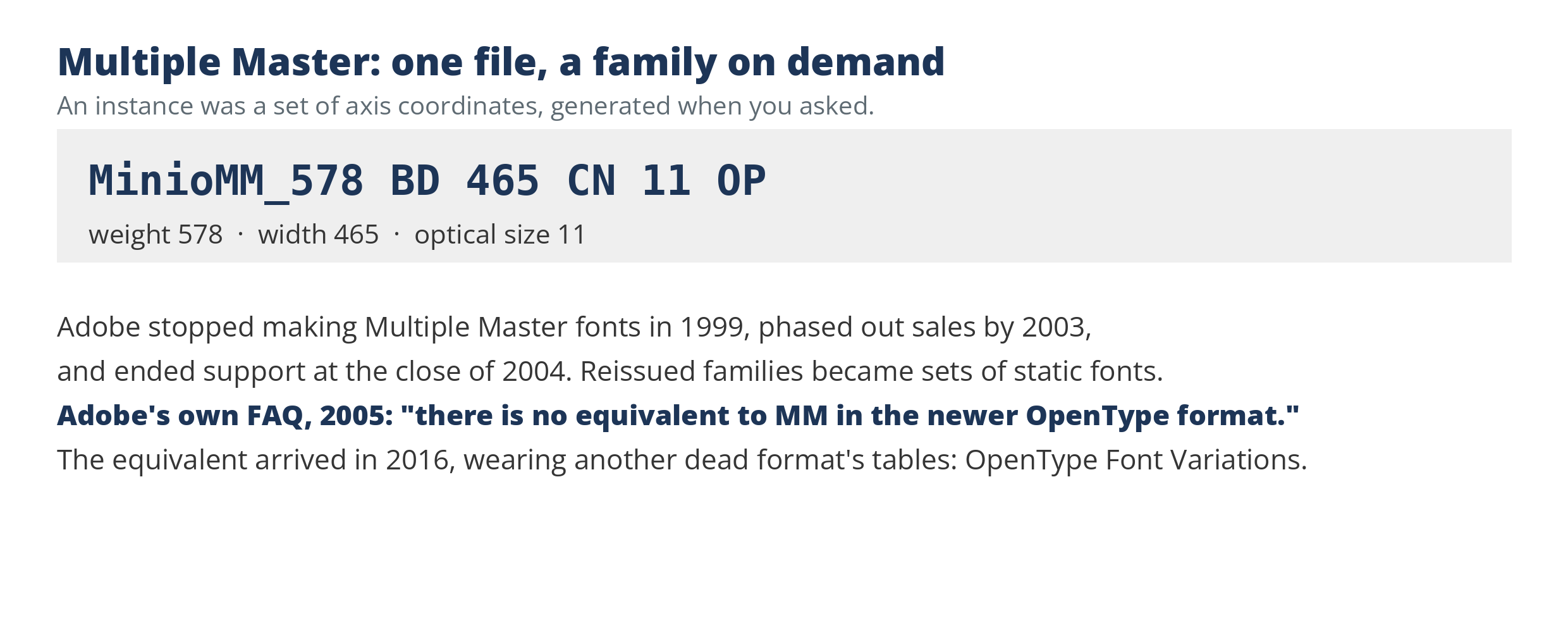
Multiple Master was Adobe’s 1991 extension of Type 1: one file, instances along weight, width, optical size and style axes. Adobe stopped making new ones in 1999, phased out sales by 2003, and ended support at the end of 2004. Its own 2005 FAQ states flatly that “there is no equivalent to MM in the newer OpenType format.” The equivalent arrived in 2016, wearing another dead format’s tables.
TrueDoc PFR was Bitstream’s entry in the web’s first font war: glyph shapes recorded compactly, replayed by Bitstream’s own player, shipped as Netscape’s Dynamic Fonts in Navigator 4. RFC 3073 registered its MIME type in 2001 and records broadcast adoption (DAVIC, DVB, DTG). Why Netscape dropped it at Navigator 6 is disputed on the record: Wikipedia says Netscape could not release Bitstream’s source code; Bitstream’s own product management wrote at the time that Netscape simply did not want it. Its tools were discontinued by April 16, 2002 (Computerworld); Monotype, which acquired Bitstream’s font business in 2012, does not market it. The irony: FreeType still decodes PFR today, so the loser is renderable in 2026, while EOT is readable by no current browser.
Three shorter certificates. Adobe SING (2004) shipped glyphlets, OpenType fonts deliberately missing the tables that would list them in menus, each carrying one rare CJK glyph in a document; gone by Creative Suite 5 in 2010, on a manual’s omission plus a forum record, not any Adobe notice. Sun F3 has the cleanest certificate here, one sentence in the Solaris 8 release notes: “F3 fonts and the TypeScaler rasterizer, the Sun proprietary scalable font technology, is no longer supported.” NFNT, the 1984 Macintosh’s only font form, lost standalone life when Mac OS X shipped outline-only rendering in 2001.
Absorbed: the deaths that were promotions
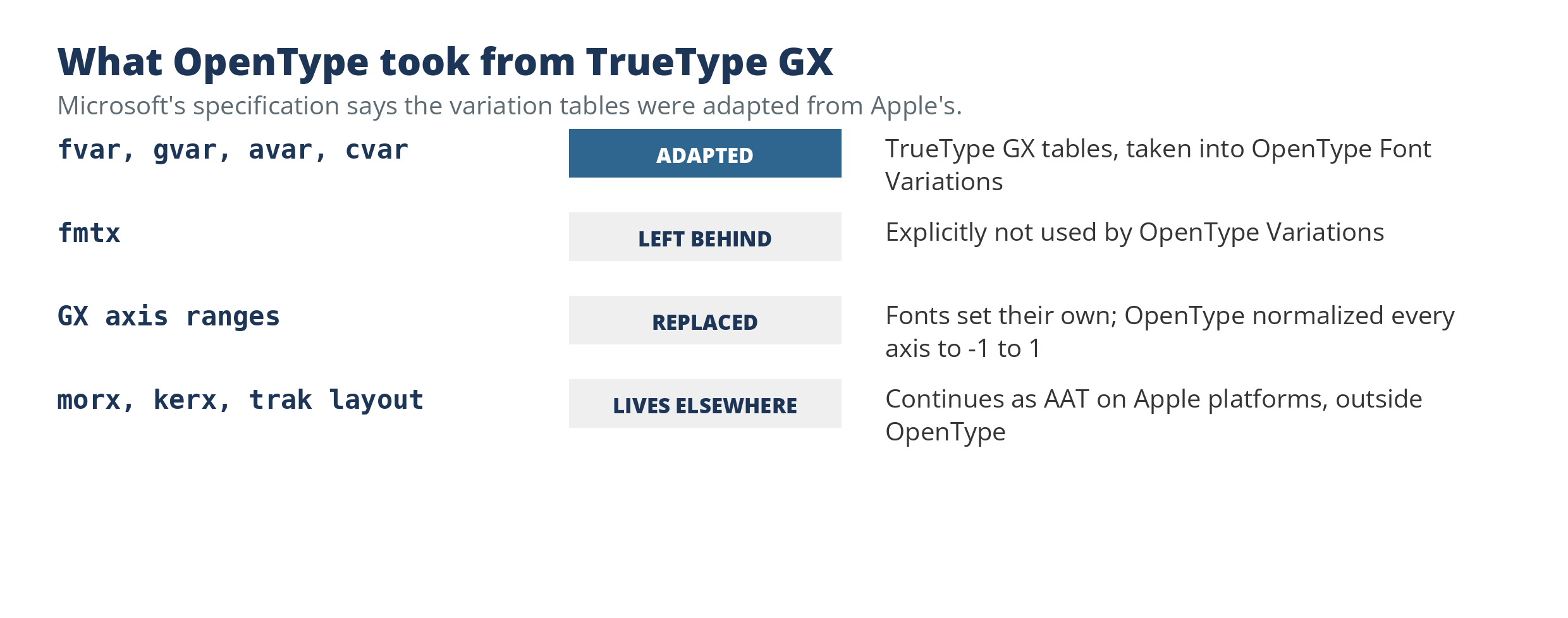
TrueType GX was Apple’s variation technology, rolled out with System 7.5 in 1995 as part of QuickDraw GX: continuous axes, plus rich layout machinery. Microsoft, refused a GX license in the early 1990s, built its own alternative. Apple ended it in stages (GX printing dropped in Mac OS 8; the system killed by Mac OS X in 2001). Then the resurrection: OpenType Font Variations, announced September 14, 2016 by Microsoft, Adobe, Apple and Google, was adapted from GX. Microsoft’s specification says variation mechanisms “were first introduced by Apple in TrueType GX,” its fvar, gvar, avar and cvar tables adapted from Apple’s. The fmtx table was explicitly not carried over, and GX’s self-set axis ranges became normalized axes. GX’s layout side continues as AAT; Skia began as a GX demonstration font.
Type 0 and CID-keyed fonts were Adobe’s answers to large CJK character sets. Adobe does not document or support the original Type 0 form, and its workshop materials describe the standalone CIDFont as an intermediate step on a conveyor (Type 1 to CIDFont to OpenType) whose endgame was “to build an OpenType/CFF font.” Supersession, not announcement, ended both. CID lives on in every CFF-flavored OpenType font and in PDF’s Type 0 composites.
Legacy-lingering: nobody ended them
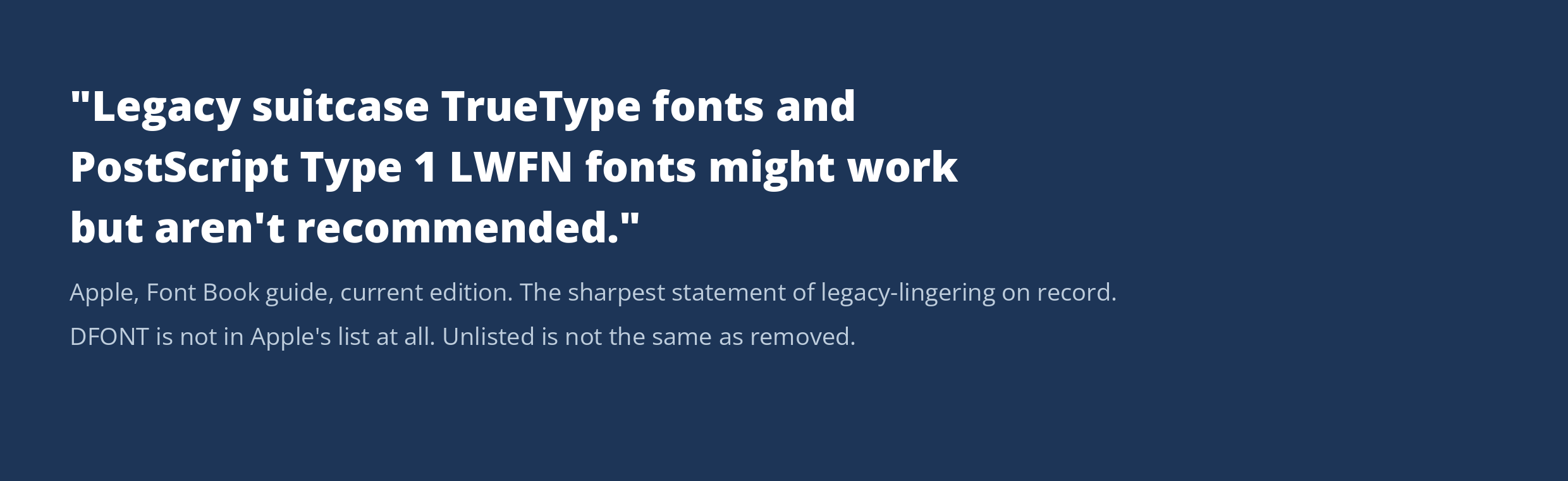
The largest class here has no death certificate. Mac font suitcases, the resource-fork containers, were ended by transition, not decree: Mac OS X moved to data-fork files in 2001, and Apple’s current Font Book guide demotes suitcases to “might work but aren’t recommended.” DFONT, the data-fork successor, is stranger: Apple stopped shipping it in 2009, never announced an end of support, and it appears in Apple’s current list not at all. Unlisted is not removed.
The X Window pair makes the same point. PCF, the compiled bitmap format X11 servers read, has a reputation for formal X.Org deprecation that the record does not support: X.Org’s own guide still prescribes compiling BDF source into PCF, and fontconfig and FreeType still treat it as supported. Any specific PCF deprecation date is folklore unless it cites a release note. BDF, its plain-text source form, was never a runtime format; Unifont still ships as BDF. HP PCL soft fonts (.sfp portrait, .sfl landscape, split because PCL did not rotate glyphs) have no formal HP end-of-life either: the file trade is dead, the mechanism lingers. PhotoFont (.phf, XML plus PNG glyphs) could never be installed in any OS; FontLab 7 imports it still, exports it no longer.
The closing case inverts the pattern. IBM AFP fonts, the FOCA architecture of mainframe production printing, were never ended or replaced and remain a current, sold product line. Instead of being absorbed by OpenType, AFP absorbed it: Ricoh’s current documentation defines AFP fonts as FOCA raster and outline fonts “or WorldType fonts, which are TrueType and OpenType outline fonts.”
Not dead, and two deaths that were not formats
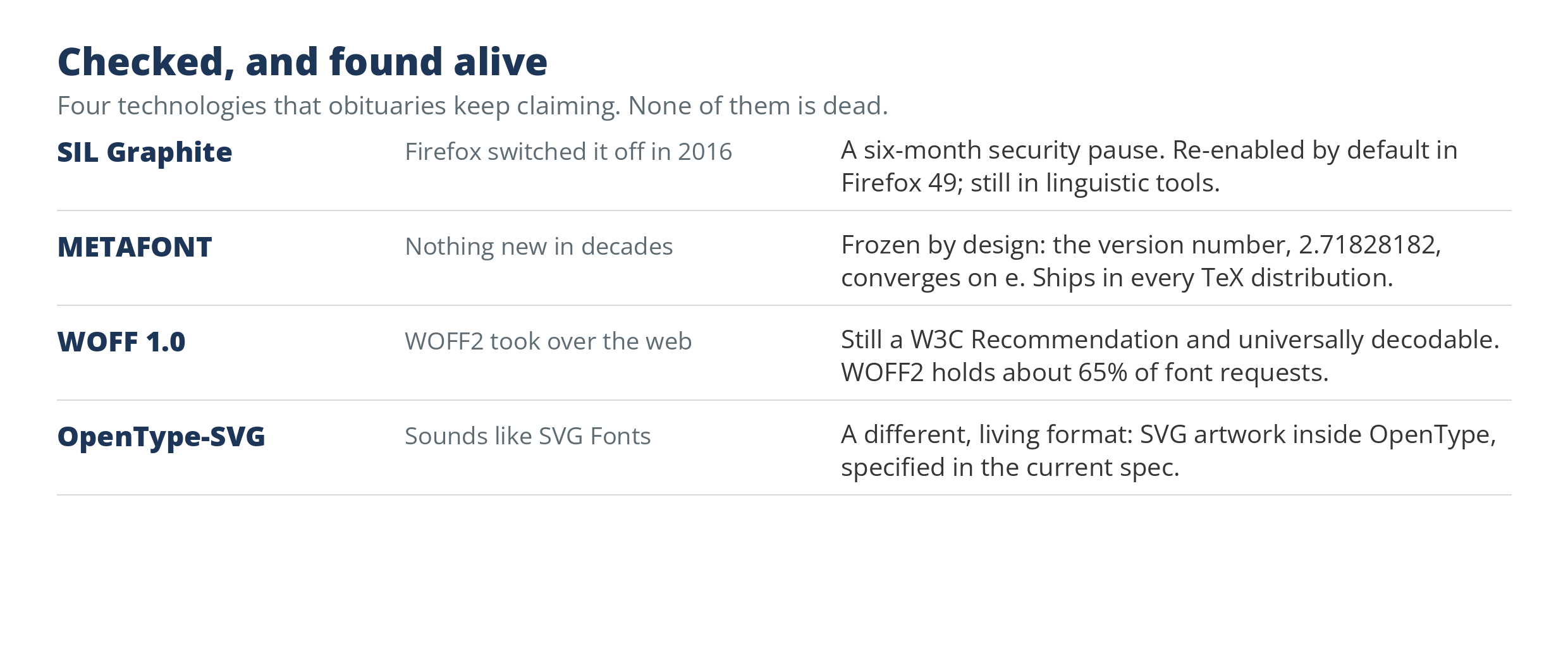
An inventory of the dead earns its authority by what it refuses to include. SIL Graphite, a smart-font technology inside TrueType fonts, is often declared dead because Firefox “removed” it. That is false: Mozilla disabled it by default in Firefox 45.0.1 (2016) after fuzzing found security bugs, the Bugzilla record shows the move was temporary, explicitly to protect minority-language users, and Firefox 49.0 re-enabled it six months later. SIL still lists supporting applications, Firefox and LibreOffice among them. METAFONT is frozen by design: version 2.71828182, converging on e, still in every TeX distribution. WOFF 1.0 is superseded, not dead: WOFF2 took roughly 65 percent of font file requests by 2025 (the W3C’s retrospective), while WOFF remains a decodable Recommendation.
Two famous deaths belong elsewhere, because neither was ever a font format. sIFR swapped HTML headings for small Flash movies with the font embedded, and Cufón converted outlines to JSON and drew them to canvas at runtime. Both were stopgaps from the years when @font-face did not work, and both are extinct as practices: sIFR died with Flash itself (support ended December 31, 2020). Cufón’s library is still distributed on cdnjs, which is distribution, not use. Formats die by decree, by supersession, by absorption, or by nobody signing anything at all; the honest list keeps the kinds separate, and the living off it.
Sources: W3C, SVG 2 changes appendix ; MDN browser compatibility data, SVG fonts ; Microsoft, Internet Explorer 11 end of support ; Adobe, PostScript Type 1 end of support FAQ ; Microsoft, deprecated Windows features ; Adobe, Multiple Master FAQ ; Microsoft, OpenType Font Variations overview ; Computerworld, on TrueDoc’s discontinued tools (2002) ; Oracle, Solaris 8 release notes ; Apple, Font Book guide ; X.Org, X11R7.7 fonts guide ; FreeType, supported formats ; SIL, Graphite applications ; Mozilla Bugzilla 1255731 ; FontLab 7 manual, font formats ; Ricoh, InfoPrint Font Collection . Full per-format evidence: font.io dead formats inventory, October 2026.