· licensing, guides, reference
Font licenses that ban whole industries
A font license normally tells you what you may do with the file. A minority of licenses tell you who may buy and what the work may say: no loggers, no fast food, no political campaigns, no AI training. We read 22 independent foundry licenses to map the clauses, and asked what they can actually enforce.
The license that bans an industry
David Kerkhoff, the Dutch designer behind Hanoded, writes hand-drawn and brush faces, 641 of them listed on FontSpace alone. His standard EULA is a normal commercial license (install on up to five computers, outlines may be converted freely, webfonts and app embedding need a special license) until section (d), Restrictions, where it becomes something else: a list of people and purposes a paid license still excludes.
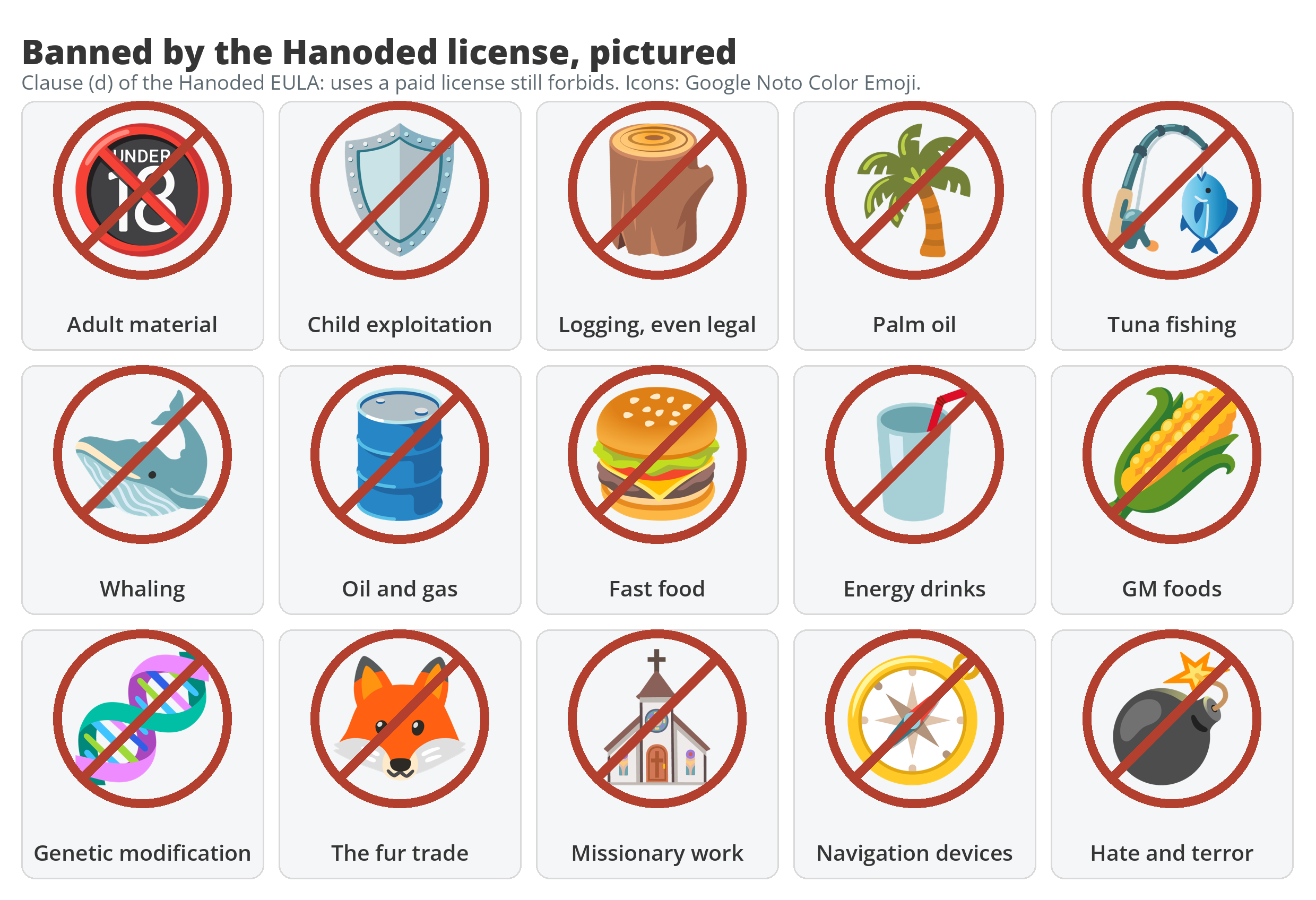
The list bans use for pornographic or hateful material and in connection with child abuse, which other licenses also say. Then it keeps going: no use by anyone involved in “logging (even legal), palm oil exploitation/harvesting, tuna fishing, whaling”, oil and gas drilling, or trafficking. No use promoting an unhealthy lifestyle, expressly including fast food, energy drinks, and foods containing GM ingredients. No use by anyone involved in genetic modification, or the fur trade. No use by missionaries or religious institutions for converting others. And, filed in the same moral list, no use in navigation devices.
The machinery around the clause matches its temperament. His free demos are deliberately incomplete files, renamed inside the font itself (older ones carry a DK prefix, newer ones the word DEMO), and commercial use of a demo is banned outright. Full versions are sold only through retailers such as MyFonts and Fontspring; he directs licensing questions to them, not to himself. Charities and community nonprofits may use the fonts free, but only after asking him by email first, because, as his FAQ puts it, “your idea of what a nonprofit is may differ from mine”.
 Hanoded FontsDavid Kerkhoff's own site: the fonts, the license, and the FAQ, in his own words.Visit site
A census of values clauses
Hanoded is the extreme, but the instinct is widespread. We read 22 independent foundry license texts in full; 13 carry at least one clause that governs conduct, content, or the customer’s identity rather than the file. The patterns:
Political and religious contexts are the commonest ban. Six small European foundries independently restrict them. Boom Type forbids use in “any violent, hateful, discriminatory, explicitly political or religious context”, and adds cryptocurrency contexts in the same sentence. Bleifrei reserves the right to block use over “ideological conflicts with the Fonts’ type designer”, the most personal clause in the census: the restriction is not a category, it is the designer’s own politics.
One license bans a class of customers. Plain Form bars use “on behalf of government agencies, military contractors, or weapons manufacturers without prior written approval”. It is the only true user-class ban we found, and note its shape: not a refusal, an approval gate.
AI clauses are now the most numerous, and they have already speciated. Typodermic and A2-TYPE ban AI training outright. Chequered Ink bans it and prices the breach: failure to abide is “subject to a licensing fee of $10,000 USD per infringement”. LettError does not ban it at all; AI training is simply a use that requires a paid license upgrade. The same value, four different legal instruments.
The negative space matters as much as the clauses. Nine texts, including Indian Type Foundry, Sudtipos, Font Diner, and Klim, contain no values clauses at all; their restrictions are the conventional commercial kind. And no license we read, other than Hanoded’s, bans an industry. A rumored fossil-fuel refusal at Klim was checked in its own licence texts and is not there.
| Foundry | What its license restricts |
|---|---|
| Hanoded (NL) | Whole industries: logging, palm oil, tuna fishing, whaling, oil and gas, fur, fast food, genetic modification; missionary use; adult and hate material |
| Plain Form (FR) | Use for government agencies, military contractors, weapons makers, without written approval |
| Boom Type (NL) | Political, religious, violent, hateful, and crypto contexts |
| Bleifrei (CH) | Political and religious contexts; any use the designer finds ideologically conflicting |
| Chequered Ink (UK) | AI training, priced at a $10,000 fee per infringement |
| LettError (NL) | AI training only under a paid license upgrade |
Can a license actually do that?
Partly, and the mechanism matters. A font license is a copyright license: permission to use a protected work, granted on conditions. American courts have long treated a use that breaks a condition defining the license’s scope as unlicensed use, which is infringement, a far heavier remedy than a contract claim for the same act. A clause written as a scope condition (“this license does not cover use in X”) stands on stronger ground than one written as a side promise.
The practical limits are detection and proportion. No foundry monitors what tuna fleets print. A values clause is mostly discovered after the fact, usually by accident or publicity, and enforcing it means a lawsuit whose cost dwarfs a font license. Which is why the two engineered variants in the census are interesting: Chequered Ink’s fixed fee turns a vague grievance into a priced, claimable number, and the approval gates at Plain Form and in Hanoded’s nonprofit rule convert a ban into a conversation that happens before any use occurs. We found no reported court decision testing a font values clause; for now these clauses work as statements of whom the designer will and will not be associated with, backed by a legal theory that has never had its day in court.
What to do with this as a buyer
Read the restrictions section before a brand project commits to a face, not after. Values clauses hide near the end of EULAs, after the familiar seats-and-embedding material. If your client is a political campaign, a religious organization, a food brand, or a defense-adjacent company, the check is not optional: several mainstream-adjacent licenses gate exactly your category, and an approval email sent before the work starts is cheap. If you are a nonprofit assuming free means free, Hanoded’s rule is the standing warning: ask, and let the designer apply their definition, not yours. And if you train models, treat AI clauses as a licensing line item; the same use is banned outright at one foundry, fee-priced at another, and a routine upgrade at a third.
A disclosure, since this site publishes licenses too: the font.io freeware licenses are conduct-neutral by design. They govern the file, its use, redistribution, and embedding, and they say nothing about who the user is or what the work is for. The designers in this census made the opposite choice, deliberately and in writing. Both are coherent positions; the reader’s job is simply to know which kind of license they are holding.